All species › Woodpeckers and allies › Woodpeckers › Golden-green Woodpecker
Golden-green Woodpecker | Piculus chrysochloros
Bronsspecht | Carpintero verdidorado | Pica-pau-dourado-escuro
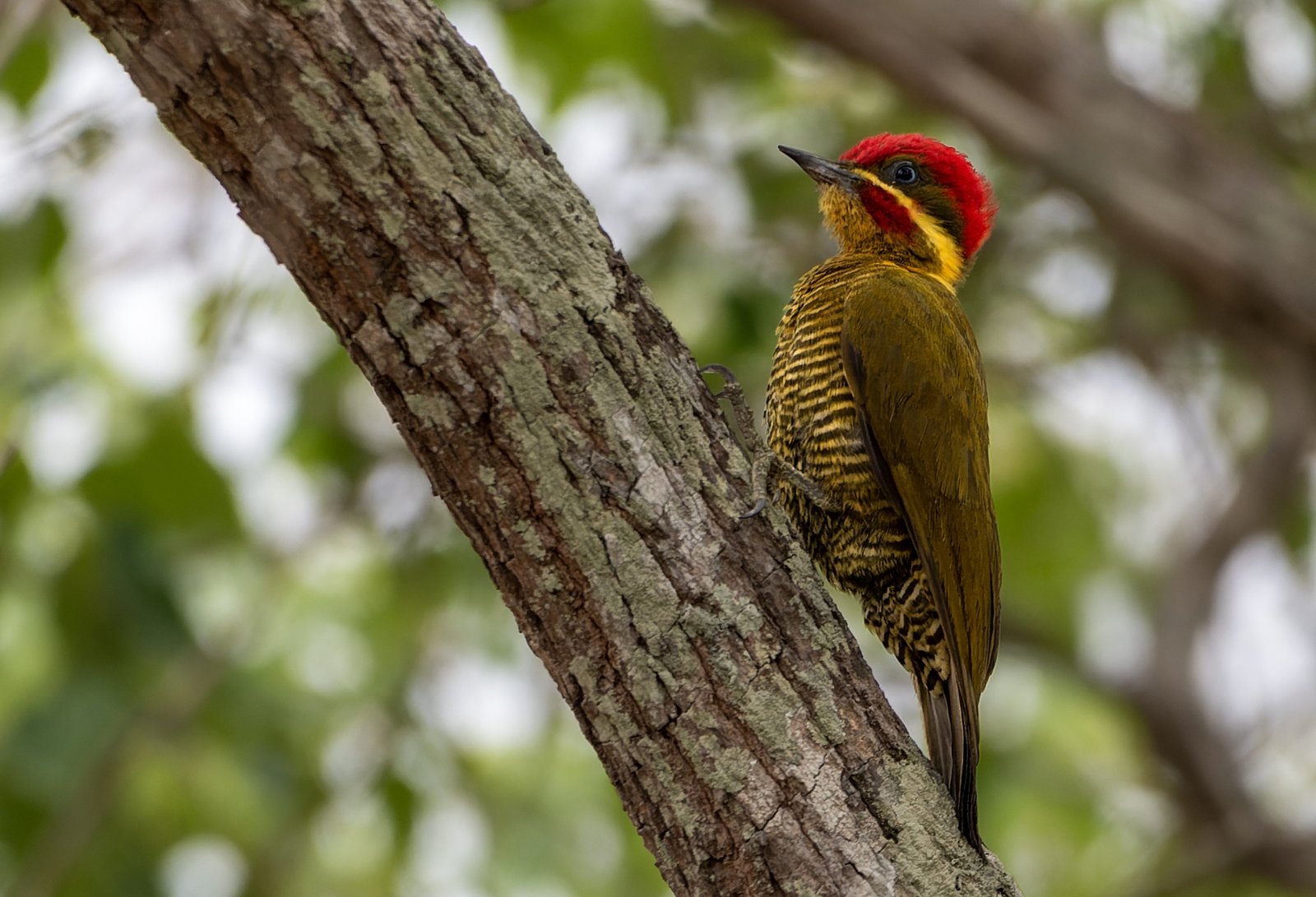
The Golden-green Woodpecker is a medium-sized green woodpecker of lowland forest east of the Andes. It forages mainly high in the canopy and often joins mixed flocks. Because it keeps to the treetops it is seen less often than its range suggests.
Voice
Rather quiet. A series of harsh, somewhat nasal calls and single sharp notes; drums infrequently.
Recording: JAYRSON ARAUJO DE OLIVEIRA — CC BY-NC-SA 4.0 · xeno-canto
Identification
20–23 cm. The upperparts are plain olive-green, with a bronzy sheen on the wings. A distinct yellow stripe runs from the base of the bill below the eye to the side of the neck and separates a dark olive cheek patch from the throat. The throat is yellow or yellowish, and the underparts are yellowish with dense olive-green bars. The male has a red crown, nape and moustachial stripe; the female has an olive-green or yellowish crown and no red in the moustache. The underwing is yellowish.
Confusion species
Yellow-throated Woodpecker Piculus flavigula has an all-yellow head without a dark cheek patch and a scaled rather than barred breast. White-throated Woodpecker Piculus leucolaemus has a white throat and a streaked, not barred, breast. Golden-olive Woodpecker Colaptes rubiginosus has a grey crown, a whitish cheek and a more golden back, and lives mainly in montane forest.
Habitat
Tall humid terra firme lowland forest, várzea, gallery forest and forest edge, in Bolivia also semi-humid and dry forest; mostly below 900 m, locally higher. It forages in the middle and upper strata on trunks and large branches. It feeds mainly on ants, termites and their larvae. It nests in a self-excavated cavity in a tree.
Where the bird is most at home, classified by the vegetation units of the Andes and the west coast.


Range and movements
In Colombia in the lowlands east of the Andes and, as a separate form, in the north of the country. In Ecuador and Peru in the Amazonian lowlands. In Bolivia in the north and east, extending into Chiquitano dry forest. Absent from the Galápagos. Outside the guide area from Panama to Brazil, Paraguay and northern Argentina.
- Resident
- dark = core range, pale = thinly spread
How and when to look
In lowland forest, watch mixed flocks in the canopy; the species climbs slowly along branches and digs into ant nests. Canopy towers and clearings with a view of the treetops give the best vantage.
Conservation status
Least Concern. The species is widespread and tolerates some forest disturbance, but disappears where forest is cleared completely.
Scientific name
Piculus chrysochloros | (Vieillot, 1818)
Vieillot described the species in 1818 as Picus chrysochloros; because it was later moved to another genus, the author and year stand in brackets. The genus Piculus was introduced in 1824 by Spix. The genus name is a diminutive of Latin picus, 'woodpecker'. The species name comes from Greek khrusos, 'gold', and khlōros, 'green', for the golden-green plumage. The specimen the first description was based on came from Paraguay and Brazil.