All species › Passerines › Ovenbirds and woodcreepers › Caribbean Hornero
Caribbean Hornero | Furnarius longirostris
Caribische ovenvogel | Hornero del Caribe | João-de-barro-do-caribe
The Caribbean Hornero is a rufous-brown ovenbird of open, dry lowlands in northern Colombia. Like other horneros it builds a domed mud nest on a post, branch or roof that resembles a bread oven. It walks over the ground with measured steps, and pairs make themselves heard with loud duets.
Voice
A loud, shrill duet: a rapid series of clear notes that speeds up and then slows down, the partners singing over each other, often with quivering wings. The call is a sharp chek.
Recording: Francisco contreras — CC BY-NC-SA 4.0 · xeno-canto
Identification
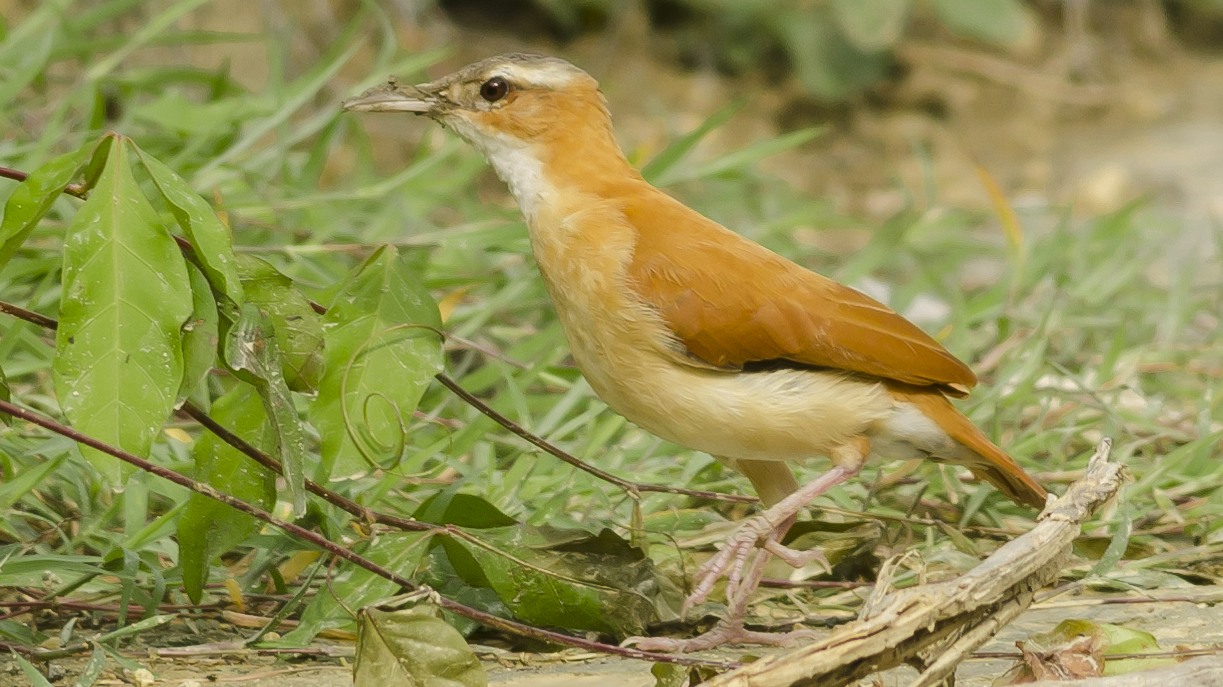
18 cm, with a fairly long, slightly decurved bill and pale, pinkish to greyish legs. The upperparts are warm rufous-brown, the crown greyish brown. A clear white supercilium extends back to the nape. The throat is white, the rest of the underparts pale cinnamon, warmer on the flanks. The tail is rufous. The sexes are alike. Juveniles are duller, with a less distinct supercilium.
Confusion species
Within its range in the guide area no other hornero of the genus Furnarius occurs. Pale-legged Hornero Furnarius leucopus of western Ecuador and Peru and of the Amazonian lowlands is very similar and was formerly treated as the same species; the ranges do not overlap.
Habitat
Open, dry to semi-humid lowlands with scattered trees: pasture, field edges, scrub, gardens, villages and the edges of marshes and riverbanks, mostly below 500 m. It forages on foot on the ground for insects, spiders and other invertebrates. The oven-shaped mud nest with a curved entrance sits on a post, a horizontal branch or a building.
Where the bird is most at home, classified by the vegetation units of the Andes and the west coast.


Range and movements
Colombia: in the Caribbean lowlands, from Córdoba and Sucre east to La Guajira and Cesar, and in the northern Magdalena Valley. Absent from Ecuador, Peru, Bolivia and the Galápagos. Outside the guide area in north-western Venezuela.
- Resident
- dark = core range, pale = thinly spread
How and when to look
In northern Colombia look along roads, pastures and farmyards with scattered trees; pairs often walk in the open and give themselves away by their loud duets. Mud nests on posts indicate the presence of the species.
Conservation status
Least Concern. The species benefits from deforestation and the creation of pasture, and also occurs in villages.
Scientific name
Furnarius longirostris | Pelzeln, 1856
Pelzeln described the species in 1856 and placed it straight away in the genus where it still stands. The genus Furnarius was introduced in 1816 by Vieillot. The genus name comes from Latin furnarius, 'baker' (from furnus, 'oven'), for the oven-shaped mud nest. The species name comes from Latin longus, 'long', and rostrum, 'bill'. The specimen the first description was based on came from Venezuela.