All species › Passerines › Ovenbirds and woodcreepers › Point-tailed Palmcreeper
Point-tailed Palmcreeper | Berlepschia rikeri
Palmkruiper | Palmero | Limpa-folha-do-buriti
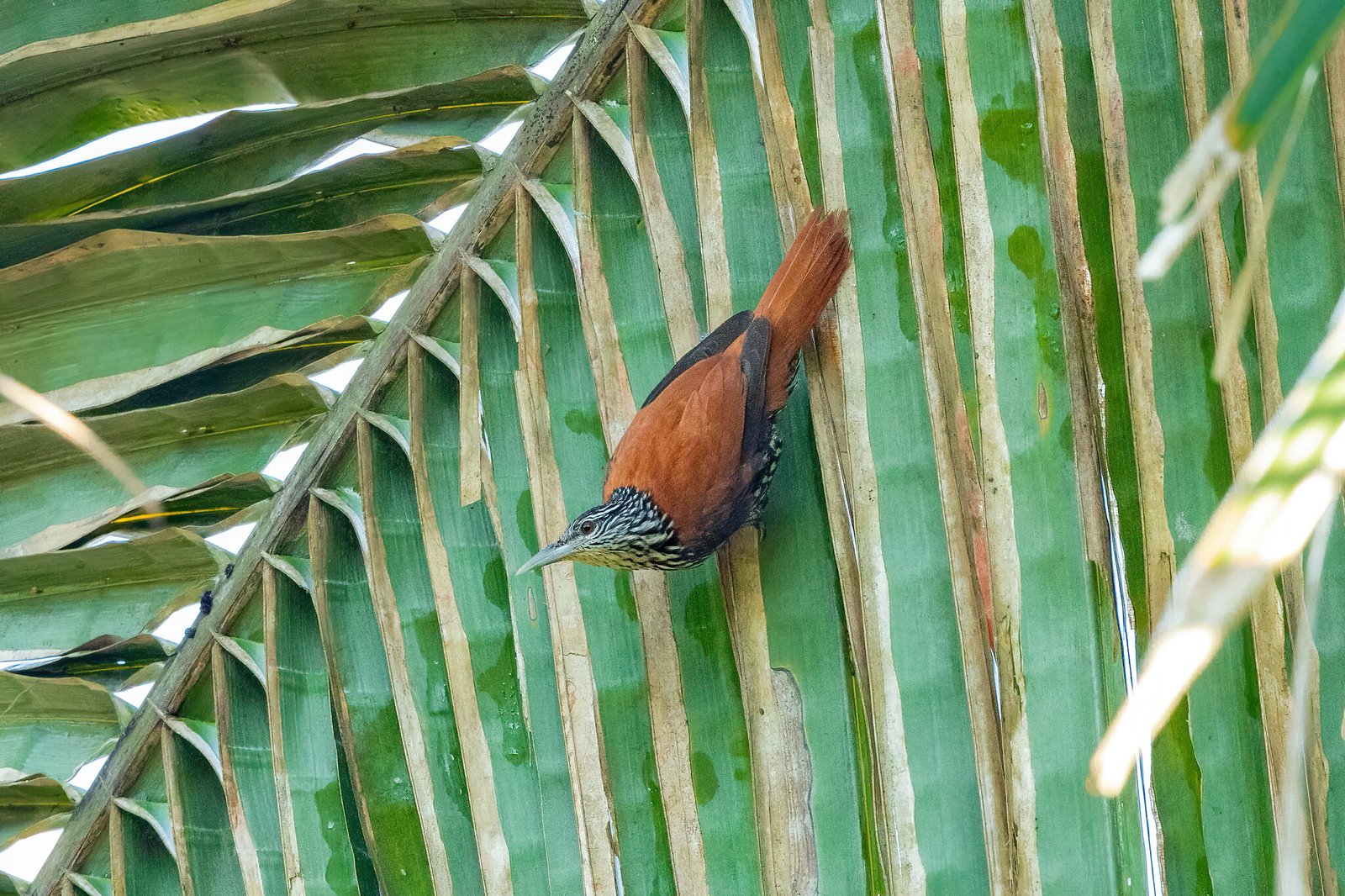
The Point-tailed Palmcreeper is a large ovenbird that lives almost exclusively in the crowns of moriche palms (Mauritia flexuosa). With its black-and-white streaked head and breast and rufous back and tail, it has no close relatives within the family; it is the only species in its genus. Its loud, ringing call is often the first sign of it from an aguajal.
Voice
A loud, ringing series of rapidly repeated notes, kee-kee-kee-kee-kee, which accelerates and then fades, often in duet and mainly at sunrise and dusk.
Recording: JAYRSON ARAUJO DE OLIVEIRA — CC BY-NC-SA 4.0 · xeno-canto
Identification
21–22 cm, with a long, straight, blackish bill and a tail with pointed, stiff feathers. The head, neck and underparts are black with dense white streaks and spots. The back, wings and tail are plain chestnut. The sexes are alike.
Confusion species
Few other birds of palm swamps combine a black-and-white streaked head and breast with a plain rufous back. Striped Woodcreeper Xiphorhynchus obsoletus and Straight-billed Woodcreeper Dendroplex picus also live in swamp forest, but are brown, climb trunks and prop themselves on their tail.
Habitat
Stands of moriche palms in palm swamps (aguajales), along rivers and in savannas in the lowlands, up to about 600 m. It searches the leaf bases and dead fronds of the palms for insects, spiders and small frogs. The nest is a cup of plant fibres in the crown of a palm.
Where the bird is most at home, classified by the vegetation units of the Andes and the west coast.


Range and movements
Colombia: local east of the Andes, in the Llanos and the Amazonian lowlands. Ecuador: local in the eastern lowlands. Peru: scattered in the Amazonian lowlands. Bolivia: in the lowlands of the north and east. Absent from the Galápagos. Outside the guide area in Venezuela, the Guianas and Amazonian and central Brazil.
- Resident
- dark = core range, pale = thinly spread
How and when to look
Search palm swamps and lines of moriche palms along rivers, especially in the early morning and towards evening. The birds often sit high in the crown and call from the leaf stalks.
Conservation status
Least Concern. The species is tied to moriche palms and disappears where they are cut, but the palm swamps of Amazonia are still extensive.
Scientific name
Berlepschia rikeri | (Ridgway, 1887)
Ridgway described the species in 1887 as Picolaptes rikeri; because it was later moved to another genus, the author and year stand in brackets. The genus Berlepschia was introduced in 1887 by Ridgway. The genus name honours Hans von Berlepsch (1850–1915), German ornithologist and collector of South American birds, who pointed out to Ridgway its differences from Picolaptes. The species name honours C.B. Riker, who collected the type specimen that Ridgway used to describe the species. The specimen the first description was based on came from Diamantina near Santarém, Brazil.