All species › Passerines › Ovenbirds and woodcreepers › Pearled Treerunner
Pearled Treerunner | Margarornis squamiger
Parelboomloper | Subepalo perlado | Corredor-de-árvore-perolado
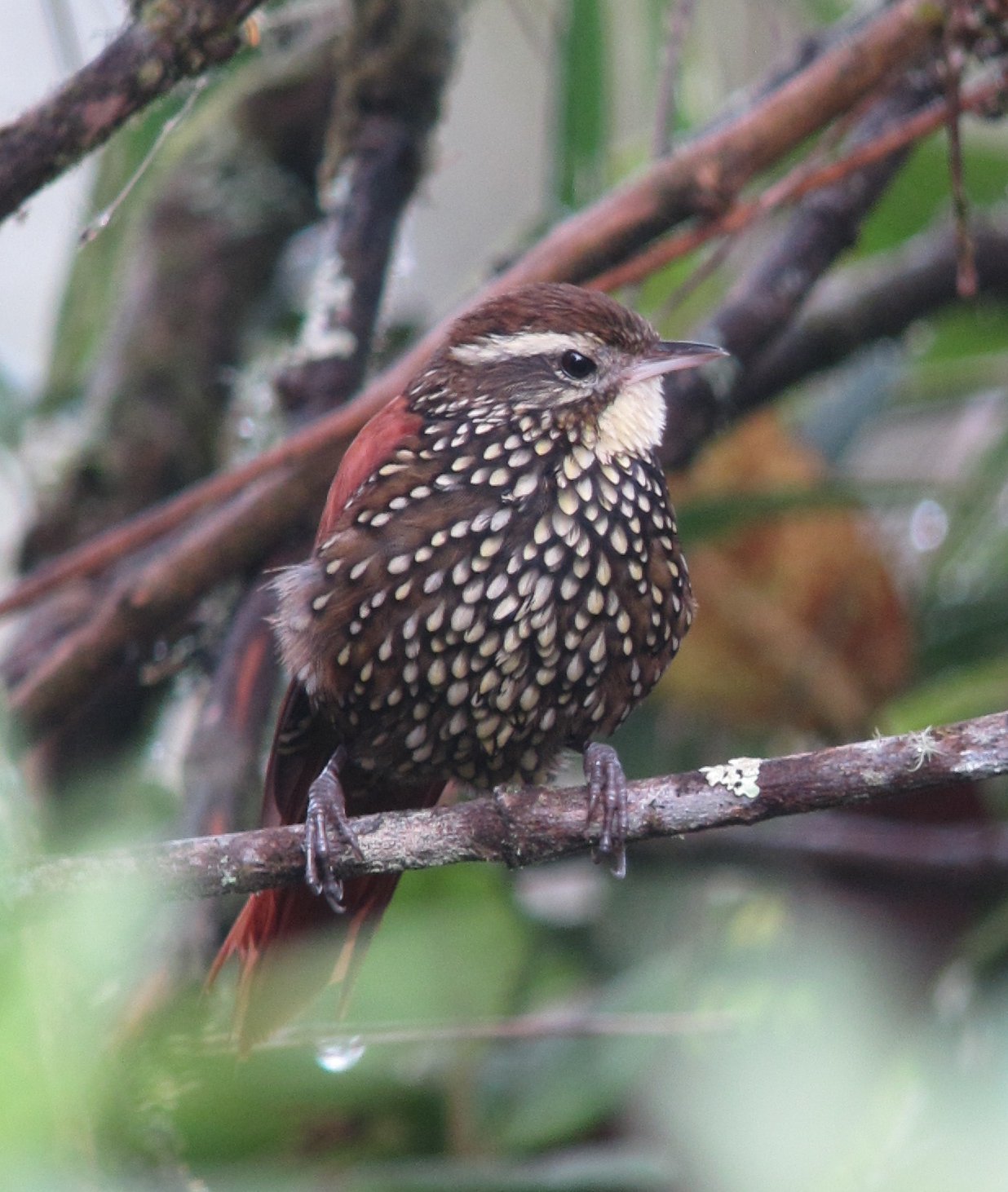
The Pearled Treerunner is one of the regular members of mixed flocks in the high montane forest of the Andes. It climbs mossy branches like a nuthatch, also upside down, bracing itself on its spiny tail. The bright rufous upperparts and the underparts full of white, black-edged droplets make it recognisable.
Voice
Very high, thin tseet calls, often repeated, and a short, high trill.
Recording: Mitch Lysinger — CC BY-NC-SA 4.0 · xeno-canto
Identification
15–16 cm, with a short, straight bill. The crown, back and tail are bright rufous; the tail has projecting shaft tips. A clear white supercilium and a white throat. The breast and belly are olive-brown, densely covered with white, drop-shaped, black-edged spots that become larger towards the belly. The sexes are alike. Juveniles are duller, with less distinct spots.
Confusion species
Star-chested Treerunner Margarornis stellatus lives lower on the western slope of Colombia and north-western Ecuador and is rufous below, with only a few spots on the breast. Spotted Barbtail Premnoplex brunnescens is dark brown, with buff spots, and keeps lower in the forest. Streaked Tuftedcheek Pseudocolaptes boissonneautii is larger, with white tufts on the sides of the neck.
Habitat
Humid upper montane forest, cloud forest, elfin forest at the treeline and Polylepis woodland, mostly between 2000 and 3600 m, locally lower and to almost 4000 m. It climbs branches, trunks and vines at all levels of the forest, almost always in mixed flocks, searching moss and epiphytes for insects and spiders. The nest is a ball of moss with a side entrance, under a branch or against a trunk.
Where the bird is most at home, classified by the vegetation units of the Andes and the west coast.


Range and movements
Colombia: in all three Andean ranges and the Sierra de Perijá. Ecuador: on both slopes of the Andes. Peru: on both slopes in the north and further along the eastern slope the length of the country. Bolivia: on the eastern slope from La Paz to Cochabamba and Santa Cruz. Absent from the Galápagos. Outside the guide area in Venezuela.
- Resident
- dark = core range, pale = thinly spread
How and when to look
Wait in high cloud forest for a mixed flock of tanagers and ovenbirds; the Pearled Treerunner is often one of the first birds you see there, climbing along mossy branches.
Conservation status
Least Concern. The species is widespread and fairly common, but disappears where high montane forest and Polylepis woodland are cleared.
Scientific name
Margarornis squamiger | (d'Orbigny, ACVMD & de Lafresnaye, 1838)
D'Orbigny, ACVMD & de Lafresnaye described the species in 1838 as Anabates squamiger; because it was later moved to another genus, the author and year stand in brackets. The genus Margarornis was introduced in 1853 by Reichenbach. The genus name combines Greek margaron, 'pearl', and ornis, 'bird': 'pearl bird', after the pearl-like spots. The species name squamiger comes from Latin squama, 'scale', and -ger, 'bearing': 'scaly'. The specimen the first description was based on came from Ayopaya, Cochabamba, Bolivia.