All species › Passerines › Ovenbirds and woodcreepers › Star-chested Treerunner
Star-chested Treerunner | Margarornis stellatus
Bruinvlekboomloper | Subepalo estrellado | Corredor-de-árvore-estrelado
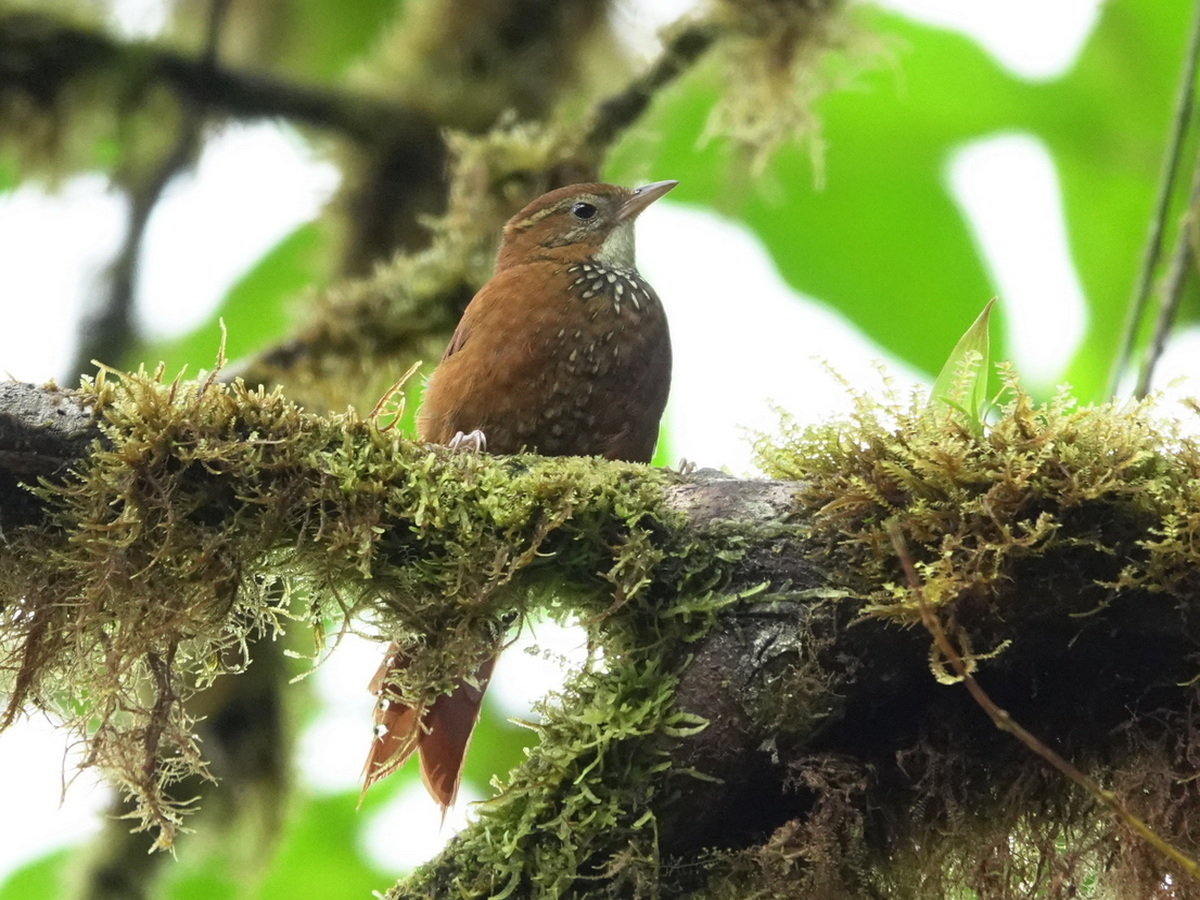
The Star-chested Treerunner is a rufous ovenbird with a small range in the wet montane forest of the Western Andes of Colombia and north-western Ecuador. It climbs mossy branches and trunks like a nuthatch, bracing itself on its spiny tail. A few white, black-edged spots on the breast give it its name.
Voice
High, thin tsip calls and a short, high trill.
Recording: Olaf Jahn — CC BY-NC-SA 4.0 · xeno-canto
Identification
15–16 cm, with a short, straight bill. Almost entirely warm rufous-brown, the upperparts slightly darker and the tail bright rufous, with projecting shaft tips. The throat is white. On the upper breast lies a small cluster of white, drop-shaped, black-edged spots; the rest of the underparts is plain rufous-brown. The sexes are alike.
Confusion species
Pearled Treerunner Margarornis squamiger has olive-brown underparts densely covered with white droplets and a clear white supercilium, and usually lives higher. Spotted Barbtail Premnoplex brunnescens is dark brown, with a buff throat and many buff spots, and keeps lower in the forest.
Habitat
Very wet, mossy montane forest and cloud forest on the Pacific slope, mostly between 1300 and 2200 m. It climbs branches, trunks and vines in the middle and upper levels of the forest, usually in mixed flocks, searching moss and epiphytes for insects and other arthropods. Little is known about the nest.
Where the bird is most at home, classified by the vegetation units of the Andes and the west coast.


Range and movements
Colombia: on the western slope of the Western Andes, from Antioquia south to Nariño. Ecuador: on the western slope in the north-west, roughly to Pichincha. Absent from Peru, Bolivia and the Galápagos. Does not occur outside the guide area.
- Resident
- dark = core range, pale = thinly spread
How and when to look
Search wet, mossy forest on the western slope in Nariño or Pichincha and follow mixed flocks; the species often climbs high on mossy branches, as Pearled Treerunner does.
Conservation status
Least Concern. The range is small and montane forest on the Pacific slope is cleared locally; the population is therefore thought to be declining.
Scientific name
Margarornis stellatus | Sclater & Salvin, 1873
Sclater & Salvin described the species in 1873 and placed it straight away in the genus where it still stands. The genus Margarornis was introduced in 1853 by Reichenbach. The genus name combines Greek margaron, 'pearl', and ornis, 'bird': 'pearl bird', after the pearl-like spots. The species name stellatus comes from Latin stellatus, 'starred', after the white spots on the breast. The specimen the first description was based on came from Province of Quito, Ecuador.