All species › Passerines › Ovenbirds and woodcreepers › Inambari Woodcreeper
Inambari Woodcreeper | Lepidocolaptes fatimalimae
Inambarimuisspecht | Trepatroncos del Inambari | Arapaçu-do-inambari
The Inambari Woodcreeper is a slim woodcreeper with a thin, slightly decurved bill from the western Amazon basin south of the Amazon. It was described only in 2013, after the former Lineated Woodcreeper was split into several species; song was an important character in that split. The name refers to the Inambari region, the part of the Amazon basin between the Andes, the Amazon and the Madeira.
Voice
The song is a soft trill of about 15 to 35 notes that fades away at the end, trrrrrr, somewhat recalling the song of a becard. The call is a short, high note.
Recording: Dante Buzzetti — CC BY-NC-SA 4.0 · xeno-canto
Identification
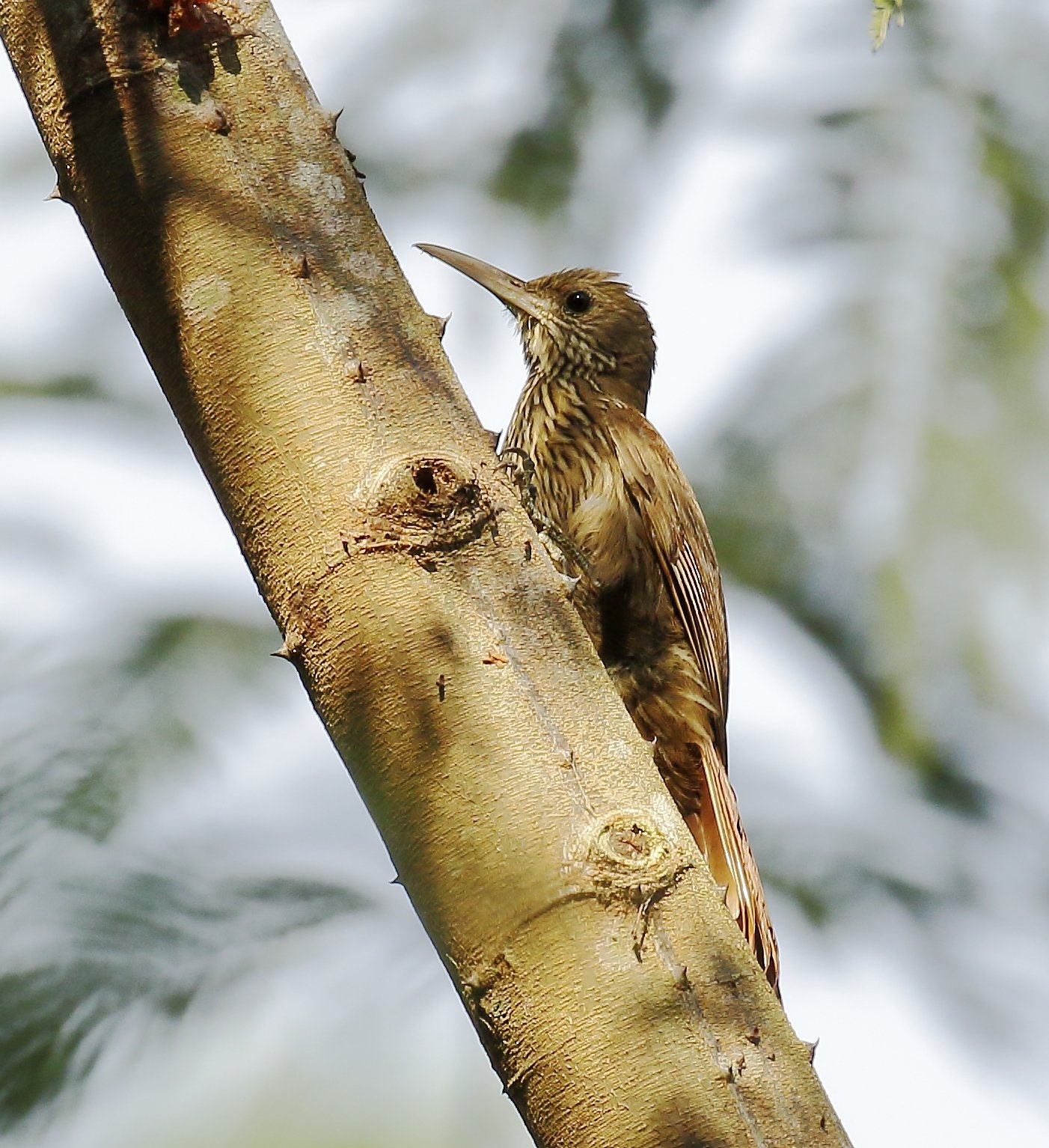
17–19 cm, slim, with a thin, slightly decurved, pale bill. The head, back and wing coverts are dark russet-brown, the crown with few or no pale spots. The rump, wings and tail are chestnut. The throat is plain buff; the breast and belly are greyish-brown to olive-brown with broad, cream to buff streaks with dark edges. The sexes are alike. Juveniles are darker above and have a greyer, slightly spotted crown.
Confusion species
Duida Woodcreeper Lepidocolaptes duidae is very similar but lives north of the Amazon and the Marañón; the two are separated mainly by song and location. Montane Woodcreeper Lepidocolaptes lacrymiger lives higher in the Andes and has a spotted crown and drop-shaped streaks below. Striped Woodcreeper Xiphorhynchus obsoletus and Elegant Woodcreeper Xiphorhynchus elegans are larger, with a heavier, straighter bill, and forage lower in the forest.
Habitat
Tall terra firme and floodplain forest, less in swamp forest and flooded várzea; also mature secondary forest and locally shade coffee. Mostly below 1000 m, exceptionally higher. It forages in the canopy and midstorey along branches and trunks for insects and spiders, often in mixed flocks. The nest is in a cavity or crevice in a tree.
Where the bird is most at home, classified by the vegetation units of the Andes and the west coast.


Range and movements
Absent from Colombia, Ecuador and the Galápagos. Peru: in the Amazonian lowlands south of the Amazon and the Marañón, up into the Andean foothills. Bolivia: in the lowlands of the north and centre. Outside the guide area in western Brazil, south of the Amazon and east to the Madeira.
- Resident
- dark = core range, pale = thinly spread
How and when to look
In the canopy of tall rainforest, watch mixed flocks; the woodcreeper climbs along the thicker branches. The soft, fading trill gives it away, especially in the morning.
Conservation status
Least Concern. The species has a large range in largely intact rainforest, but depends on tall forest and disappears where forest is cleared.
Scientific name
Lepidocolaptes fatimalimae | Rodrigues, Aleixo, Whittaker & Naka, 2013
Rodrigues, Aleixo, Whittaker & Naka described the species in 2013 and placed it straight away in the genus where it still stands. The genus Lepidocolaptes was introduced in 1853 by Reichenbach. The genus name combines Greek lepis, 'scale', with kolaptēs, 'pecker', after the scaly plumage. The species name honours Fátima Lima, manager of the bird collections at the Museu Paraense Emílio Goeldi in Belém. The specimen the first description was based on came from Guajará, Amazonas, Brazil.