All species › Waders, gulls and terns › Skimmers, noddies, terns and gulls › Caspian Tern
Caspian Tern | Hydroprogne caspia
Reuzenstern | Pagaza piquirroja | Trinta-réis-cáspio
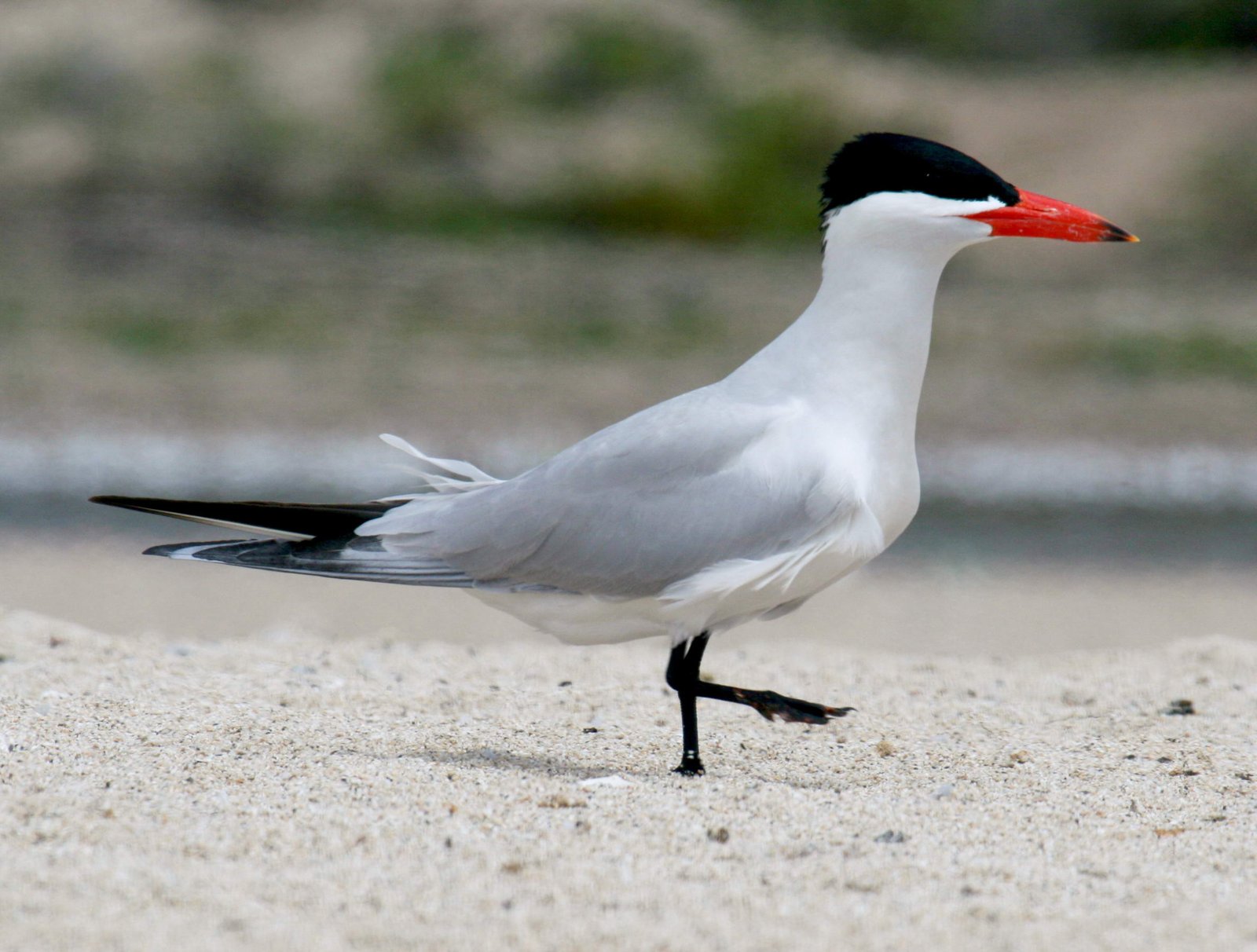
The Caspian Tern is the largest tern in the world, as big as a medium-sized gull, with a heavy red bill. It breeds scattered across every continent except South America and Antarctica. In the guide area it is a scarce Nearctic winter visitor to the coast.
Voice
A deep, harsh, heron-like kraa-ah; juveniles beg with a high, whistled wee-oo.
Recording: Clément Bruneau — CC BY-NC-SA 4.0 · xeno-canto
Identification
48–56 cm, a very large, heavily built tern with broad wings, a short, shallowly forked tail and black legs. The bill is thick and deep red, with a dark smudge just before the tip. In breeding plumage a complete black cap without a noticeable crest. The upperparts are pale grey, the underparts white. From below the outer primaries are conspicuously dark. In non-breeding plumage the cap is finely streaked white, but the forehead remains largely dark. The sexes are alike. Juveniles have brown spotting on the upperparts and an orange-red bill.
Confusion species
Royal Tern Thalasseus maximus is slimmer, with a thinner orange bill, a shaggy crest, a white forehead in non-breeding plumage and pale undersides to the primaries. Elegant Tern Thalasseus elegans is much smaller and slimmer, with a long, thin, orange-yellow bill. Large gulls such as Kelp Gull Larus dominicanus have a yellow bill and no black cap.
Habitat
Estuaries, lagoons, salt pans, shrimp farms and sheltered coasts, rarely on the open sea; outside the guide area also large inland lakes. It fishes by diving into the water from a fair height and eats mainly fish. It does not breed in the guide area.
Where the bird is most at home, classified by the vegetation units of the Andes and the west coast.


Range and movements
In Colombia a scarce winter visitor to the Caribbean coast. In Ecuador a scarce but regular visitor to the south-west coast, mainly around the Gulf of Guayaquil and the Santa Elena peninsula. In Peru a rare visitor to the north coast. Virtually absent from Bolivia and the Galápagos. Breeds in North America, Europe, Asia, Africa and Australia; North American birds winter south to Central America and northern South America.
- Resident
- dark = core range, pale = thinly spread
How and when to look
Search among the flocks of terns and gulls at the Ecuasal salt pans near Salinas (Ecuador) and in the lagoons and shrimp farms around the Gulf of Guayaquil. Its size and red bill stand out at once in a flock of Royal Terns.
Conservation status
Least Concern. The world population is large and has increased in North America; local threats are disturbance of colonies and the loss of nesting islands.
Scientific name
Hydroprogne caspia | (Pallas, 1770)
Pallas described the species in 1770 as Sterna caspia; because it was later moved to another genus, the author and year stand in brackets. The genus Hydroprogne was introduced in 1829 by Kaup. The genus name comes from Greek hudro-, 'water-', and Latin progne, 'swallow'. The species name is Latin and, like the English name, refers to the Caspian Sea. The specimen the first description was based on came from Caspian Sea.