All species › Waders, gulls and terns › Skimmers, noddies, terns and gulls › Gull-billed Tern
Gull-billed Tern | Gelochelidon nilotica
Lachstern | Pagaza piconegra | Trinta-réis-de-bico-preto
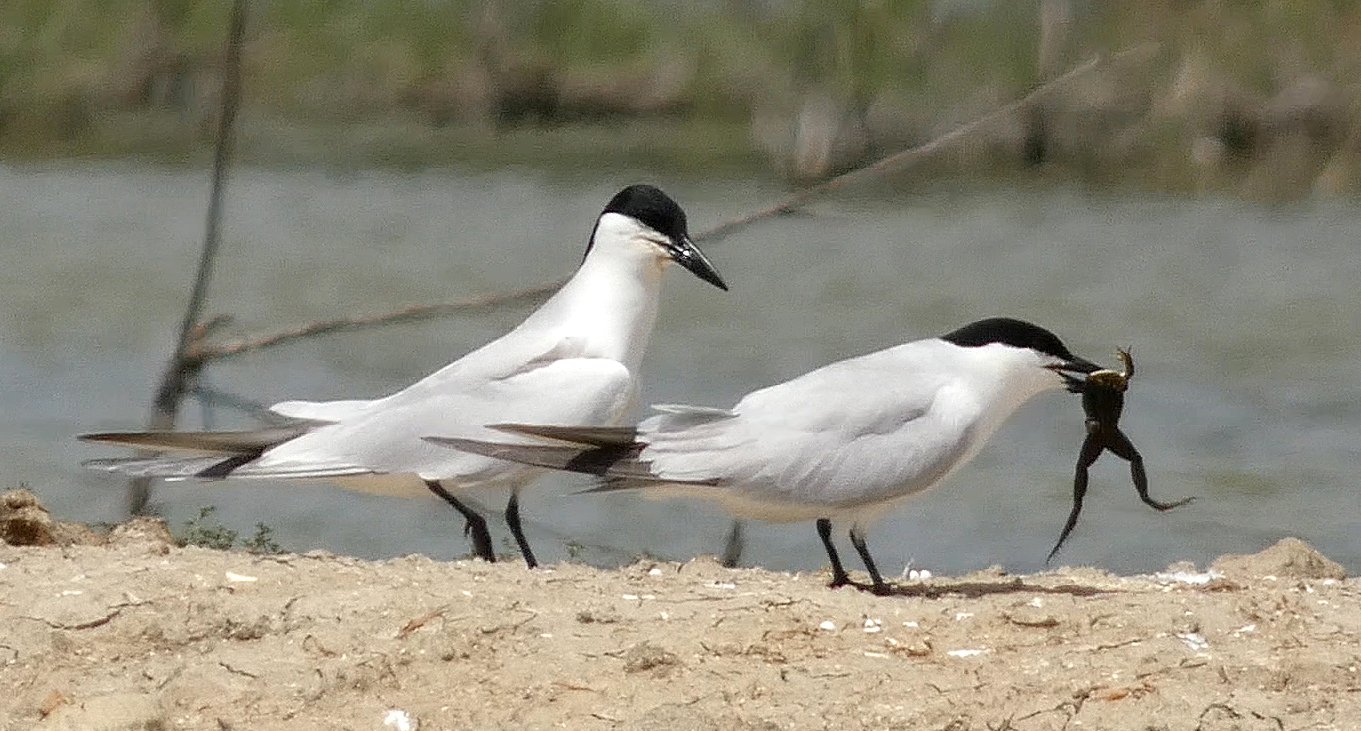
The Gull-billed Tern is a pale grey tern with a short, thick black bill that recalls a gull rather than a tern. Unlike most terns it fishes little: it hunts low over land and water for insects, crabs and small vertebrates. The species occurs on every continent; in the guide area both as a breeding bird and as a winter visitor.
Voice
A rasping, nasal kay-wek or ke-wik, often disyllabic and somewhat laughing in tone.
Recording: Walter Wallner — CC BY-NC-SA 4.0 · xeno-canto
Identification
35–38 cm, a fairly large, pale tern with broad wings, a short, shallowly forked tail, long black legs and a short, thick, all-black bill. In breeding plumage a smooth black cap without a crest. The upperparts and tail are pale grey and the underparts white; the primaries have dark trailing edges. In non-breeding plumage the head is white, with a dark patch behind the eye. The sexes are alike. Juveniles have light brown spotting on the back and wings and a dark eye patch.
Confusion species
Sandwich Tern Thalasseus sandvicensis is slimmer, with a longer, thinner bill, a shaggy crest and shorter legs, and plunge-dives for fish. Common Tern Sterna hirundo and Forster's Tern Sterna forsteri are smaller, with a slender red or orange bill and a deeply forked tail. In non-breeding plumage it resembles a small gull, but the black bill and the habit of hunting with short swoops to the ground are distinctive.
Habitat
Lagoons, estuaries, salt pans, shrimp farms, rice fields, wet grassland and beaches; inland along large rivers and marshes. It flies low and picks its prey from the surface of land or water: insects, crabs, small fish, lizards and sometimes young birds. It breeds in small colonies on sandy or shelly islets and dykes in salt pans; the nest is a scrape in the ground.
Where the bird is most at home, classified by the vegetation units of the Andes and the west coast.


Range and movements
In Colombia along the Caribbean and Pacific coasts and inland in the Llanos. In Ecuador mainly on the south-west coast, where a small population breeds, for example in the salt pans near Salinas; winter visitors also occur. In Peru mainly on the north coast. In Bolivia a scarce visitor to the lowlands. On the Galápagos at most a vagrant. Occurs worldwide; in the Americas it breeds on the coasts of the United States, Mexico and the Caribbean and locally in South America.
- Resident
- dark = core range, pale = thinly spread
How and when to look
Search the Ecuasal salt pans near Salinas and the shrimp farms around the Gulf of Guayaquil (Ecuador), or the mangroves and ponds of Puerto Pizarro near Tumbes (Peru). Look for a pale tern hunting low over the dykes and mud instead of diving.
Conservation status
Least Concern. Locally colonies are threatened by disturbance, the loss of coastal wetlands and changing water levels in salt pans and shrimp farms.
Scientific name
Gelochelidon nilotica | (Gmelin, 1789)
Gmelin described the species in 1789 as Sterna nilotica; because it was later moved to another genus, the author and year stand in brackets. The genus Gelochelidon was introduced in 1830 by Brehm. The genus name combines Greek gelaō, 'to laugh', with khelidōn, 'swallow'. The species name is Latin niloticus, 'of the River Nile'. The specimen the first description was based on came from Egypt.