All species › Waders, gulls and terns › Skimmers, noddies, terns and gulls › Inca Tern
Inca Tern | Larosterna inca
Incastern | Charrán inca | Trinta-réis-inca
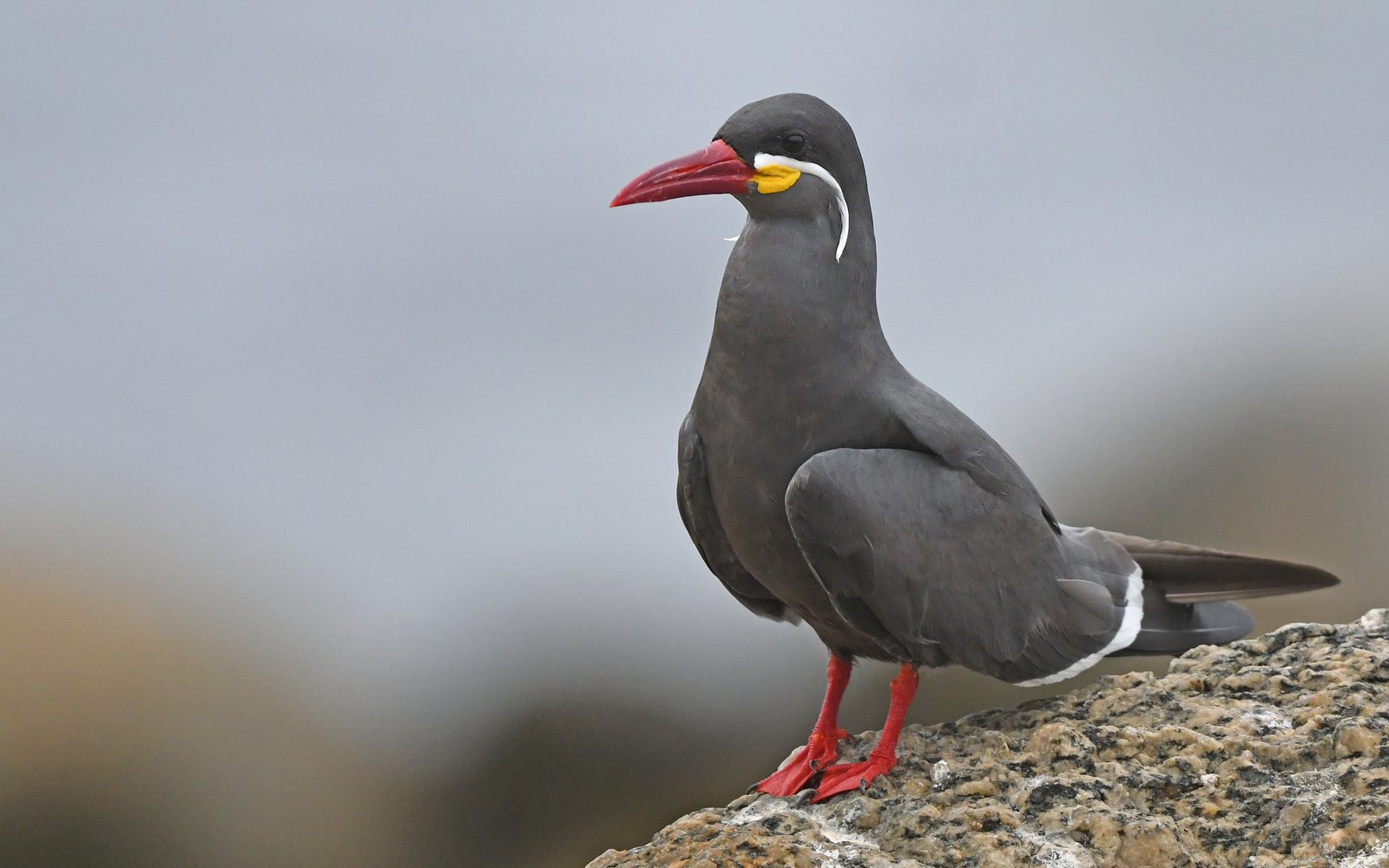
The Inca Tern is a slate-grey tern with a red bill and a white, curled moustache that hangs from the gape down along the cheek. It lives only in the cold Humboldt Current along the coasts of Peru and Chile, where it fishes in flocks over shoals of anchovy. It is the only species in its genus.
Voice
A short, cat-like, mewing meow or a grating krrah, often in a busy chorus in flocks and at the colony.
Recording: Cristian Pinto Fernandez — CC BY-NC-SA 4.0 · xeno-canto
Identification
39–42 cm, a medium-sized tern with a slightly forked tail. The plumage is dark slate-grey, with a blackish crown and a white trailing edge to the secondaries. A long, white, curled plume runs from the base of the bill below the eye to the neck. The bill and legs are red, and there is a yellow fleshy wattle at the base of the bill. The sexes are alike. Juveniles are browner, with a dark bill and legs and no or only a short moustache.
Confusion species
With its slate-grey colour, red bill and white moustache the Inca Tern cannot be confused with any other tern in the guide area. Brown Noddy Anous stolidus is brown with a pale crown and a black bill, and lives mainly on the open sea and the Galápagos. Grey Gull Leucophaeus modestus is also grey, but larger and heavier, with a pale head in breeding plumage, a black bill and a gull-like flight.
Habitat
Rocky shores, sea cliffs, guano islands, harbours and jetties, and the cool inshore waters of the Humboldt Current. It fishes in flocks by diving from flight or picking fish from the surface, mainly anchovy and other small shoaling fish; it also follows sea lions, cormorants and fishing boats for scraps. It nests in burrows and crevices in rocks, under boulders and in old nest burrows of penguins and petrels, and nowadays also in artificial structures in harbours.
Where the bird is most at home, classified by the vegetation units of the Andes and the west coast.


Range and movements
In Peru along the entire coast, most numerous around the guano islands of the centre and south. In Ecuador a scarce visitor to the south-west coast, mainly after El Niño years. In Colombia at most a vagrant. Absent from Bolivia and the Galápagos. Outside the guide area along the coast of northern and central Chile.
- Resident
- dark = core range, pale = thinly spread
How and when to look
Search harbours and rocky shores near Lima, such as Pucusana and Chorrillos, and the Islas Ballestas off Paracas; birds often sit in groups on quays, boats and rocks and allow a close view.
Conservation status
Near Threatened. The population fluctuates strongly with El Niño, when the food-rich cold current temporarily fails, and is further threatened by overfishing of anchovy, disturbance on the nesting islands and introduced rats and cats.
Scientific name
Larosterna inca | (Lesson & Garnot, 1827)
Lesson & Garnot described the species in 1827 as Sterna Inca; because it was later moved to another genus, the author and year stand in brackets. The genus Larosterna was introduced in 1852 by Blyth. The genus name combines the genus names Larus (gull) and Sterna (tern), as the species shows features of both. The species name refers to the Inca, the people of the ancient empire in Peru, where the species occurs. The specimen the first description was based on came from Lima, Peru.