All species › Waders, gulls and terns › Skimmers, noddies, terns and gulls › Black Tern
Black Tern | Chlidonias niger
Zwarte stern | Fumarel común | Trinta-réis-negro
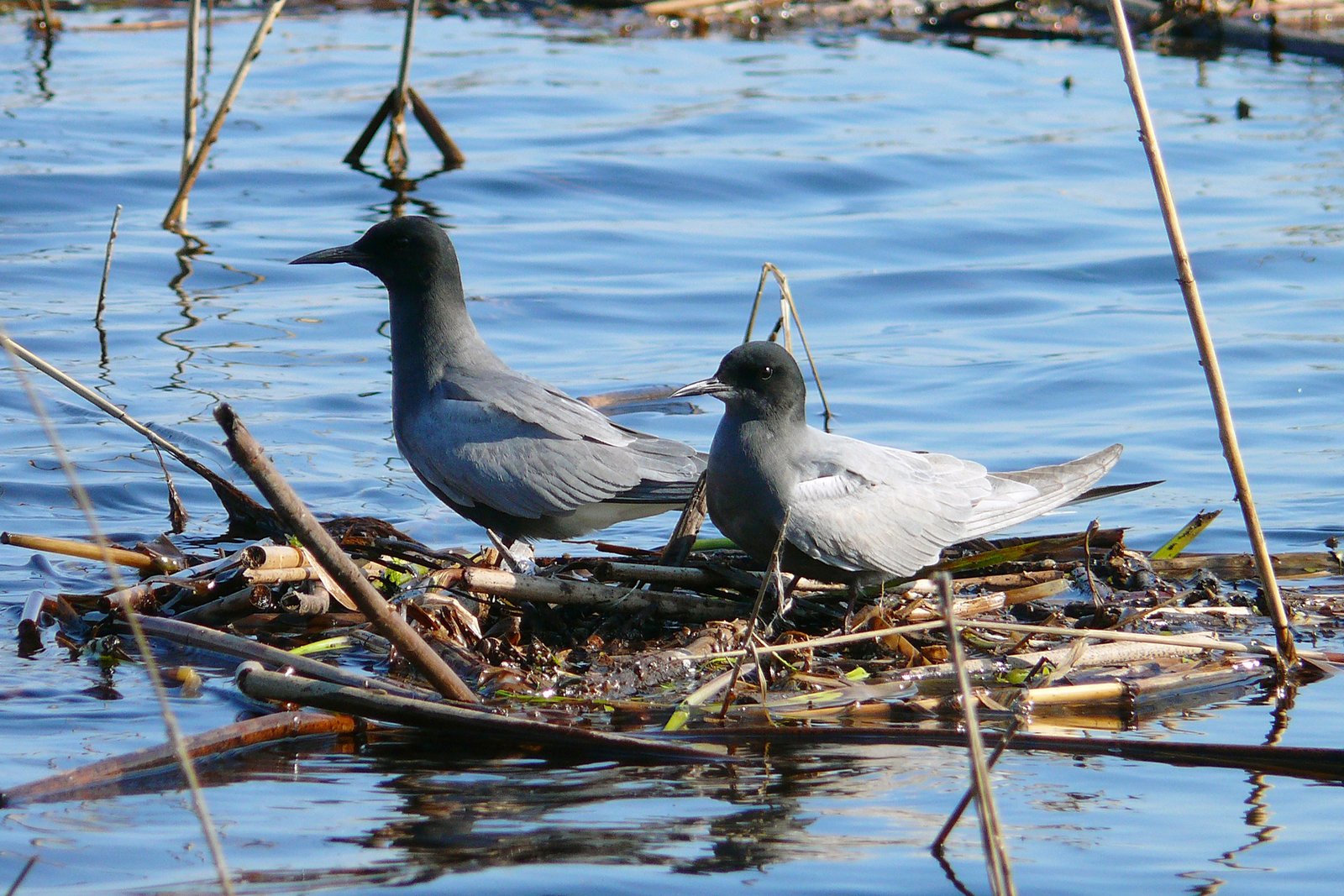
The Black Tern is a small, dark marsh tern that breeds on ponds and marshes in North America and Eurasia and spends the winter at sea. American birds winter in large numbers in the food-rich inshore waters of the Pacific coast from Colombia to Peru. In the guide area it is seen mainly in non-breeding plumage.
Voice
A short, sharp keek or kyek; usually silent at sea.
Recording: Ricardo Hevia — CC BY-NC-SA 4.0 · xeno-canto
Identification
23–26 cm, a small, compact tern with broad, dark grey wings, a short, shallowly notched tail and a thin black bill. In breeding plumage, which in the guide area is seen mainly in April and August, the head and body are black, with white undertail coverts and pale grey underwings. In non-breeding plumage the underparts are white, with a dark patch on the side of the breast, a dark crown and ear patch and dark grey upperparts. The sexes are almost alike. Juveniles resemble non-breeding plumage, with brown fringes on the upperparts.
Confusion species
Least Tern Sternula antillarum and Peruvian Tern Sternula lorata are smaller, much paler grey above, without a breast patch, and have a yellow bill in breeding plumage. Common Tern Sterna hirundo in non-breeding plumage is larger and paler, with a deeply forked tail and no breast patch. The flight is light and swerving, and the birds pick food from the water surface rather than plunging.
Habitat
In the guide area mainly inshore and offshore waters, often in large flocks over food-rich water, also in bays, estuaries and lagoons; on passage also on lakes and marshes inland. It picks small fish, crustaceans and insects from the surface. It breeds on floating nests in freshwater marshes outside the guide area.
Where the bird is most at home, classified by the vegetation units of the Andes and the west coast.


Range and movements
In Colombia a winter visitor along and off the Pacific coast, less numerous on the Caribbean coast. In Ecuador and Peru a winter visitor along and off the entire coast, most numerous in the north. On the Galápagos an irregular visitor. In Bolivia a rare passage migrant on inland lakes. Breeds in northern North America and in Eurasia; American birds winter along the coasts of Central America and north-western South America, European and Asian birds mainly off West Africa.
- Resident
- Summer visitor (c. Apr–Sep)
- Winter visitor (c. Oct–Mar)
- Passage (Mar–Apr, Oct–Nov)
- dark = core range, pale = thinly spread
How and when to look
Join a boat trip from Salinas (Ecuador) or head out from Buenaventura (Colombia) into Pacific inshore waters; flocks of hundreds to thousands of birds forage over food-rich current fronts. From the shore they can sometimes be seen just off the beach on the north coast of Peru and at Salinas.
Conservation status
Least Concern. The North American population has declined strongly since the 1960s, mainly through the loss of marshes on the breeding grounds.
Scientific name
Chlidonias niger | (Linnaeus, 1758)
Linnaeus described the species in 1758 as Sterna nigra; because it was later moved to another genus, the author and year stand in brackets. The genus Chlidonias was introduced in 1822 by Rafinesque. The genus name is from Greek khelidonios, 'swallow-like', from khelidōn, 'swallow'. The species name is Latin niger, 'black', after the black breeding plumage. The specimen the first description was based on came from Uppsala, Sweden.