All species › Waders, gulls and terns › Skimmers, noddies, terns and gulls › Sandwich Tern
Sandwich Tern | Thalasseus sandvicensis
Grote stern | Charrán patinegro | Trinta-réis-de-bando
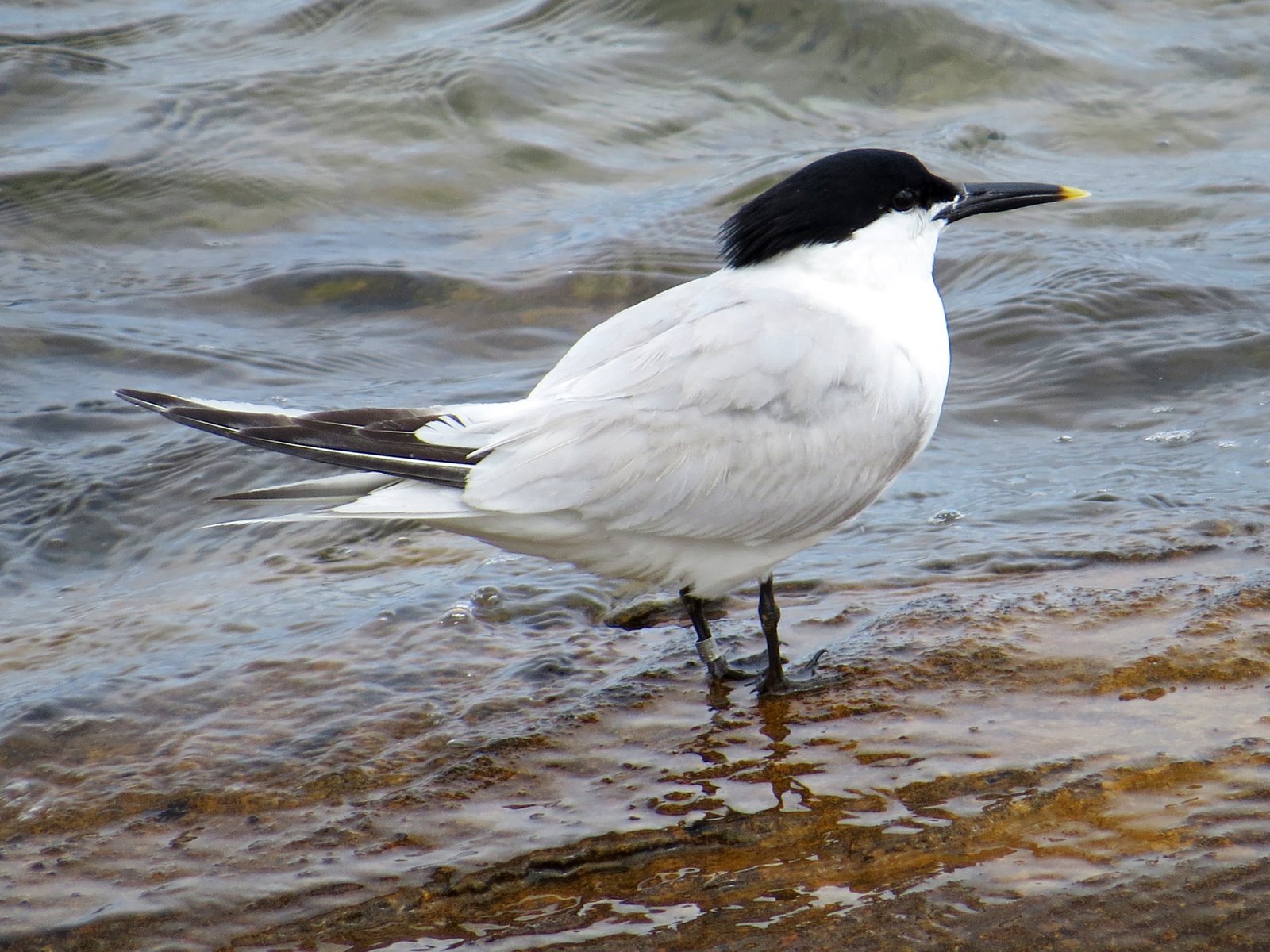
The Sandwich Tern is a medium-sized, very pale crested tern with a long black bill with a yellow tip. It breeds on the coasts of Europe and western Asia and, in a separate American form that is sometimes regarded as a species of its own, on the coasts of North America, the Caribbean and eastern South America. In the guide area it is a winter visitor along both coasts.
Voice
A loud, grating, disyllabic keer-rick, often in flight and in flocks.
Recording: Clément Bruneau — CC BY-NC-SA 4.0 · xeno-canto
Identification
36–41 cm, a slender tern with long, narrow wings, a short, forked tail and black legs. The bill is long, thin and black with a yellow tip; in the Caribbean form eurygnathus, which occurs on the Caribbean coast of Colombia, it is entirely or largely yellow. In breeding plumage a black cap with a shaggy crest on the hindcrown. The upperparts are very pale grey, the underparts white. In non-breeding plumage, which is most often seen in the guide area, the forehead is white and the crown speckled white, with a black crest behind the eye. The sexes are alike. Juveniles have dark spotting on the upperparts and a shorter bill.
Confusion species
Royal Tern Thalasseus maximus is larger and heavier, with a thick orange bill. Elegant Tern Thalasseus elegans has a longer, slightly drooping, orange-yellow bill and a longer crest; yellow-billed birds of the form eurygnathus are very similar, but the bill is straighter and yellower, not orange. Gull-billed Tern Gelochelidon nilotica has a short, thick, all-black bill and no crest.
Habitat
Sandy beaches, estuaries, lagoons, harbours, jetties and inshore waters, usually within a few kilometres of the coast. It fishes by diving into the water from some height and eats mainly small shoaling fish such as anchovies and sardines. It roosts in flocks on beaches and sandbars, often with other terns and gulls. In the guide area, as far as known, only small numbers of the Caribbean form breed.
Where the bird is most at home, classified by the vegetation units of the Andes and the west coast.


Range and movements
In Colombia along the Caribbean and Pacific coasts; on the Caribbean coast also yellow-billed birds. In Ecuador a winter visitor along the whole coast. In Peru a winter visitor along the coast, most numerous in the north. Rare on the Galápagos. Absent from Bolivia. The American form breeds on the Atlantic and Gulf coasts of North America, in the Caribbean and along the coast of Brazil and Argentina; the nominate form breeds in Europe and western Asia.
- Resident
- Winter visitor (c. Oct–Mar)
- Passage (Mar–Apr, Oct–Nov)
- dark = core range, pale = thinly spread
How and when to look
Search flocks of roosting terns on the beaches of the Santa Elena peninsula (Ecuador), on the north coast of Peru or near Santa Marta (Colombia). In a flock of Royal Terns, look for the smaller, paler birds with a black, yellow-tipped bill.
Conservation status
Least Concern. Colonies are sensitive to disturbance and to fluctuations in the supply of small shoaling fish.
Scientific name
Thalasseus sandvicensis | (Latham, 1787)
Latham described the species in 1787 as Sterna sandvicensis; because it was later moved to another genus, the author and year stand in brackets. The genus Thalasseus was introduced in 1822 by Boie. The genus name comes from Greek thalassa, 'sea'; thalasseus means 'seaman' or 'fisherman'. The specific name sandvicensis refers to Sandwich in Kent (England); this is not necessarily the type locality. The specimen the first description was based on came from Sandwich, Kent, England.