All species › Passerines › Antbirds › Chapman's Antshrike
Chapman's Antshrike | Thamnophilus zarumae
Chapmans gebandeerde mierklauwier | Batará de Chapman | Choca-de-chapman
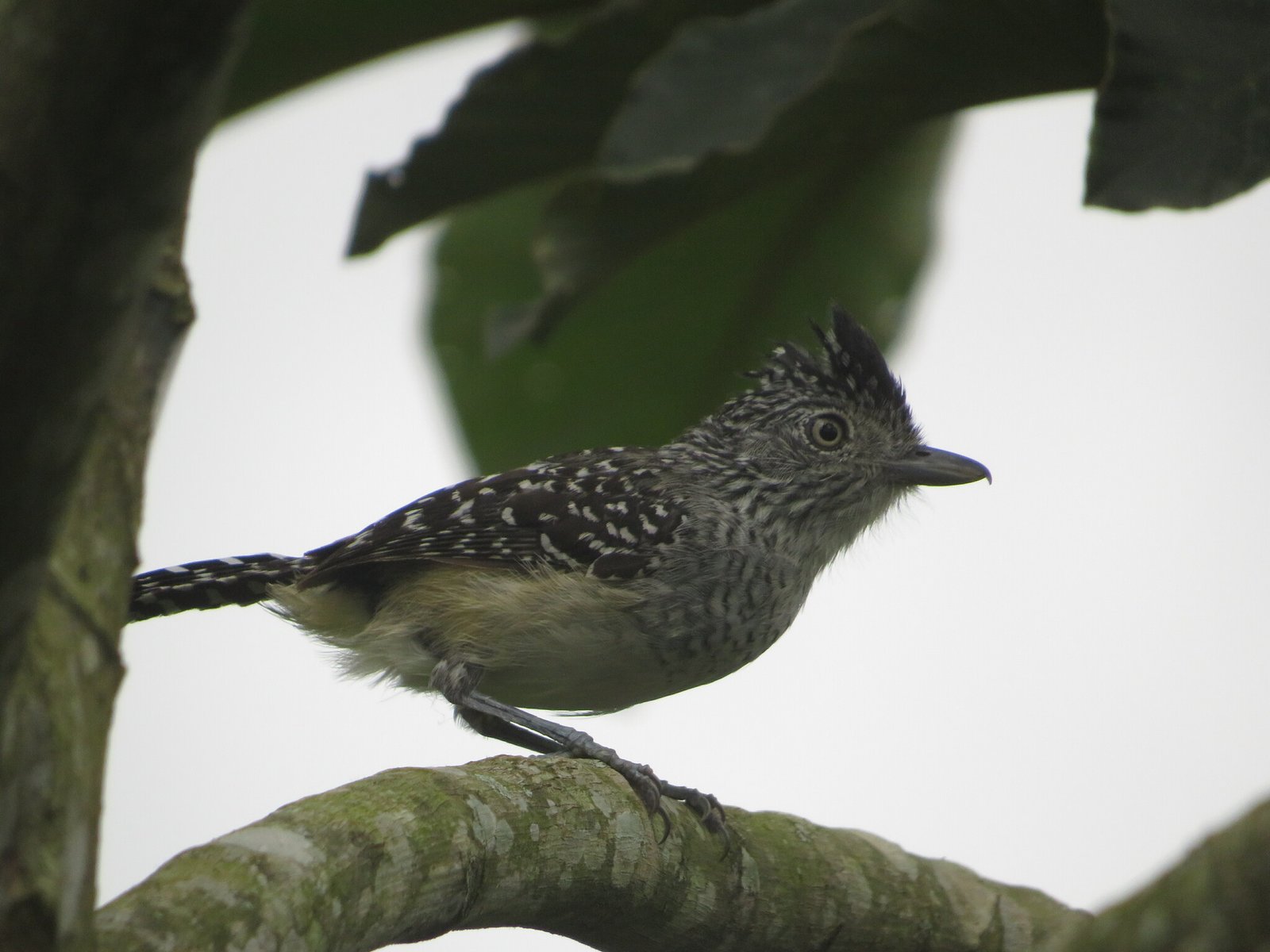
Chapman's Antshrike is the barred antshrike of the dry forests of south-western Ecuador and north-western Peru, the Tumbesian region. The male has a black crown and is barred black and white on the back, throat and breast. It belongs to the group of species found only in this region.
Voice
The song is an accelerating series of nasal notes with a short, emphatic ending, shorter than that of the Barred Antshrike. Also growling calls.
Recording: Peter de Rouw — CC BY-NC-SA 4.0 · xeno-canto
Identification
15–16 cm, with a crest and a fairly heavy, hooked bill. The male has a black crown, a black-and-white barred back, throat and breast, a whitish belly and buff flanks and vent. The female has a rufous crown, brown upperparts, a streaked face and buff underparts.
Confusion species
Barred Antshrike Thamnophilus doliatus lives east of the Andes; the male is barred throughout, including the belly and crest. Collared Antshrike Thamnophilus bernardi in the same region is larger, with a white collar and unbarred underparts. Black-crowned Antshrike Thamnophilus atrinucha is grey with white wing spots and lives in more humid forest.
Habitat
Dry and semi-humid deciduous forest, scrub, forest edges and vegetated ravines, also in degraded woodland; from about 400 to 2000 m, locally lower. It searches low to mid-level in dense growth for insects, usually in pairs. The nest is a small cup in a fork.
Where the bird is most at home, classified by the vegetation units of the Andes and the west coast.


Range and movements
Ecuador: in the south-west, in the dry forests of El Oro and Loja and locally further north. Peru: in the north-west, in Tumbes, Piura and adjacent Cajamarca and Lambayeque. Absent from Colombia, Bolivia and the Galápagos. Does not occur outside the guide area.
- Resident
- dark = core range, pale = thinly spread
How and when to look
Listen in the dry forests of Loja and Tumbes for the accelerating series of nasal notes; the birds stay in dense scrub but sometimes come to the edge while singing.
Conservation status
Least Concern. The Tumbesian dry forests are heavily fragmented by grazing and logging, but the species tolerates scrub and edges.
Scientific name
Thamnophilus zarumae | Chapman, 1921
Chapman described the species in 1921 and placed it straight away in the genus where it still stands. The genus Thamnophilus was introduced in 1816 by Vieillot. The genus name comes from Greek thamnos, 'bush', and philos, 'loving': bush-lover. The species name refers to Zaruma in El Oro province, Ecuador. The specimen the first description was based on came from Zaruma, El Oro, Ecuador.