All species › Passerines › Cotingas › Chestnut-capped Piha
Chestnut-capped Piha | Lipaugus weberi
Kastanjekruinpiha | Guardabosques antioqueño | Cricrió-de-boné-castanho
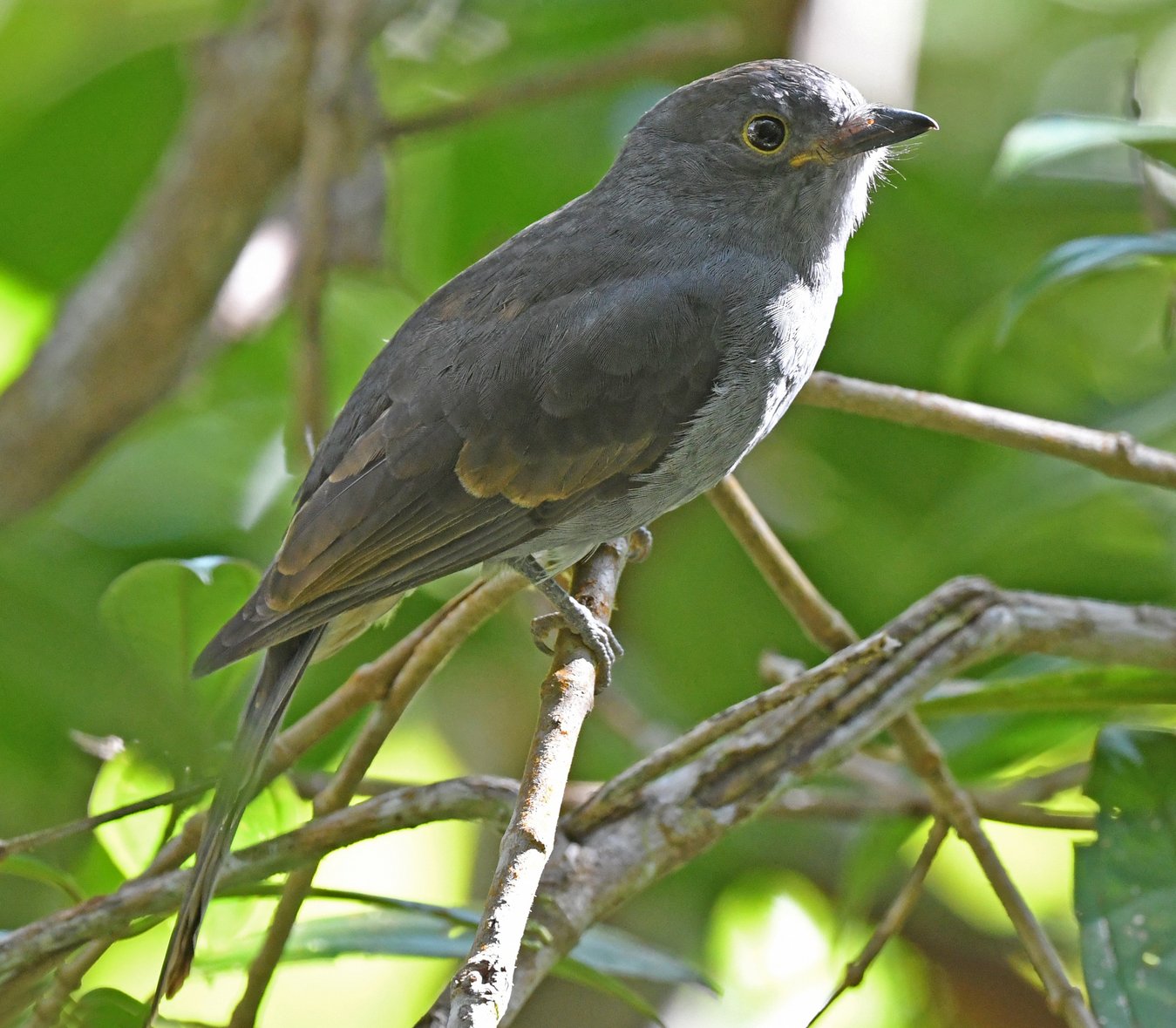
The Chestnut-capped Piha is a dark grey piha found only on the northern end of the Central Andes in Antioquia, Colombia. The species was described only in 2001. It lives in a small, highly fragmented area and is among the most threatened birds of Colombia.
Voice
Loud, clear whistles and sharp calls, which differ from those of Dusky Piha. In display flight the male makes a whirring sound with its wings.
Recording: Paul van Els — CC BY-NC-SA 4.0 · xeno-canto
Identification
24–25 cm, slender, with a fairly long tail and a straight, dark bill. The plumage is dark slate-grey, slightly paler below. On the crown the bird has a dull chestnut cap. Around the brown eye is a distinct yellow eye-ring. The undertail coverts are pale cinnamon. The bill and legs are dark. The sexes are alike.
Confusion species
Dusky Piha Lipaugus fuscocinereus is much larger and longer-tailed, paler grey, without a chestnut cap or yellow eye-ring, and lives higher. Screaming Piha Lipaugus vociferans lives in the Amazonian lowlands and does not occur in the same area. Smoke-colored Pewee Contopus fumigatus is smaller, with a short crest and a broad, flat bill, and sallies for insects from bare branches.
Habitat
Very humid montane rainforest and cloud forest on the northern end of the Central Andes, between about 1400 and 1900 m, in the forest interior and at edges. It feeds mainly on fruit, with some invertebrates. Little is known about the nest.
Where the bird is most at home, classified by the vegetation units of the Andes and the west coast.


Range and movements
Only in Colombia, on the northern end of the Central Andes in north-eastern Antioquia, around Anorí and Amalfi. Absent from Ecuador, Peru, Bolivia and the Galápagos. Does not occur outside the guide area.
- Resident
- dark = core range, pale = thinly spread
How and when to look
Visit the nature reserve near Anorí in Antioquia, which was set up for this species. In the morning, listen for the loud whistles in the cloud forest.
Conservation status
Critically Endangered. The species lives in a very small area, much of whose forest has been cleared for cattle, farming and mining; the population is small and declining.
Scientific name
Lipaugus weberi | Cuervo, Salaman, Donegan & Ochoa, 2001
Cuervo, Salaman, Donegan & Ochoa described the species in 2001 and placed it straight away in the genus where it still stands. The genus Lipaugus was introduced in 1828 by Boie. The genus name comes from Ancient Greek lipaugēs, 'dark' or 'devoid of light'. The species name honours Walter H. Weber, a Colombian ornithologist from Medellín who worked on the study and conservation of birds in Antioquia. The specimen the first description was based on came from Anorí, Antioquia, Colombia.