All species › Passerines › Cotingas › Screaming Piha
Screaming Piha | Lipaugus vociferans
Schreeuwpiha | Guardabosques gritón | Cricrió
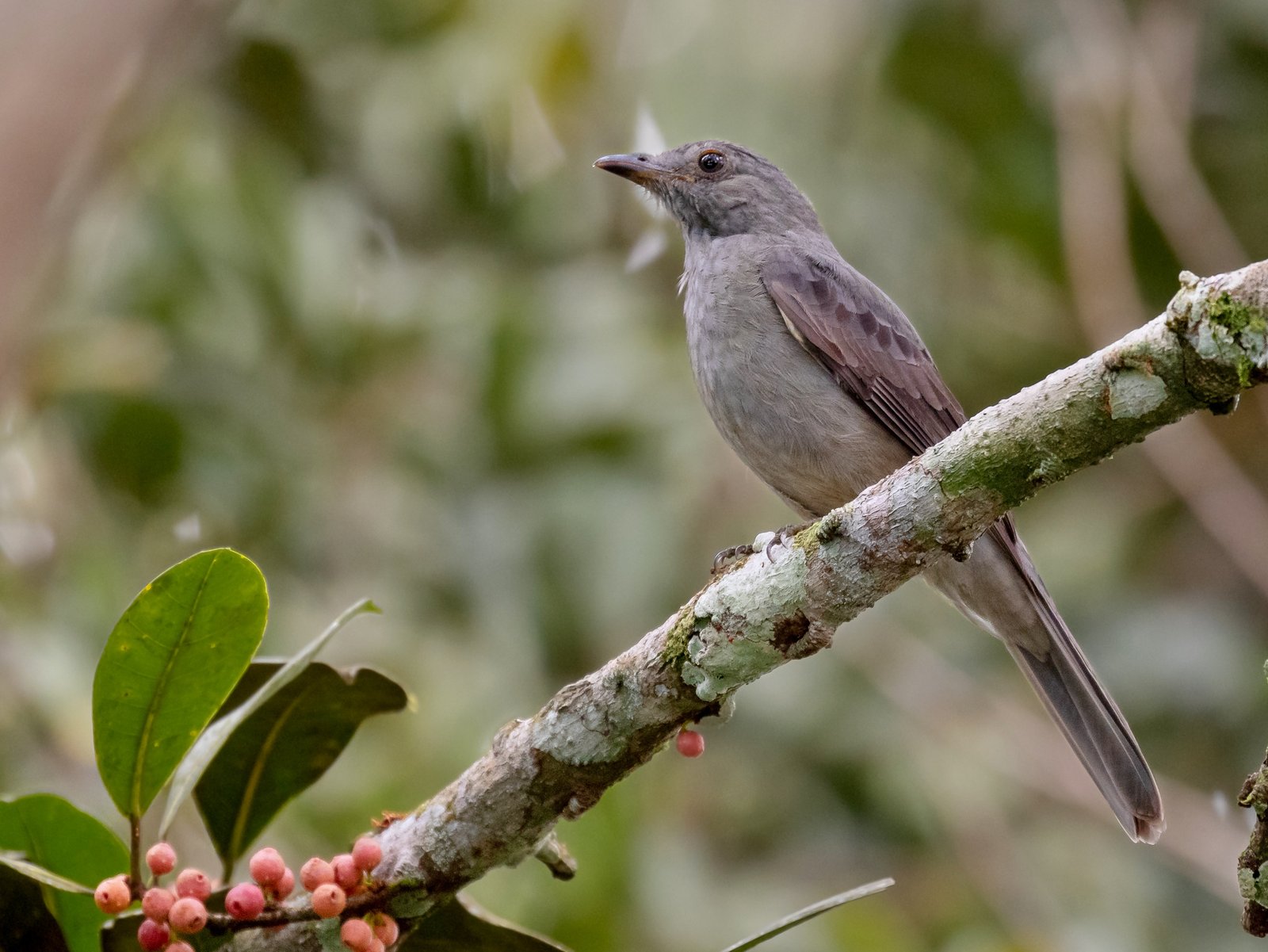
The Screaming Piha is a grey cotinga of Amazonia with one of the loudest calls of the lowland forest. Males call in loose groups from fixed sites in the middle storey, throughout the day. The bird itself is uniform grey and sits still for long periods on a branch.
Voice
An extremely loud, piercing three-part whistle, roughly wee-wee-yoo, the last note loudest, repeated after short pauses. Also softer, rising notes. The call carries over a great distance.
Recording: Juan Freile — CC BY-NC-SA 4.0 · xeno-canto
Identification
25–26 cm, slender, with a fairly long tail, a rounded head and a straight, dark bill. Entirely mid-grey, slightly darker above and paler grey below; the wings and tail are slightly browner grey. The sexes are alike. Young birds have rufous edges to the wing coverts.
Confusion species
Greyish Mourner Rhytipterna simplex is smaller and slimmer, with an olive to yellowish wash on the underparts. Cinereous Mourner Laniocera hypopyrra has cinnamon spots on the wing coverts and often orange-yellow tufts on the flanks. Grey-tailed Piha Snowornis subalaris is olive-green with a grey tail and lives higher, in foothill forest. Dusky Piha Lipaugus fuscocinereus is larger and lives in montane forest.
Habitat
The middle storey of humid lowland rainforest, in terra firme and várzea, also old secondary forest, up to about 1000 m. It feeds on fruit and insects, taken with short sallies from a perch; it sometimes joins mixed flocks. The nest is a small, flimsy platform of twigs on a branch, with one egg.
Where the bird is most at home, classified by the vegetation units of the Andes and the west coast.


Range and movements
In Colombia east of the Andes, from Meta south to Amazonas. In Ecuador throughout the eastern lowlands. In Peru in the Amazonian lowlands. In Bolivia in the northern and central lowlands. Absent from the Galápagos. Outside the guide area throughout Amazonia to the Guianas, and in the Atlantic Forest of eastern Brazil.
- Resident
- dark = core range, pale = thinly spread
How and when to look
In lowland forest, follow the loud call and then search the middle storey, where the bird sits upright and still on a horizontal branch. Where several males call, they can often be found at the same site day after day.
Conservation status
Least Concern. The species is widespread in the Amazonian lowlands.
Scientific name
Lipaugus vociferans | (Wied-Neuwied, 1820)
Wied-Neuwied described the species in 1820 as Muscicapa vociferans; because it was later moved to another genus, the author and year stand in brackets. The genus Lipaugus was introduced in 1828 by Boie. The genus name comes from Ancient Greek lipaugēs, 'dark' or 'devoid of light'. The species name is Latin vociferans, 'crying out loudly', for the very loud call. The specimen the first description was based on came from near Caravelas, Bahia, Brazil.