All species › Passerines › Cotingas › Rufous Piha
Rufous Piha | Lipaugus unirufus
Rosse piha | Piha rojiza | Cricrió-ruivo
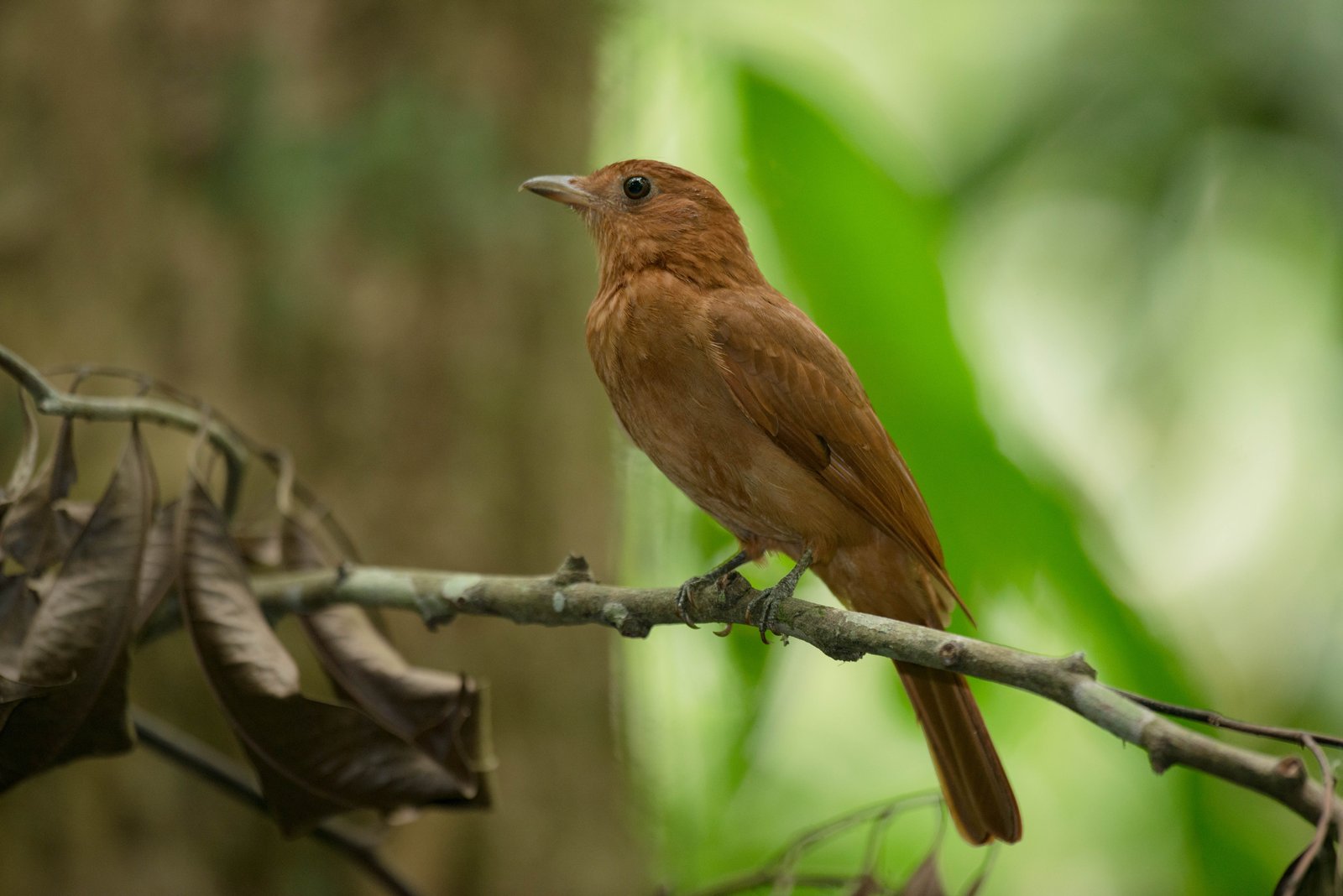
The Rufous Piha is a uniformly rufous-brown cotinga of humid lowland forest on the Pacific side of the Andes. It lives in the middle storey and is mainly detected by ear: a sudden loud noise, such as a clap or a falling branch, often makes several birds answer with their explosive call. In plumage it closely resembles some mourners.
Voice
A loud, explosive whistle, roughly peeeeoo or whee-yoo, often repeated several times and by several birds in turn. It often responds to loud noises in the forest.
Recording: Juan Freile — CC BY-NC-SA 4.0 · xeno-canto
Identification
23–25 cm, a slender, thrush-like bird with a rounded head, large dark eyes and a fairly broad bill. Entirely rufous-brown, slightly darker above and slightly paler below, with a paler, cinnamon throat. The bill is dark, with a paler base to the lower mandible. The sexes are alike.
Confusion species
Rufous Mourner Rhytipterna holerythra is smaller and slimmer, with a smaller head and a narrower bill, and more uniformly rufous; its call is a two-note, falling whistle. Speckled Mourner Laniocera rufescens has rufous spots on the wing coverts and faint dark barring on the breast. Cinnamon Becard Pachyramphus cinnamomeus is much smaller, with a large head and a pale loral stripe.
Habitat
The middle storey and lower canopy of humid lowland and foothill rainforest, also old secondary forest, mostly below 1000 m. It feeds on fruit and large insects, picked with a short sally from a perch. The nest is a small, shallow platform of twigs on a horizontal branch.
Where the bird is most at home, classified by the vegetation units of the Andes and the west coast.


Range and movements
In Colombia in the Pacific lowlands from Chocó to Nariño and in the northern lowlands east to the middle Magdalena valley. In Ecuador in the north-west, mainly in Esmeraldas and western Pichincha. Absent from Peru, Bolivia and the Galápagos. Outside the guide area from southern Mexico through Central America to Panama.
- Resident
- dark = core range, pale = thinly spread
How and when to look
In lowland forest in the Chocó, listen for the explosive call; a sudden loud noise sometimes provokes an answer. The bird often sits still for long periods on a branch in the middle storey.
Conservation status
Least Concern. In north-western Ecuador its habitat has been greatly reduced by deforestation.
Scientific name
Lipaugus unirufus | Sclater, 1860
Sclater described the species in 1860 and placed it straight away in the genus where it still stands. The genus Lipaugus was introduced in 1828 by Boie. The genus name comes from Ancient Greek lipaugēs, 'dark' or 'devoid of light'. The species name comes from Latin uni-, 'one', and rufus, 'rufous', for the uniformly rufous plumage. The specimen the first description was based on came from Playa Vicente, Mexico.