All species › Passerines › Cotingas › Spangled Cotinga
Spangled Cotinga | Cotinga cayana
Halsbandcotinga | Cotinga lentejuelada | Anambé-azul
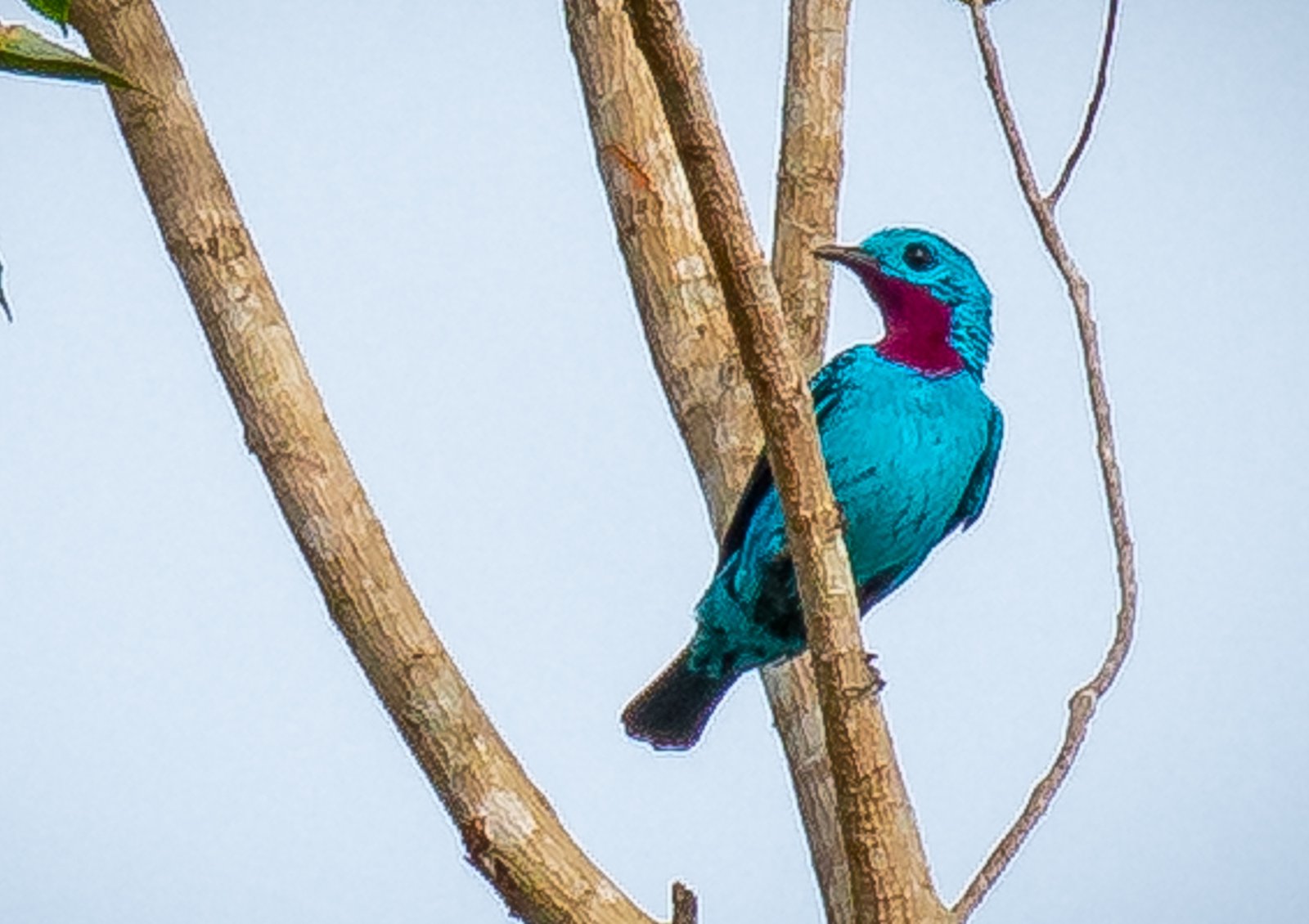
The Spangled Cotinga is the most widespread blue cotinga of Amazonia. The male is turquoise blue with a purple throat and often sits for long periods on a bare branch high above the canopy. Females and young birds are greyish brown and scaled.
Voice
Mostly silent. In flight the male's wings make a soft rattling or whistling sound.
Recording: Jonas Nilsson — CC BY-NC-SA 4.0 · xeno-canto
Identification
20 cm, with a rounded head, a short black bill and a fairly short tail. The male is bright turquoise blue; the black feather bases show through everywhere, so that the head, back and underparts look spotted. The throat is magenta to purple, and the wings and tail are black with blue edges. The female is greyish brown, finely scaled above and below by pale feather edges. Young males at first resemble the female.
Confusion species
The male Plum-throated Cotinga Cotinga maynana is more uniform turquoise blue, without the spotted pattern, and has a smaller plum-coloured throat patch. Purple-breasted Cotinga Cotinga cotinga is darker blue, with a purple throat and breast, and occurs only in the far east of Colombia. Blue Cotinga Cotinga nattererii lives west of the Andes. The females of the Cotinga cotingas are very similar.
Habitat
The canopy and edges of tall terra firme and várzea rainforest, also forest edges, clearings with scattered tall trees and riverbanks, up to about 1000 m. It feeds mainly on fruit and sometimes insects; several birds sometimes gather at fruiting trees. The nest is a small, shallow cup high in a tree; the female incubates alone.
Where the bird is most at home, classified by the vegetation units of the Andes and the west coast.


Range and movements
In Colombia east of the Andes, from Meta south to Amazonas. In Ecuador throughout the eastern lowlands. In Peru in the Amazonian lowlands from north to south. In Bolivia in the northern and central lowlands. Absent from the Galápagos. Outside the guide area in the Amazon basin of Venezuela, the Guianas and Brazil.
- Resident
- dark = core range, pale = thinly spread
How and when to look
In the morning, scan the bare tops of tall trees from a canopy tower, an open riverbank or a forest edge; the male often sits there motionless for a long time.
Conservation status
Least Concern. The species is widespread over large parts of the Amazonian lowlands.
Scientific name
Cotinga cayana | (Linnaeus, 1766)
Linnaeus described the species in 1766 as [Ampelis] cayana; because it was later moved to another genus, the author and year stand in brackets. The genus Cotinga was introduced in 1760 by Brisson. The genus name goes back, via Brisson (1760), to the Tupí name catingá, 'bright forest (bird)', for the colourful cotingas. The species name refers to Cayenne in French Guiana. The specimen the first description was based on came from Cayenne, French Guiana.