All species › Passerines › Cotingas › Purple-breasted Cotinga
Purple-breasted Cotinga | Cotinga cotinga
Purperborstcotinga | Cotinga pechimorada | Anambé-de-peito-roxo
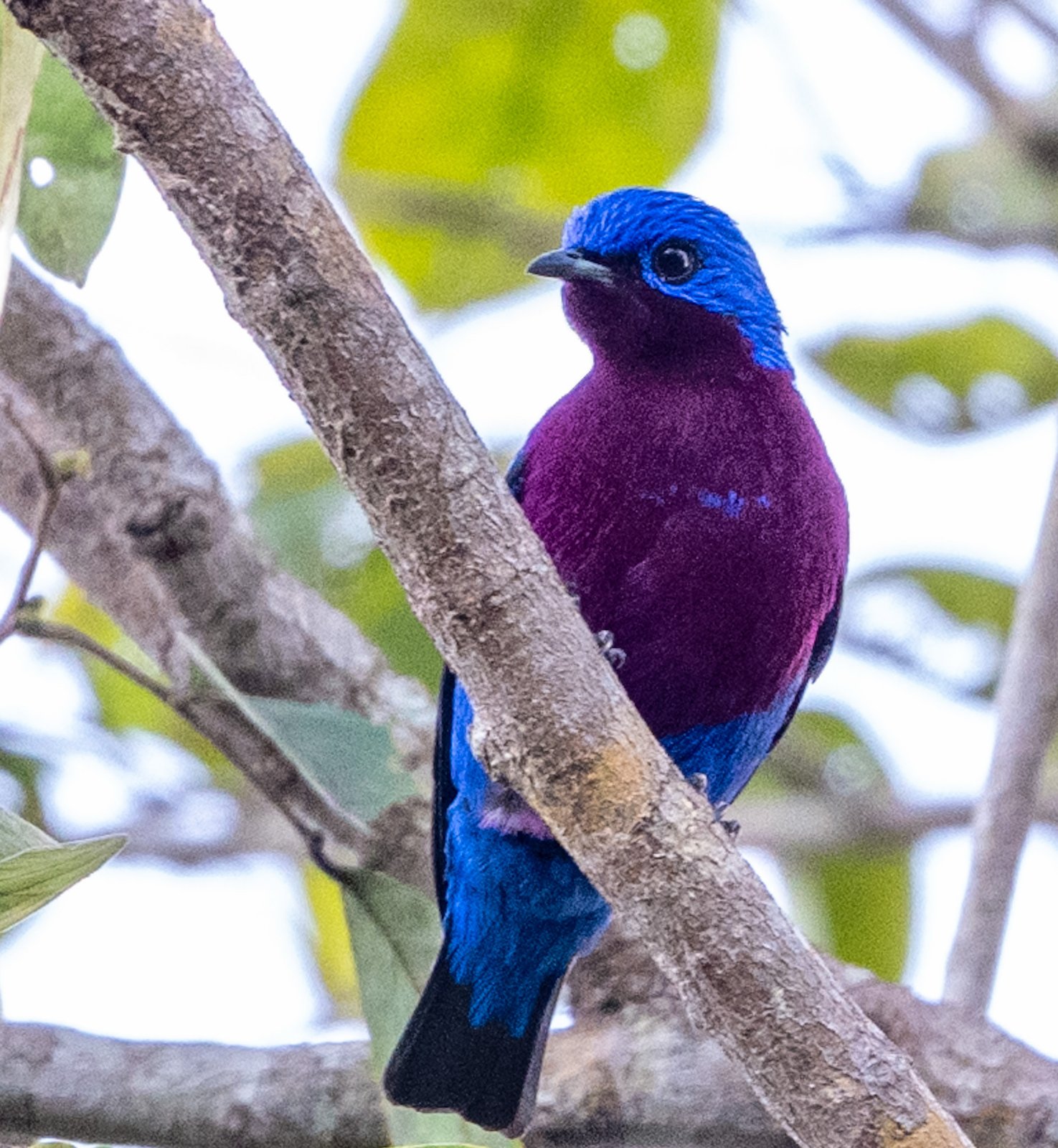
The Purple-breasted Cotinga is a small, compact cotinga of the lowland forest canopy in north-eastern South America. The male is deep ultramarine blue with a purple throat and breast. In the guide area the species occurs only in the far east of Colombia, at the edge of its range.
Voice
Mostly silent. In flight the male's wings make a soft whistling or rattling sound.
No recording with a suitable Creative Commons licence is available for this species yet.
Identification
18 cm, with a rounded head, a short, broad bill and large dark eyes. The male is deep ultramarine blue, with black wings and tail and a uniform deep purple throat, breast and upper belly; the lower belly and undertail coverts are blue. The female is dark brown, scaled above and below by pale buff feather edges. Young males at first resemble the female.
Confusion species
Spangled Cotinga Cotinga cayana is larger and paler turquoise blue, with black feather bases giving a spotted pattern, and has only a purple throat; the breast is blue. The male Plum-throated Cotinga Cotinga maynana is paler turquoise blue, with a small plum-coloured throat patch, and lives farther south-west. The females of these species are similar; that of Purple-breasted Cotinga is darker brown and more heavily scaled.
Habitat
The canopy and edges of tall humid lowland forest, including forest on sandy soils, mostly below 500 m. It feeds mainly on fruit, picked in the crown; it often sits still for long periods on a bare branch above the canopy. The nest is a small, shallow cup high in a tree.
Where the bird is most at home, classified by the vegetation units of the Andes and the west coast.


Range and movements
In Colombia only in the far east, along the borders with Venezuela and Brazil. Absent from Ecuador, Peru, Bolivia and the Galápagos. Outside the guide area in southern Venezuela, the Guianas and the northern Brazilian Amazon.
- Resident
- dark = core range, pale = thinly spread
How and when to look
In eastern Colombia, scan the canopy from a clearing or a riverbank and watch the bare tops of emergent trees, especially in the morning. Fruiting trees attract the species.
Conservation status
Least Concern. In the guide area the species is known from only a few sites.
Scientific name
Cotinga cotinga | (Linnaeus, 1766)
Linnaeus described the species in 1766 as [Ampelis] Cotinga; because it was later moved to another genus, the author and year stand in brackets. The genus Cotinga was introduced in 1760 by Brisson. The genus name goes back, via Brisson (1760), to the Tupí name catingá, 'bright forest (bird)', for the colourful cotingas. The species name repeats the genus name and goes back to the Tupí name catingá, 'bright forest (bird)'; Linnaeus took it from Brisson's 'Cotinga' (1760). The specimen the first description was based on came from Belém, Pará, Brazil.