All species › Passerines › Antpittas › Chestnut-crowned Antpitta
Chestnut-crowned Antpitta | Grallaria ruficapilla
Roestkapmierpitta | Tororoí coronicastaño | Tovacuçu-de-coroa-castanha
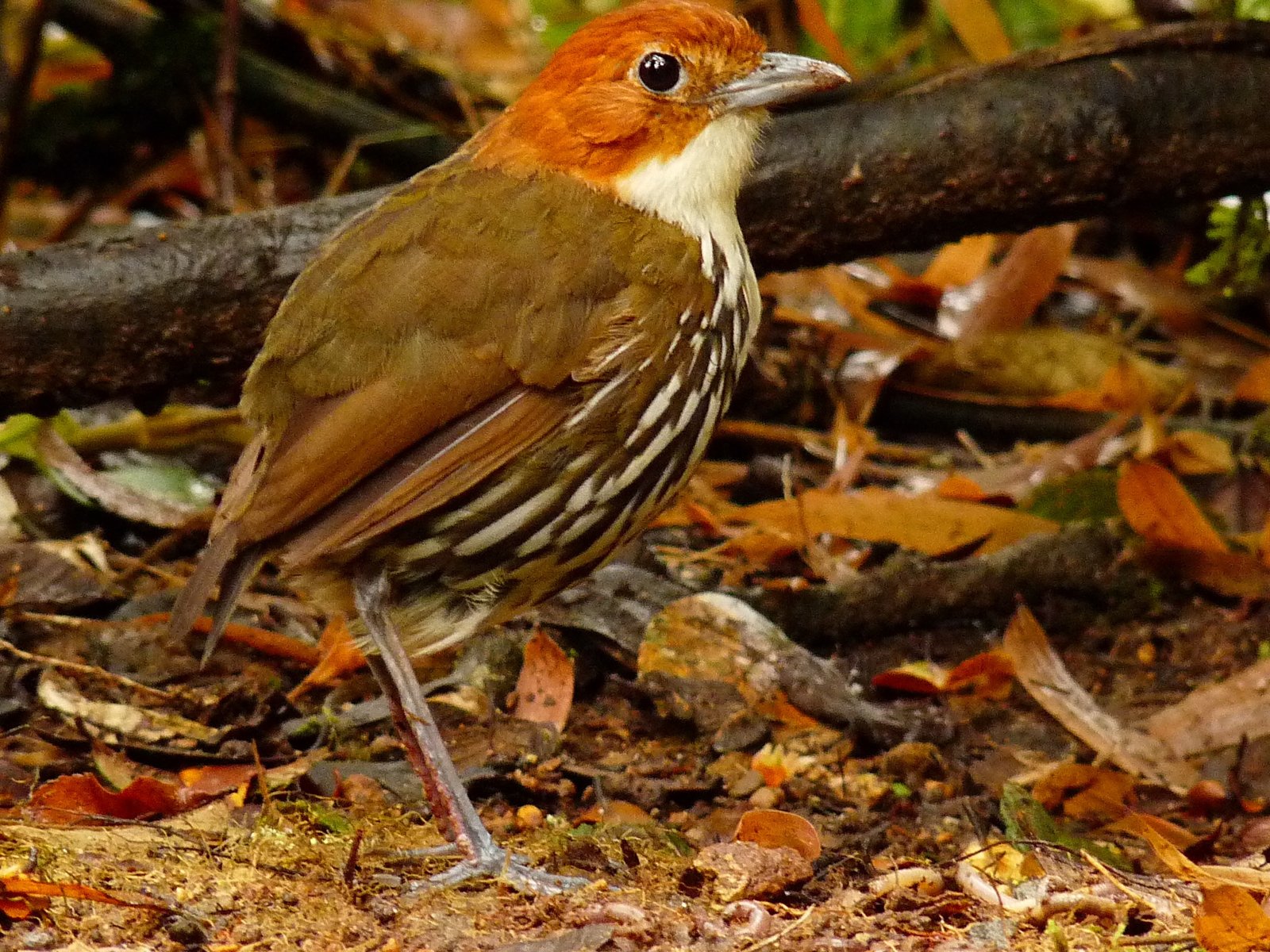
The Chestnut-crowned Antpitta is one of the most widespread antpittas of the northern Andes, recognised by its rufous head and streaked white underparts. It lives not only in undisturbed forest but also in shrubby forest edges and overgrown pasture. Its three-note whistle is a familiar sound of montane forest.
Voice
A clear three-note whistle: a long first note followed by two shorter notes, rendered in Spanish-speaking areas as compra pan. Also heard regularly during the day.
Recording: Paul Molina Abril — CC BY-NC-SA 4.0 · xeno-canto
Identification
18–19 cm, round and short-tailed, on long grey legs. The crown, nape and sides of the head are bright rufous, the back and wings olive-brown. The throat is white; the breast and flanks are white with broad brown to blackish streaks, and the centre of the belly is unstreaked white. The sexes are alike.
Confusion species
Watkins's Antpitta Grallaria watkinsi of the dry south-west has a duller crown, paler legs and a different song. White-bellied Antpitta Grallaria hypoleuca has rufous upperparts and unstreaked white underparts. Chestnut-naped Antpitta Grallaria nuchalis has a rufous crown but dark grey underparts without streaks.
Habitat
Humid montane forest, cloud forest, forest edges, secondary forest and shrubby pasture, at roughly 1800 to 3400 m. It forages on the ground for earthworms and insects, often in clearings and along trails. The nest is low in dense vegetation.
Where the bird is most at home, classified by the vegetation units of the Andes and the west coast.


Range and movements
In Colombia in all three Andean ranges. In Ecuador on the western and eastern slopes. In Peru on the eastern slope and in the north also on the western slope, south to the centre of the country. Absent from Bolivia and the Galápagos. Outside the guide area in the mountains of northern Venezuela.
- Resident
- dark = core range, pale = thinly spread
How and when to look
Listen along forest edges and trails in montane forest for the three-note whistle. At several sites in Colombia and Ecuador, such as Río Blanco near Manizales, birds come to feeding stations with earthworms.
Conservation status
Least Concern. The species tolerates partial deforestation and also occurs in small-scale farmland with forest remnants.
Scientific name
Grallaria ruficapilla | de Lafresnaye, 1842
De Lafresnaye described the species in 1842 and placed it straight away in the genus where it still stands. The genus Grallaria was introduced in 1816 by Vieillot. The genus name comes from New Latin grallarius, 'stilt-walker', referring to the long legs. The species name comes from Latin rufus, 'red', and capillus, 'hair of the head': with a rufous crown. The specimen the first description was based on came from Colombia.