All species › Cranes, rails and allies › Rails, gallinules and coots › Chestnut-headed Crake
Chestnut-headed Crake | Anurolimnas castaneiceps
Kastanjekopral | Polluela cabecicastaña | Sanã-de-cabeça-castanha
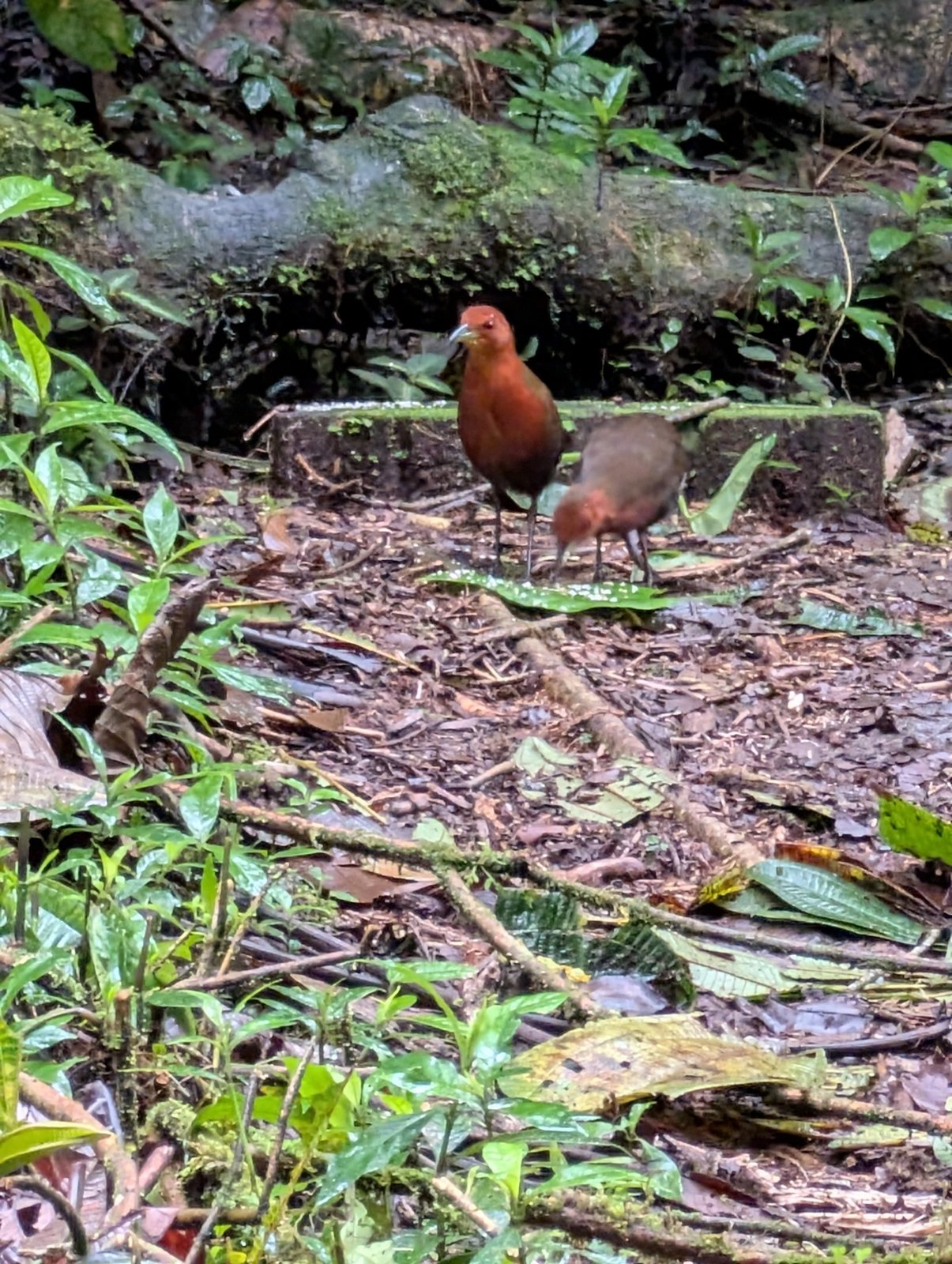
The Chestnut-headed Crake is a medium-sized rail of the forest floor in the Amazonian lowlands and the Andean foothills. It lives hidden in dense undergrowth, often along streams and at humid forest edges, and is mostly detected by its loud duets. The contrast between the chestnut head and breast and the dark body separates it from other rails in this forest.
Voice
A loud, rhythmic duet of repeated, ringing notes, roughly too-tuk, too-tuk, which can go on for a long time; mainly in the early morning and at dusk.
No recording with a suitable Creative Commons licence is available for this species yet.
Identification
20–23 cm, compact, with a fairly short tail. The head, neck and breast are warm chestnut; the upperparts, wings and tail dark olive-brown, the belly and flanks dark brownish black. The bill is greenish yellow, the iris red and the legs red to reddish brown. The sexes are alike; juveniles are duller, with less chestnut on the head and breast.
Confusion species
Uniform Crake Amaurolimnas concolor is evenly rufous-brown, without contrast between head and body, and paler below. Russet-crowned Crake Rufirallus viridis is smaller, with only the crown rufous, a grey face and rufous underparts, and lives in open, grassy terrain. Grey-cowled Wood Rail Aramides cajaneus is much larger, with a grey neck, a rufous breast and a black rear belly.
Habitat
Dense undergrowth of humid lowland and foothill forest, especially along streams, in swampy hollows, Heliconia thickets and old secondary forest, up to about 1200 m. It searches the forest floor for insects and other invertebrates. The nest is placed low in dense vegetation.
Where the bird is most at home, classified by the vegetation units of the Andes and the west coast.


Range and movements
In Colombia in the south-east, east of the Andes. In Ecuador in the Amazonian lowlands and on the lower eastern slope. In Peru in the Amazonian lowlands and foothills, mainly in the north and centre. In Bolivia in the north. Absent from the Galápagos. Outside the guide area in western Brazilian Amazonia.
- Resident
- dark = core range, pale = thinly spread
How and when to look
Listen in the early morning along forest streams and humid forest edges in the lowlands and foothills east of the Andes. Birds respond to each other's duets but usually stay in cover; waiting at an opening in the undergrowth gives the best chance of seeing one.
Conservation status
Least Concern. The species depends on forest and disappears locally through deforestation, but its range is large.
Scientific name
Anurolimnas castaneiceps | (Sclater & Salvin, 1869)
Sclater & Salvin described the species in 1869 as Porzana castaneiceps; because it was later moved to another genus, the author and year stand in brackets. The genus Anurolimnas was introduced in 1893 by Sharpe. The genus name comes from Greek an-, 'without', and oura, 'tail', with New Latin limnas, 'rail', after the short tail. The species name comes from Latin castaneus, 'chestnut', and -ceps, 'headed'. The specimen the first description was based on came from Río Napo, Ecuador.