All species › Cranes, rails and allies › Finfoots › Sungrebe
Sungrebe | Heliornis fulica
Kleine fuutkoet | Pájaro cantil | Picaparra
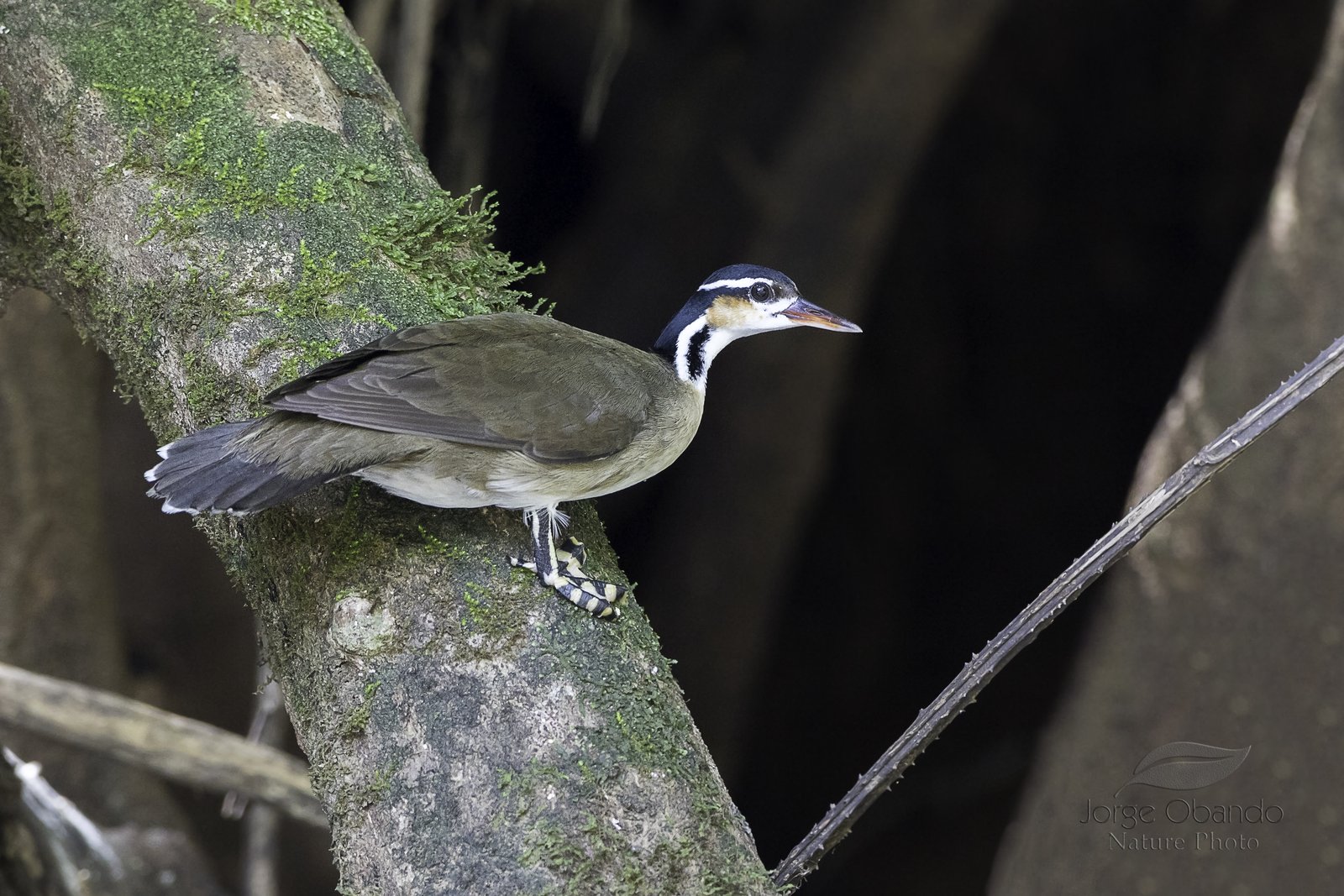
The Sungrebe is a slender bird that swims low in the water along quiet, shaded banks in the tropical lowlands. It swims with a bobbing head along overhanging branches and hides in waterside vegetation when disturbed. The male carries the newly hatched young in skin folds under the wings, even in flight.
Voice
Usually silent. Sometimes a series of short, hollow, somewhat barking notes, mainly from dense waterside vegetation.
Recording: JAYRSON ARAUJO DE OLIVEIRA — CC BY-NC-SA 4.0 · xeno-canto
Identification
26–33 cm, with a long, thin neck, a pointed bill and a fairly long, broad tail with a white tip. The crown and hindneck are black, with a white supercilium and a white stripe down the side of the neck; the throat and foreneck are white. The upperparts are olive-brown, the underparts whitish. The feet are boldly banded black and yellow. The female has rufous cheeks and a reddish bill in the breeding season; the male has pale cheeks.
Confusion species
Least Grebe Tachybaptus dominicus is compact and grey, with a yellow eye, no striped head and almost no tail. Pied-billed Grebe Podilymbus podiceps is browner and heavier, with a short, thick bill. Female Anhingas Anhinga anhinga also swim low in the water, but are much larger, with a buff neck and a long, dagger-shaped bill.
Habitat
Slow rivers, streams, creeks and oxbow lakes (cochas) with dense, overhanging waterside vegetation, also swamp forest and flooded forest, in the lowlands, mostly below 500 m. Forages while swimming and along the bank for insects, spiders, crustaceans, frogs and small fish. The nest is a platform of twigs and plant material on a branch or in shrubbery over water.
Where the bird is most at home, classified by the vegetation units of the Andes and the west coast.


Range and movements
In Colombia widespread in the lowlands west and east of the Andes, including the Llanos and Amazonia. In Ecuador in the western lowlands and the eastern Amazonian lowlands. In Peru in the Amazonian lowlands. In Bolivia in the lowlands of the north and east. Absent from the Galápagos. Outside the guide area from Mexico to north-eastern Argentina.
- Resident
- dark = core range, pale = thinly spread
How and when to look
Paddle or motor slowly along shaded banks of cochas and side rivers in the Amazonian lowlands, especially in the early morning; the bird often swims just under overhanging branches and slips into the vegetation as a boat approaches.
Conservation status
Least Concern. The species is widespread, but depends on undisturbed banks with dense vegetation and disappears where banks are cleared.
Scientific name
Heliornis fulica | (Boddaert, 1783)
Boddaert described the species in 1783 as Colymbus fulica; because it was later moved to another genus, the author and year stand in brackets. The genus Heliornis was introduced in 1791 by Bonnaterre. The genus name comes from Greek hēlios, 'sun', and ornis, 'bird'. The species name is Latin fulica, 'coot'. The specimen the first description was based on came from Cayenne, French Guiana.