All species › Cranes, rails and allies › Limpkin › Limpkin
Limpkin | Aramus guarauna
Koerlan | Carrao | Carão
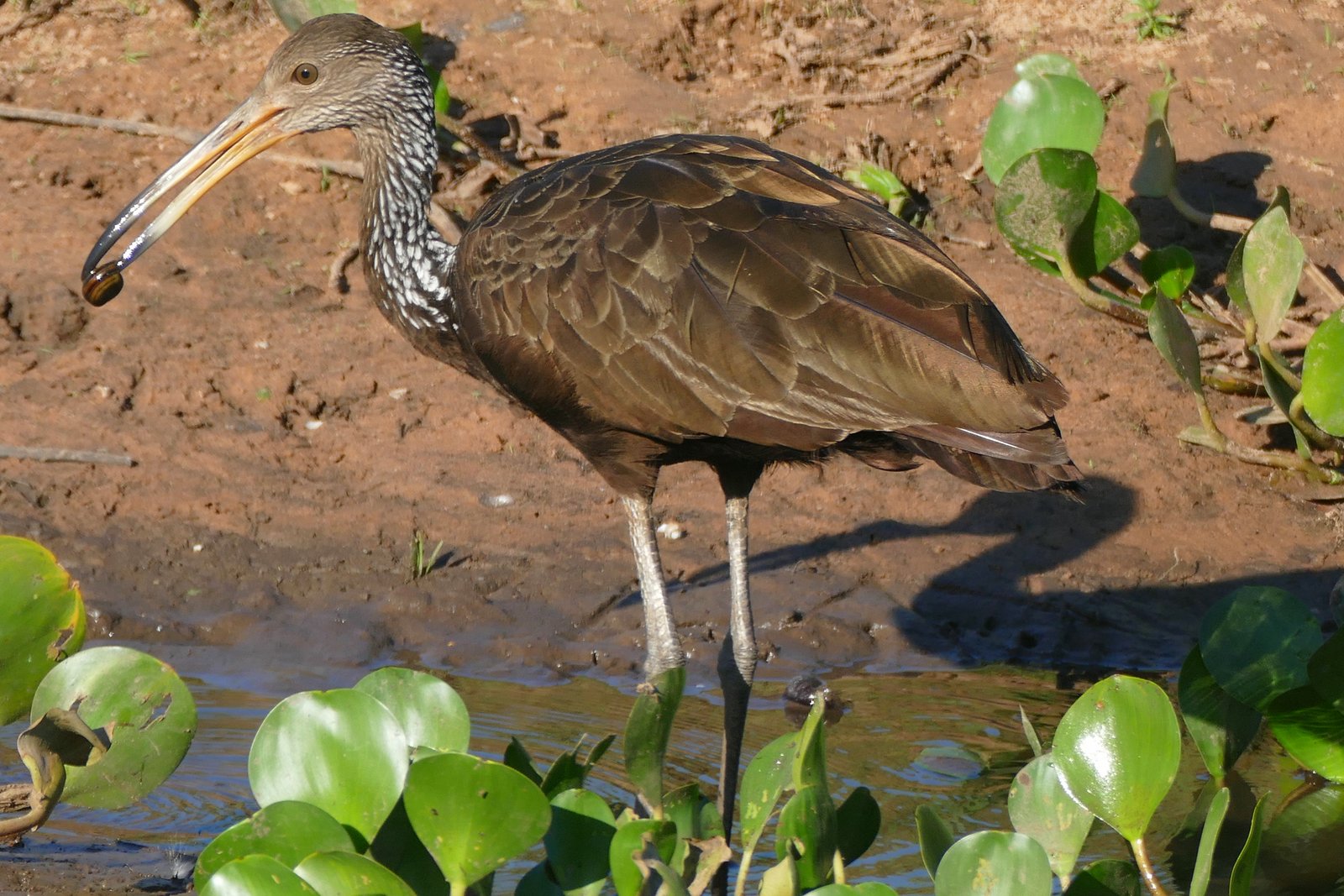
The Limpkin is a large, brown, white-spotted marsh bird with long legs and a long, slightly decurved bill. It is the only species in its family and feeds mainly on large freshwater snails (apple snails), which it pulls from the shell with its bill. Its loud, wailing call often carries across marshes and shores at night.
Voice
A loud, wailing, shrill scream, often rendered as krr-eeow, repeated and often in series, mainly at night, at dusk and in overcast weather. Also clucking notes.
Recording: Carlos Delgado JUMABITA — CC BY-NC-SA 4.0 · xeno-canto
Identification
64–71 cm, with a long neck, long dark grey legs and a long bill, slightly decurved at the tip, yellowish with a dark tip. The plumage is dark olive-brown, with white streaks and spots on the head, neck, back and wing coverts; the head and throat are paler. In flight it holds neck and legs outstretched and gives short, jerky wingbeats. The sexes are alike; juveniles are duller.
Confusion species
Green Ibis Mesembrinibis cayennensis is darker and greenish, without white spots, with a more strongly decurved, dark bill and shorter legs. Bare-faced Ibis Phimosus infuscatus is smaller and dark, with a pink bill and bare pink facial skin. Juvenile Rufescent Tiger Herons Tigrisoma lineatum are finely barred rather than streaked white and have a straight, pointed bill.
Habitat
Freshwater marshes, flooded grassland, shores of lakes and oxbow lakes (cochas), slow rivers and swamp forest, also rice fields and irrigation channels, mainly in the lowlands, locally to about 1500 m. Feeds mainly on apple snails, also on freshwater mussels, crustaceans and other small animals. The nest is a platform of plant material in dense waterside vegetation, a shrub or low in a tree over or near water.
Where the bird is most at home, classified by the vegetation units of the Andes and the west coast.


Range and movements
In Colombia in the lowlands of the Caribbean region, the Magdalena valley, the Llanos and Amazonia. In Ecuador in the western lowlands, especially in the Guayas basin, and in the eastern Amazonian lowlands. In Peru mainly in the Amazonian lowlands, locally in the north-west. In Bolivia widespread in the lowlands, especially in the wet savannas of the Beni. Absent from the Galápagos. Outside the guide area from Florida and Mexico to Argentina.
- Resident
- dark = core range, pale = thinly spread
How and when to look
Around marshes and flooded grassland in the Llanos, the Beni and the Guayas plain, where birds hunt snails in open patches or perch on a post or tree. Empty apple snail shells along the water's edge reveal its presence; the call can be heard in the evening and at night.
Conservation status
Least Concern. The species is widespread, but depends on marshes with good snail numbers and disappears where wetlands are drained.
Scientific name
Aramus guarauna | (Linnaeus, 1766)
Linnaeus described the species in 1766 as Scopolax Guarauna; because it was later moved to another genus, the author and year stand in brackets. The genus Aramus was introduced in 1816 by Vieillot. The genus name, given by Vieillot in 1816, comes from Greek aramos, a kind of heron mentioned by Hesychius. The species name comes from Guaráuna, a Tupi name for a black bird, applied to a kind of marsh bird; the name already appears in Marcgrave (1648). The specimen the first description was based on came from South America.