All species › Cranes, rails and allies › Trumpeters › Pale-winged Trumpeter
Pale-winged Trumpeter | Psophia leucoptera
Witvleugeltrompetvogel | Trompetero aliblanco | Jacamim-de-costas-brancas
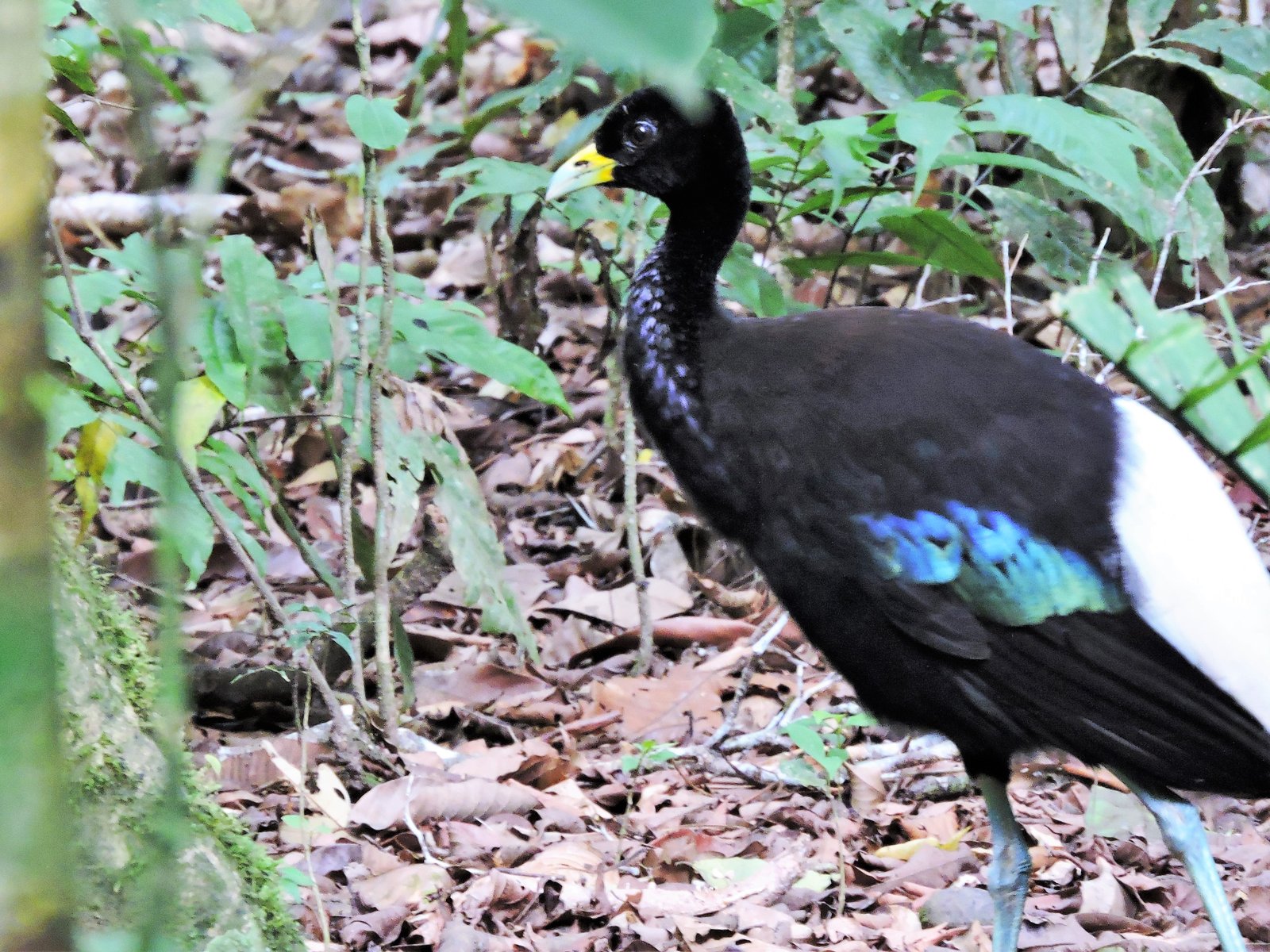
The Pale-winged Trumpeter is a hunched, long-legged ground bird of the Amazonian rainforest south of the Amazon and the Marañón. Groups walk quietly over the forest floor and often follow monkeys to pick up fallen fruit. It is the southern counterpart of the Grey-winged Trumpeter and differs mainly in its white back patch.
Voice
A deep, ventriloquial, rumbling hum of notes that first speed up and then slow down, often at night or at dusk. When alarmed also loud, shrill cries and a cackling alarm.
Recording: Jacob Wijpkema — CC BY-NC-SA 4.0 · xeno-canto
Identification
45–52 cm, with a small head, a long neck, a hunched back and long legs. The plumage is mostly velvety black, with a purple and bronze glossy patch on the lower neck. A large white patch lies on the lower back, formed by the long inner secondaries, which drape over the back like a cape; in flight the wings are otherwise black. The bill is short and greenish to yellowish, the legs greenish to grey. The sexes are alike.
Confusion species
Grey-winged Trumpeter Psophia crepitans, north of the Amazon and the Marañón, has an ash-grey rather than white back patch; the two species do not occur together and are separated by the large rivers. Curassows such as Razor-billed Curassow Mitu tuberosum are larger, with a heavy red bill and a chestnut belly, and lack a pale back patch.
Habitat
Tall humid terra firme rainforest in the lowlands and low foothills, also seasonally flooded forest along rivers, mostly below 500 m. Groups of a few to more than ten birds search the forest floor for fallen fruit, insects and other small animals. Roosts high in trees. Nests in a tree cavity; the whole group helps to raise the young.
Where the bird is most at home, classified by the vegetation units of the Andes and the west coast.


Range and movements
In Peru in the Amazonian lowlands south of the Amazon and the Marañón, east of the Andes. In Bolivia in the lowlands of the north and centre of the country. Absent from Colombia, Ecuador and the Galápagos. Outside the guide area in western Brazilian Amazonia south of the Amazon.
- Resident
- dark = core range, pale = thinly spread
How and when to look
Groups slip away quietly when disturbed; the best chance is on quiet trails in large, little-hunted forest, early in the morning, for example in protected areas in south-eastern Peru. Hearing the deep hum at night or at first light means a group is nearby.
Conservation status
Least Concern. Disappears quickly where hunted and is therefore often absent near villages and roads. Depends on large, unbroken forest and suffers from deforestation in Amazonia.
Scientific name
Psophia leucoptera | Spix, 1825
Spix described the species in 1825 and placed it straight away in the genus where it still stands. The genus Psophia was introduced in 1758 by Linnaeus. The genus name comes from Greek psophos, 'noise', after the loud calls of trumpeters. The species name comes from Greek leukos, 'white', and -pteros, 'winged'. The specimen the first description was based on came from Left bank of the Rio Madeira, Brazil.