All species › Woodpeckers and allies › Toucans › Chestnut-tipped Toucanet
Chestnut-tipped Toucanet | Aulacorhynchus derbianus
Derby-arassari | Tucanete de Derby | Tucaninho-de-ponta-castanha
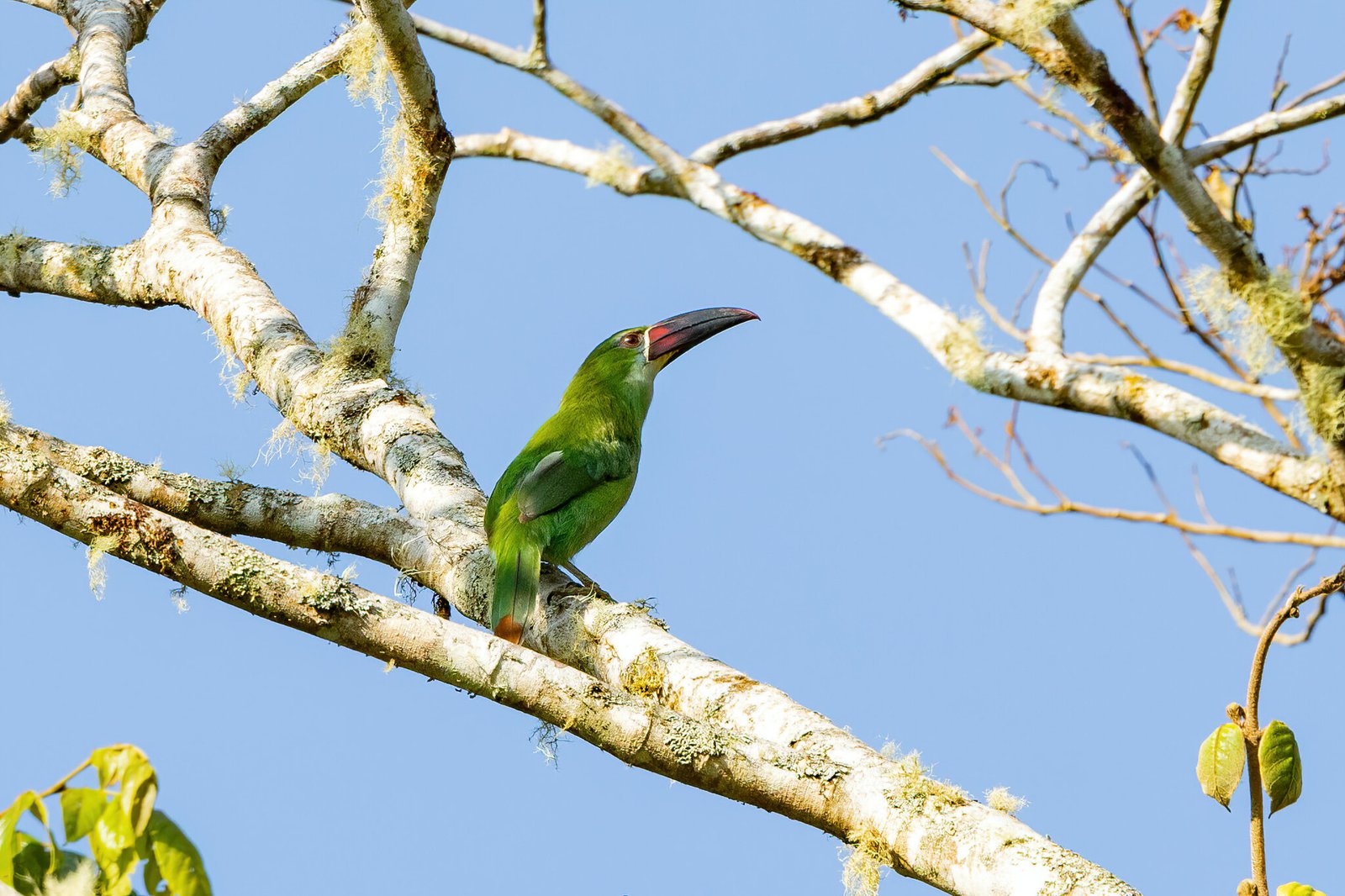
The Chestnut-tipped Toucanet is a green toucanet of the lower slopes on the eastern side of the Andes, from southern Colombia to Bolivia. It usually lives lower than Southern Emerald Toucanet and is scarce and local in many places. The broad chestnut tips of the tail feathers explain the English name.
Voice
Long series of grunting to croaking notes, such as grrrump or kwuk, often given by pairs together; also rattling calls.
Recording: GABRIEL LEITE — CC BY-NC-SA 4.0 · xeno-canto
Identification
36–40 cm. Mainly green, with a bluish tinge on the nape, a whitish throat and broad chestnut tips to the tail feathers. The rump is green. The bill is black with a dark red base, grooves on the upper mandible and a narrow vertical white line at the base; some birds have an almost entirely black bill. The eye is red-brown, with some blue skin below it. The sexes are alike; juveniles are duller.
Confusion species
Southern Emerald Toucanet Aulacorhynchus albivitta has yellow on the upper mandible and chestnut undertail coverts, and usually lives higher. Blue-banded Toucanet Aulacorhynchus coeruleicinctis in Peru and Bolivia has a blue breast band, a red rump and a bluish grey bill, and lives higher. Yellow-browed Toucanet Aulacorhynchus huallagae in northern Peru has a yellow stripe behind the eye and a bluish grey bill.
Habitat
Humid montane forest and cloud forest on the lower slopes, also upper foothill forest, mainly between 600 and 2000 m; in Bolivia also in tropical forest. It eats mainly fruit, also insects. It nests in a tree cavity.
Where the bird is most at home, classified by the vegetation units of the Andes and the west coast.


Range and movements
In Colombia only in the far south, on the eastern slope. In Ecuador locally on the eastern slope. In Peru on the eastern slope along the whole length of the country. In Bolivia on the eastern slope south to Cochabamba. Absent from the Galápagos. Does not occur outside the guide area.
- Resident
- dark = core range, pale = thinly spread
How and when to look
Along forest edges and roads through lower montane forest on the eastern slope, such as the road to the Manu area in Peru. Birds often sit high in the canopy and are usually first noticed by their croaking call.
Conservation status
Least Concern. The species is local and scarce, but the range is large and much of the eastern slope is still forested.
Scientific name
Aulacorhynchus derbianus | Gould, 1835
Gould described the species in 1835 and placed it straight away in the genus where it still stands. He introduced the genus Aulacorhynchus in that same work. The genus name comes from Greek aulax, 'furrow', and rhunkhos, 'bill'. The species name honours Edward Smith-Stanley, 13th Earl of Derby (1775–1851), a British naturalist and patron with a large animal collection at Knowsley. The specimen the first description was based on came from (per the description).