All species › Woodpeckers and allies › Toucans › Groove-billed Toucanet
Groove-billed Toucanet | Aulacorhynchus sulcatus
Geeloogarassari | Tucanete piquisurcado | Tucaninho-de-bico-sulcado
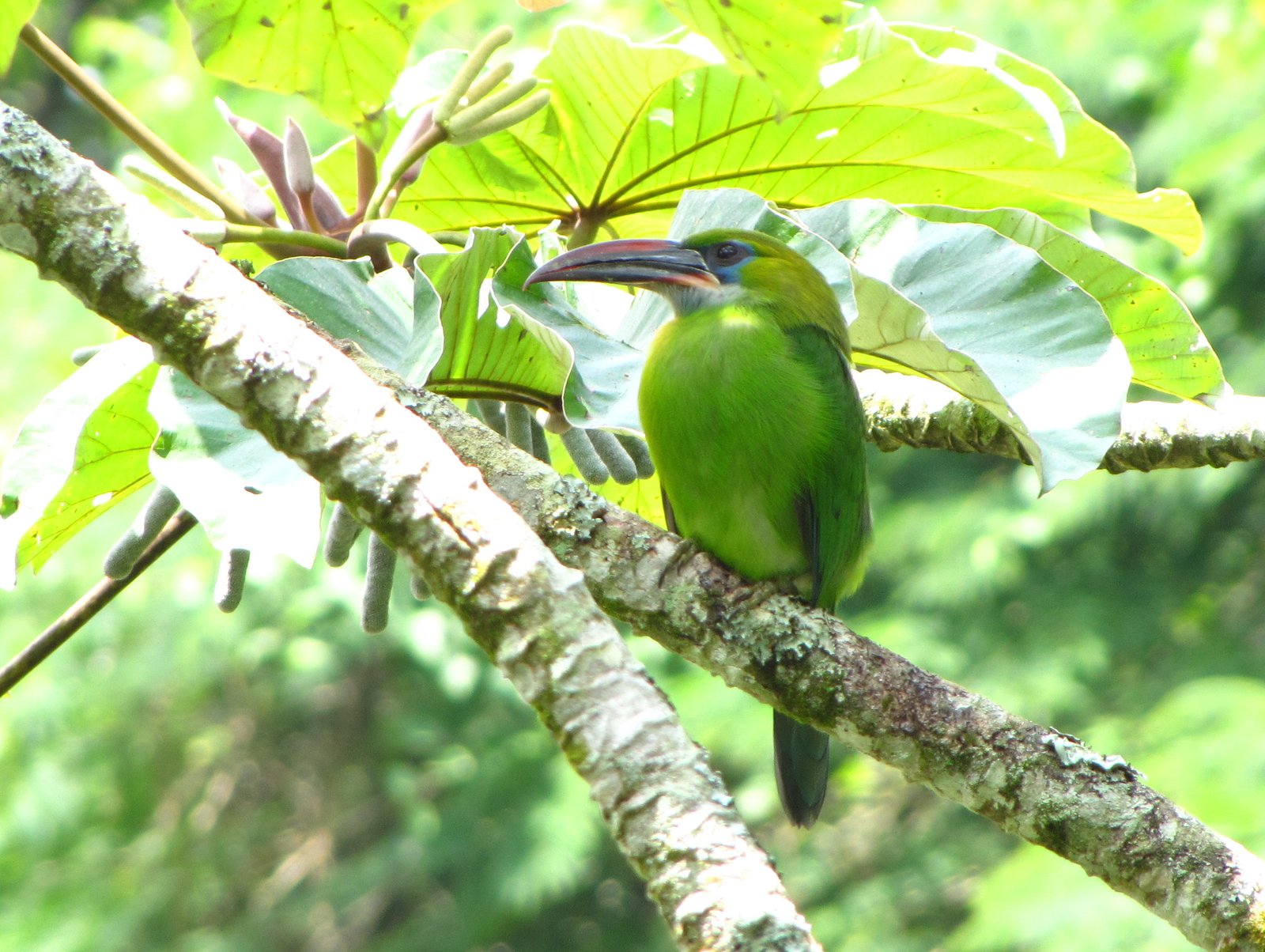
The Groove-billed Toucanet is a green toucanet of the coastal mountains of Venezuela that occurs in the guide area only in the far north of Colombia. The form there, in the Sierra Nevada de Santa Marta and the Serranía de Perijá, has a mainly yellow bill and was formerly treated as a separate species. The grooves on the bill explain the English and Spanish names.
Voice
Series of barking, croaking notes, sometimes in duet; the male sounds lower than the female.
Recording: GABRIEL LEITE — CC BY-NC-SA 4.0 · xeno-canto
Identification
33–37 cm. Mainly green, with paler underparts, a white throat and yellowish undertail coverts. Bare blue skin surrounds the eye. The bill has obvious grooves and a narrow white band at the base; in the Colombian form it is mainly yellow, with some black and an orange-red base to the lower mandible. In Venezuela other forms have a wine-red bill with a black stripe. The sexes are alike; juveniles are duller.
Confusion species
Southern Emerald Toucanet Aulacorhynchus albivitta lives in the same mountains, usually higher, and has a black bill with yellow on the upper mandible, a grey throat and chestnut undertail coverts and tail tips. Crimson-rumped Toucanet Aulacorhynchus haematopygus has a red rump and a dark red bill.
Habitat
Humid montane forest, secondary forest, forest edges, scattered trees and gardens, mainly between 900 and 2000 m, locally lower or higher. It eats mainly fruit, also insects and small vertebrates. It nests in a tree cavity.
Where the bird is most at home, classified by the vegetation units of the Andes and the west coast.


Range and movements
In the guide area only in Colombia, on the slopes of the Sierra Nevada de Santa Marta and in the Serranía de Perijá. Absent from Ecuador, Peru, Bolivia and the Galápagos. Outside the guide area in the mountains of northern and north-eastern Venezuela.
- Resident
- dark = core range, pale = thinly spread
How and when to look
On the lower and middle slopes of the Sierra Nevada de Santa Marta, for example around Minca, at fruiting trees, along forest edges and in shade-grown coffee plantations.
Conservation status
Not Evaluated in this species limit. In the guide area it is confined to two mountain ranges, where much of the forest on the lower slopes has been converted to farmland.
Scientific name
Aulacorhynchus sulcatus | (Swainson, 1820)
Swainson described the species in 1820 as Pteroglossus sulcatus; because it was later moved to another genus, the author and year stand in brackets. The genus Aulacorhynchus was introduced in 1835 by Gould. The genus name comes from Greek aulax, 'furrow', and rhunkhos, 'bill'. The species name comes from Latin sulcatus, 'furrowed', for the grooves on the bill. The specimen the first description was based on came from Venezuela.