All species › Woodpeckers and allies › Toucans › Southern Emerald Toucanet
Southern Emerald Toucanet | Aulacorhynchus albivitta
Andesarassari | Tucanete esmeralda | Tucaninho-esmeralda-do-sul
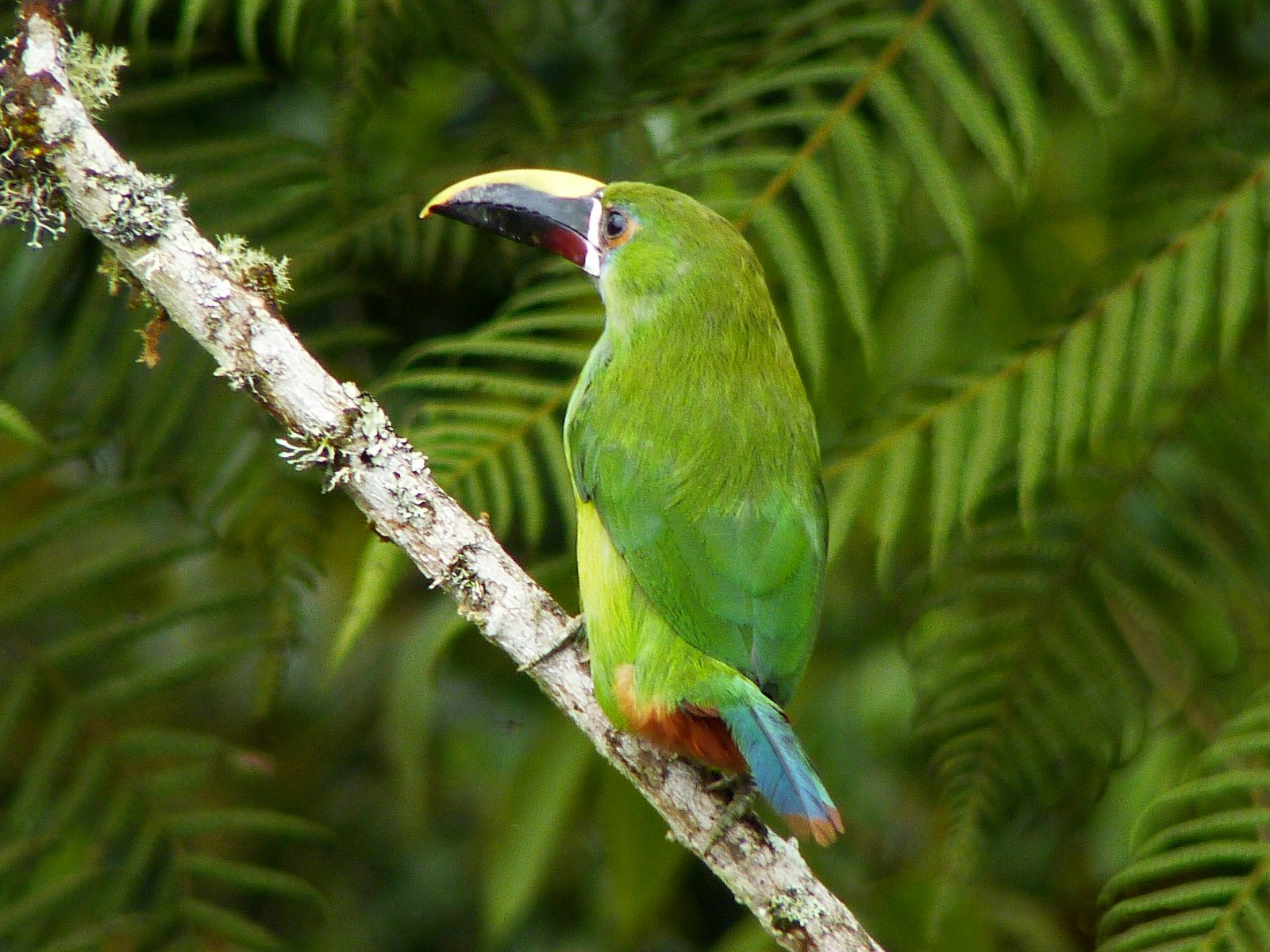
The Southern Emerald Toucanet is the most widespread green toucanet of montane forest in the Andes, from the Sierra Nevada de Santa Marta to Bolivia. Several forms occur in the guide area that differ mainly in throat colour: white, grey, blue or black. It lives in pairs or small groups and often gives itself away by its dry, barking call rather than by its green plumage.
Voice
A long series of dry, barking or croaking notes, such as krrek krrek krrek, often given by pairs in duet. The call varies in speed and tone from region to region. The wings make a whirring sound in flight.
Recording: Jaime Suárez — CC BY-NC-SA 4.0 · xeno-canto
Identification
30–35 cm. Mainly grass-green, with chestnut undertail coverts and chestnut tips to the tail feathers. The bill is mainly black, in most forms with yellow on the upper mandible, and has a narrow white rim at the base. Bare dark skin surrounds the eye. Depending on the form the throat is white (eastern and central Andes of Colombia, eastern Ecuador), grey or pale blue (western Andes of Colombia, Santa Marta), blue (southern Ecuador and northern Peru) or black (Peru and Bolivia). The sexes are alike, but the female has a shorter bill; juveniles are duller.
Confusion species
Crimson-rumped Toucanet Aulacorhynchus haematopygus in Colombia and western Ecuador has a red rump, a dark red bill with a white band at the base and no chestnut undertail coverts. Chestnut-tipped Toucanet Aulacorhynchus derbianus on the eastern slope has a black-and-red bill without yellow and green undertail coverts, and usually lives lower. Blue-banded Toucanet Aulacorhynchus coeruleicinctis in Peru and Bolivia has a blue breast band, a red rump and a greyish bill. Groove-billed Toucanet Aulacorhynchus sulcatus in northern Colombia has a mainly yellow bill and yellowish undertail coverts.
Habitat
Humid montane forest, cloud forest, forest edges, secondary forest and semi-open country with scattered trees and coffee plantations, at roughly 1500 to 3000 m; the forms in Peru and Bolivia also lower, in the foothills and adjacent lowlands. It forages in the middle and upper canopy, eating fruit, insects, small lizards and eggs and nestlings of other birds. It nests in a tree cavity, often an old woodpecker hole.
Where the bird is most at home, classified by the vegetation units of the Andes and the west coast.


Range and movements
In Colombia in the three Andean ranges, the Serranía de Perijá and the Sierra Nevada de Santa Marta. In Ecuador mainly on the eastern slope, locally also in the north of the western slope. In Peru on the eastern slope along the whole length of the country. In Bolivia on the eastern slope south to Santa Cruz. Absent from the Galápagos. Outside the guide area in western Venezuela.
- Resident
- dark = core range, pale = thinly spread
How and when to look
Forest edges and fruiting trees along roads through cloud forest, and fruit feeders in Colombia and Ecuador. Birds often sit in the middle and upper canopy and fly from tree to tree with fast wingbeats; the barking call is usually the first sign.
Conservation status
Not Evaluated in this species limit. The species is widespread and tolerates secondary forest and semi-open country, but disappears where forest is cleared completely.
Scientific name
Aulacorhynchus albivitta | (Boissonneau, 1840)
Boissonneau described the species in 1840 as Pteroglossus albivitta; because it was later moved to another genus, the author and year stand in brackets. The genus Aulacorhynchus was introduced in 1835 by Gould. The genus name comes from Greek aulax, 'furrow', and rhunkhos, 'bill'. The species name comes from Latin albus, 'white', and vitta, 'band, ribbon', for the white throat. The specimen the first description was based on came from Bogotá, Colombia.