All species › Woodpeckers and allies › Toucans › Northern Emerald Toucanet
Northern Emerald Toucanet | Aulacorhynchus prasinus
Smaragdarassari | Tucaneta verde | Tucaninho-verde-do-norte
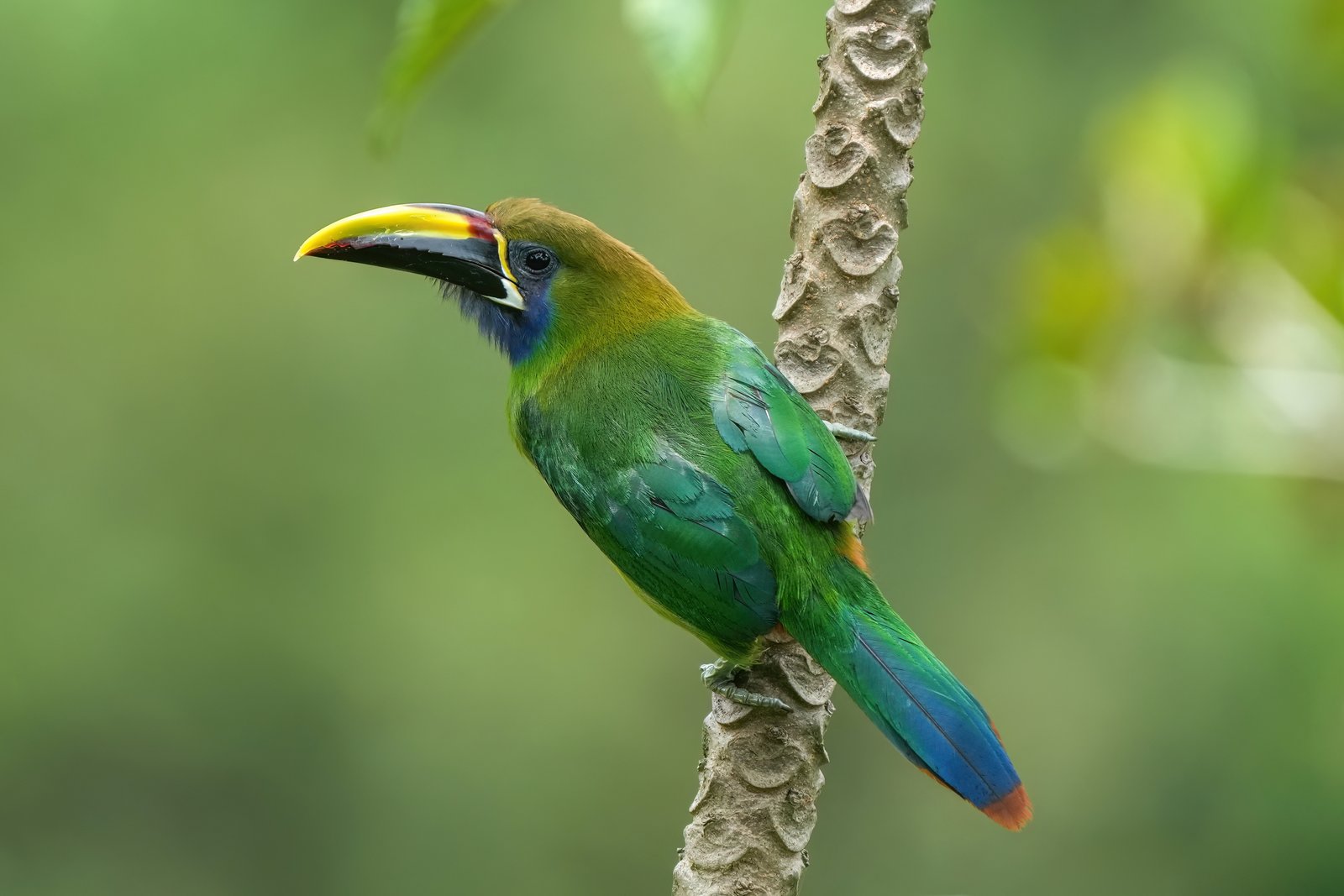
The Northern Emerald Toucanet is a small, green toucan of the montane forests of Mexico and Central America. In the guide area it occurs only marginally, in the Darién mountains on the border of Colombia and Panama (form cognatus). In the Andes it is replaced by Southern Emerald Toucanet, with which it was formerly treated as one species.
Voice
A dry, croaking or barking call, repeated in long series, like kwek-kwek-kwek; also rattling notes.
Recording: Orlando Jarquín G. — CC BY-NC-SA 4.0 · xeno-canto
Identification
30–35 cm, compact, with a fairly long, graduated tail. The plumage is largely bright green, with a bluish throat, chestnut undertail coverts and chestnut tail tips. The bill is black, with a yellow band along the ridge of the upper mandible and a narrow white line at the base. Bare, dark skin surrounds the eye. The sexes are alike; the female has a shorter bill.
Confusion species
Southern Emerald Toucanet Aulacorhynchus albivitta, in the Andes of Colombia and further south, has a white to greyish throat instead of a bluish one; as far as known the two species do not overlap in the guide area. Yellow-eared Toucanet Selenidera spectabilis in the Darién is black and yellow, with a yellow ear patch, and not green. The aracaris of the genus Pteroglossus are far more boldly patterned, with black, yellow and red.
Habitat
Humid montane forest, cloud forest, forest edges and old secondary forest, in the guide area in the Darién mountains, roughly between 800 and 1800 m; elsewhere in Central America also lower. It lives in pairs or small groups. It eats mainly fruit, also insects, eggs and nestlings. It nests in tree cavities, often old woodpecker holes.
Where the bird is most at home, classified by the vegetation units of the Andes and the west coast.


Range and movements
In Colombia only in the far north-west, in the Darién mountains (Serranía del Darién, Cerro Tacarcuna) on the border with Panama. Absent from Ecuador, Peru, Bolivia and the Galápagos. Outside the guide area in the montane forests of Mexico south through Central America to eastern Panama.
- Resident
- dark = core range, pale = thinly spread
How and when to look
In the guide area to be expected only in the remote Darién mountains. Green toucanets elsewhere in Colombia, Ecuador, Peru and Bolivia are Southern Emerald Toucanets or other Aulacorhynchus species.
Conservation status
Not Evaluated in this species limit. The species is widespread in Central America and tolerates forest edges and secondary forest, but suffers locally from deforestation.
Scientific name
Aulacorhynchus prasinus | (Gould, 1833)
Gould described the species in 1833 as Pteroglossus prasinus; because it was later moved to another genus, the author and year stand in brackets. The genus Aulacorhynchus was introduced in 1835 by Gould. The genus name comes from Greek aulax, 'furrow', and rhunkhos, 'bill'. The species name comes from Greek prasinos, 'leek-green', for the green plumage. The specimen the first description was based on came from Valle Real, Mexico.