All species › Passerines › Tityras, becards and allies › Cinnamon Becard
Cinnamon Becard | Pachyramphus cinnamomeus
Kaneelbekarde | Cabezón canelo | Caneleiro-canela
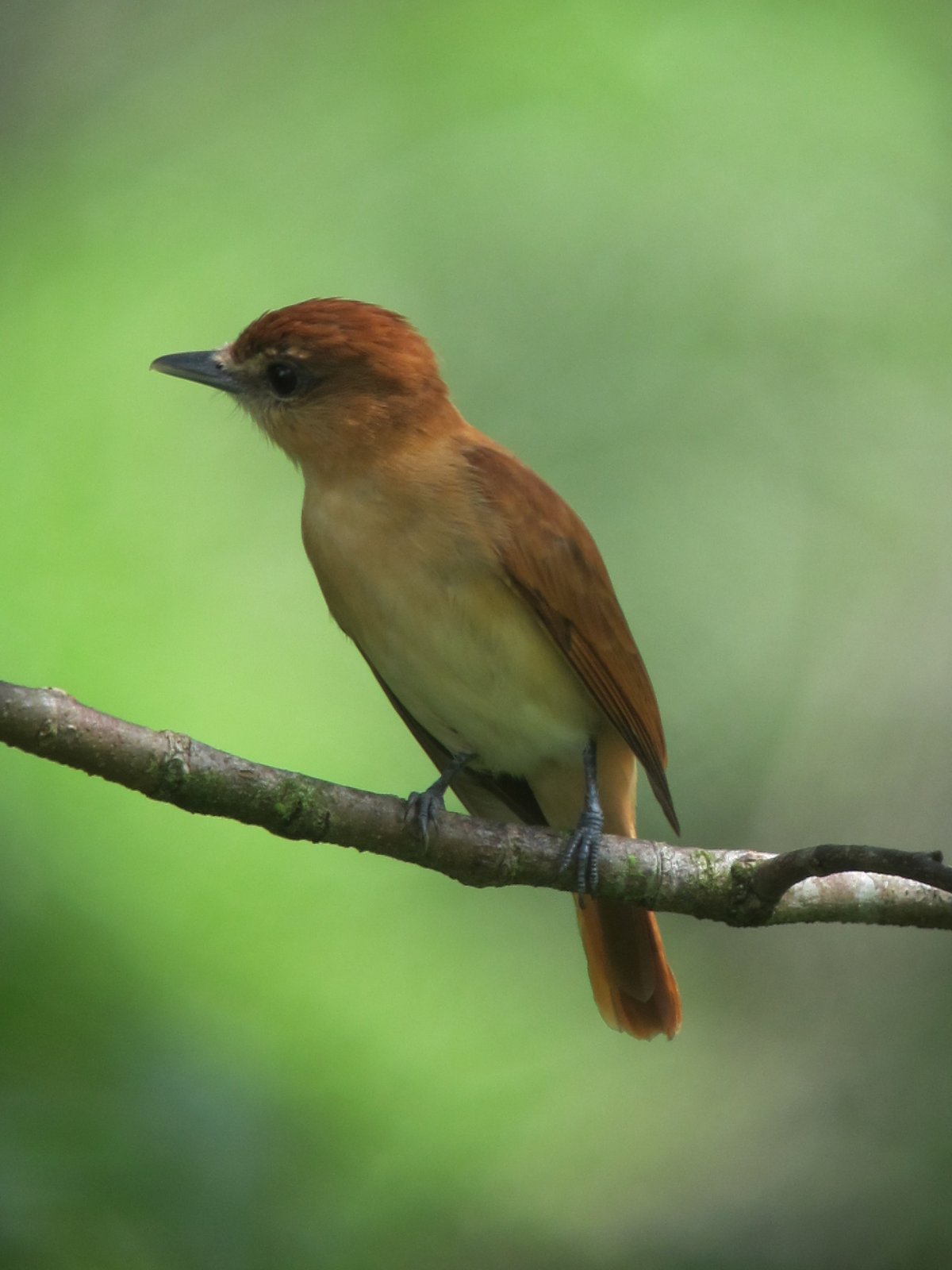
The Cinnamon Becard is a uniformly cinnamon becard of forest edges and open woodland in the humid lowlands west of the Andes and in northern Colombia. Male and female are almost identical. It is one of the most frequently heard becards in western Colombia and Ecuador.
Voice
The song is a clear, fast, slightly descending series of high whistles, like a short trill. Also a few separate, soft calls.
Recording: rudy gelis — CC BY-NC-SA 4.0 · xeno-canto
Identification
14 cm, with a large head and a short, thick bill. The upperparts are rufous to cinnamon, the crown slightly darker brown. A pale greyish to whitish stripe runs above the dark lores. The underparts are paler cinnamon to ochre, the throat paler still. The wings have dark flight feathers with cinnamon edges. The sexes are alike. Young birds are somewhat duller.
Confusion species
Chestnut-crowned Becard Pachyramphus castaneus lives east of the Andes and has a grey band behind the crown. The female One-colored Becard Pachyramphus homochrous is larger, without a pale stripe above the lores. The female Slaty Becard Pachyramphus spodiurus also lacks that pale stripe and lives in drier forest in south-western Ecuador. Rufous Mourner Rhytipterna holerythra and Rufous Piha Lipaugus unirufus are larger, with different posture and voice.
Habitat
Edges of humid forest, open and secondary forest, wooded gardens, coffee plantations and riversides, from the lowlands to about 1500 m. It takes insects and fruit in the middle storey and canopy, sometimes in mixed flocks. The nest is a large, globular structure with a side entrance, on a branch high above the ground.
Where the bird is most at home, classified by the vegetation units of the Andes and the west coast.


Range and movements
In Colombia in the Pacific lowlands, the Caribbean lowlands, the Magdalena valley and the lower slopes in the north. In Ecuador in the western lowlands and the Andean foothills, south to El Oro and Loja. Absent from Peru, Bolivia and the Galápagos. Outside the guide area from southern Mexico to Panama and in north-western Venezuela.
- Resident
- dark = core range, pale = thinly spread
How and when to look
Along forest edges and forest tracks in western Ecuador, for example in the lower parts of the Mindo area, and in the northern lowlands of Colombia, listen for the high, fast song from the canopy.
Conservation status
Least Concern. The species tolerates secondary forest and forest edges.
Scientific name
Pachyramphus cinnamomeus | Lawrence, 1861
Lawrence described the species in 1861 and placed it straight away in the genus where it still stands. The genus Pachyramphus was introduced in 1840 by Gray. The genus name comes from Greek pakhus, 'stout, thick', and rhamphos, 'bill'. The species name is Latin cinnamomeus, 'cinnamon-coloured'. The specimen the first description was based on came from Lion Hill, Panama.