All species › Passerines › Tityras, becards and allies › Chestnut-crowned Becard
Chestnut-crowned Becard | Pachyramphus castaneus
Kastanjebekarde | Anambé castaño | Caneleiro
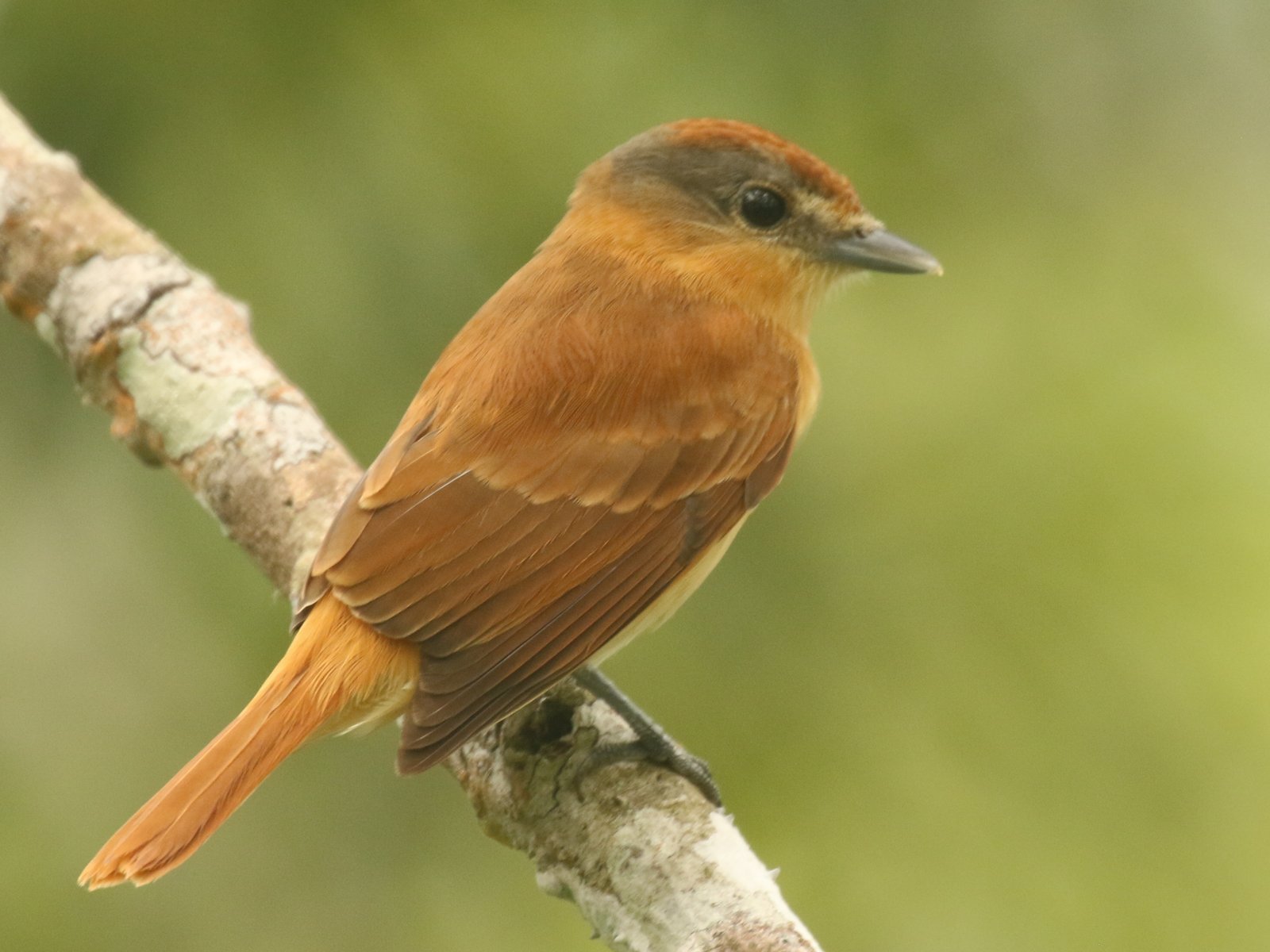
The Chestnut-crowned Becard is a rufous becard of forest edges and riversides in the lowlands east of the Andes. Male and female are alike. The grey band bordering the chestnut crown at the rear distinguishes it from the other brown becards.
Voice
The song is a series of soft, plaintive whistles, often slightly descending, like 'teeu, tee-tee-tee'. Also short, soft calls.
Recording: Faustino Hollmann — CC BY-NC-SA 4.0 · xeno-canto
Identification
14–14.5 cm, with a large head and a short, thick bill. The upperparts are bright rufous, the crown dark chestnut, bordered at the rear by a grey band that runs from behind the eye round the nape. The lores are pale buff. The underparts are paler cinnamon to ochre, with a paler throat. The sexes are alike.
Confusion species
Cinnamon Becard Pachyramphus cinnamomeus lives west of the Andes and lacks the grey nape band. The female Cinereous Becard Pachyramphus rufus has a whitish throat and paler underparts, without a grey band. The female Black-capped Becard Pachyramphus marginatus has a rufous crown, but olive upperparts and yellow underparts. Rufous Casiornis Casiornis rufus has a slimmer bill and a different posture.
Habitat
Edges of humid forest, várzea, riverine forest, river islands, secondary forest and open woodland with scattered trees in the lowlands and Andean foothills, up to about 1200 m. It takes insects and some fruit in the middle storey and canopy, often in mixed flocks. The nest is a large, globular structure with a side entrance, high in a tree.
Where the bird is most at home, classified by the vegetation units of the Andes and the west coast.


Range and movements
In Colombia in the lowlands and foothills east of the Andes. In Ecuador in the eastern lowlands and foothills. In Peru in the Amazonian lowlands and the foothills of the east slope. In Bolivia in the north and in the Andean foothills. Absent from the Galápagos. Outside the guide area in Venezuela, Amazonian Brazil and further south to south-eastern Brazil, Paraguay and north-eastern Argentina.
- Resident
- dark = core range, pale = thinly spread
How and when to look
Search forest edges, clearings at lodges and riverbanks in the Amazonian lowlands. The soft, plaintive song often gives the bird away before its plumage does.
Conservation status
Least Concern. The species tolerates forest edges and secondary forest.
Scientific name
Pachyramphus castaneus | (Jardine & Selby, 1827)
Jardine & Selby described the species in 1827 as Tityra castanea; because it was later moved to another genus, the author and year stand in brackets. The genus Pachyramphus was introduced in 1840 by Gray. The genus name comes from Greek pakhus, 'stout, thick', and rhamphos, 'bill'. The species name is Latin castaneus, 'chestnut-coloured'. The specimen the first description was based on came from Rio de Janeiro, Brazil.