All species › Passerines › Tityras, becards and allies › White-winged Becard
White-winged Becard | Pachyramphus polychopterus
Witvleugelbekarde | Cabezón aliblanco | Caneleiro-preto
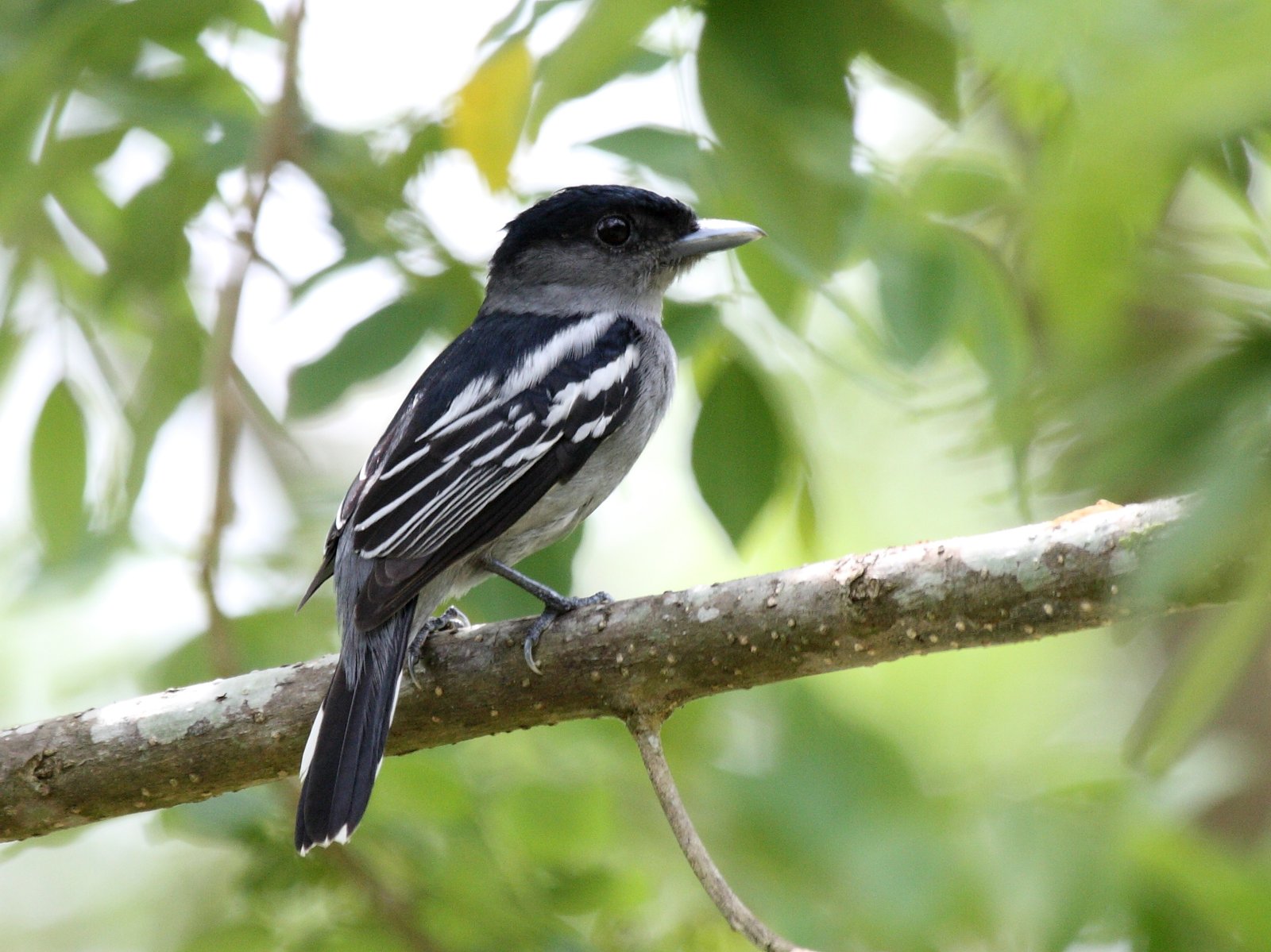
The White-winged Becard is the most widespread becard of the guide area, occurring from the lowlands on both sides of the Andes into the lower mountains. The male is black and grey with much white in the wing, the female olive-grey and yellow with buffy wing markings. Its song is one of the most familiar sounds of forest edges in the tropical lowlands.
Voice
The song is a soft, melodious series of whistles, often with one or two separate introductory notes followed by a quick, slightly descending or level series, like 'tu, tu-tu-tu-tu'. Also short, soft calls.
Recording: Nick Talbot — CC BY-NC-SA 4.0 · xeno-canto
Identification
14.5–15 cm, with a large head and a short, thick bill. The male has a black crown and back, dark grey to blackish underparts depending on the subspecies, and black wings with white scapulars, two white wing bars and broad white edges to the tertials; the black tail has white tips. The female is olive-grey above, with a browner crown, a broken pale eye-ring and pale lores, and pale yellow below; the wings are dark with buff to ochre bars and edges. Young males at first resemble the female.
Confusion species
The male Black-and-white Becard Pachyramphus albogriseus has a grey back, a white supercilium and pale grey underparts; the female has a chestnut crown bordered black. The male Black-capped Becard Pachyramphus marginatus has a grey back with black spots and pale grey underparts; the female has a rufous crown. The female Green-backed Becard Pachyramphus viridis has a green back and a yellow collar. White-naped Xenopsaris Xenopsaris albinucha is smaller and slimmer, with a white nape.
Habitat
Forest edges, open and secondary forest, várzea, river islands, gallery forest, plantations and wooded gardens, from the lowlands to about 1500 m, locally higher. It takes insects and fruit in the middle storey and canopy, often in mixed flocks. The nest is a large, globular structure with a side entrance, on a branch high above the ground.
Where the bird is most at home, classified by the vegetation units of the Andes and the west coast.


Range and movements
In Colombia widespread in the lowlands and lower slopes, both west and east of the Andes. In Ecuador in the western and eastern lowlands and foothills. In Peru mainly in the Amazonian lowlands and the foothills of the east slope, locally also in the north-west. In Bolivia in the lowlands and Andean foothills. Absent from the Galápagos. Outside the guide area from Guatemala to northern Argentina and Uruguay.
- Resident
- dark = core range, pale = thinly spread
How and when to look
At forest edges, lodges and along rivers listen for the soft, melodious song; the bird often perches in the open on a bare branch in the canopy or travels with mixed flocks.
Conservation status
Least Concern. The species is common and tolerates secondary forest and semi-open landscapes.
Scientific name
Pachyramphus polychopterus | (Vieillot, 1818)
Vieillot described the species in 1818 as Platyrhynchos polychopterus; because it was later moved to another genus, the author and year stand in brackets. The genus Pachyramphus was introduced in 1840 by Gray. The genus name comes from Greek pakhus, 'stout, thick', and rhamphos, 'bill'. The species name comes from Greek polukhroos, 'variegated', and -pteros, '-winged'; Vieillot spelled it polychopterus. The specimen the first description was based on came from Bahia, Brazil.