All species › Passerines › Tityras, becards and allies › Black-and-white Becard
Black-and-white Becard | Pachyramphus albogriseus
Eksterbekarde | Cabezón blanquinegro | Caneleiro-preto-e-branco
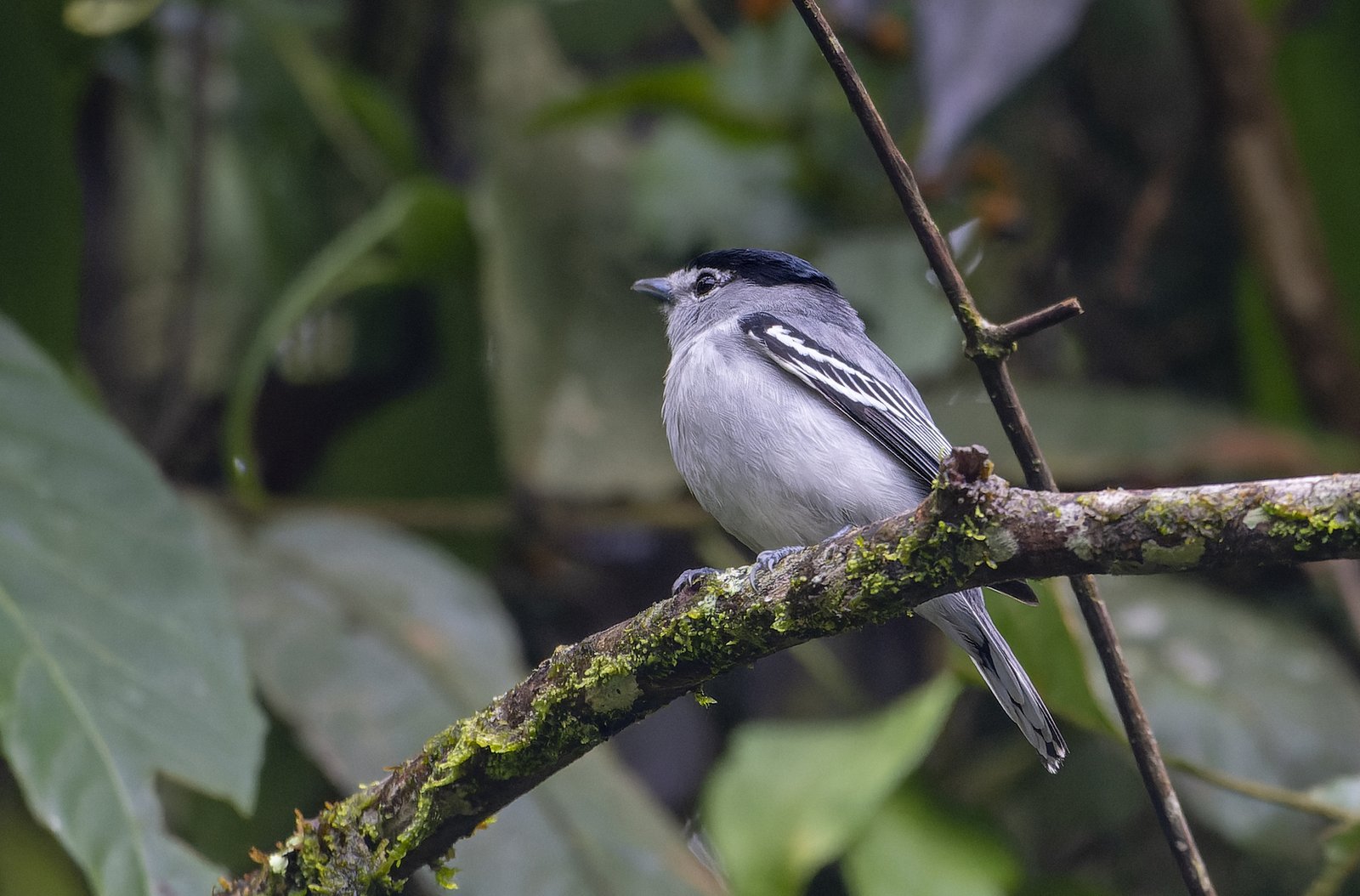
The Black-and-white Becard is a grey, black and white becard of humid montane forest. Since the split of Cryptic Becard the species comprises the birds of the Colombian mountains and the east slope of the Andes. The two species are very similar and are best told apart by song.
Voice
The song is an unhurried series of a variable number of soft notes that always ends in a long, mainly rising note. Also a short, rapid trill of a few descending notes.
Recording: rudy gelis — CC BY-NC-SA 4.0 · xeno-canto
Identification
14–15 cm, with a large head and a short, thick bill. The male has a glossy blue-black crown, black lores with a white stripe above them, a grey back and whitish to pale grey underparts, often slightly greyer on the breast. The wings are black with white edges and a broad white upper wing bar. The female has a chestnut crown bordered black, a black eye-stripe, an olive back, blackish wings with cinnamon edges and pale yellow to greenish-yellow underparts with a white throat.
Confusion species
Cryptic Becard Pachyramphus salvini is almost identical, with a finer bill, grey rather than black lores and a narrower upper wing bar; song is the best feature. The male White-winged Becard Pachyramphus polychopterus has a black back and lacks the white supercilium. The male Cinereous Becard Pachyramphus rufus lives lower and has a white forehead edge without distinct wing bars. The female Green-backed Becard Pachyramphus viridis has a grey head and a yellow collar.
Habitat
Humid foothill and montane forest, cloud forest and their edges with a dense understorey, mostly between 900 and 2200 m. It takes insects and fruit from the upper understorey to the canopy, often in mixed flocks. The nest is a large, globular structure with a side entrance, on a branch high above the ground.
Where the bird is most at home, classified by the vegetation units of the Andes and the west coast.


Range and movements
In Colombia in the Sierra Nevada de Santa Marta, the Serranía del Perijá, the Eastern Andes and on the east slope of the Andes in the south. In Ecuador on the east slope of the Andes. In Peru on the east slope, mainly in the north; which of the two species occurs where in Peru is not yet fully known. Absent from Bolivia and the Galápagos. Outside the guide area in Costa Rica, Panama and Venezuela.
- Resident
- dark = core range, pale = thinly spread
How and when to look
Search mixed flocks in cloud forest along mountain roads on the east slope in Ecuador and in the Santa Marta mountains in Colombia. Listen for the unhurried song with its long final note to separate it from Cryptic Becard.
Conservation status
Not Evaluated in its current, narrower sense. The former, broader species was rated Least Concern. The species depends on montane forest and suffers locally from deforestation.
Scientific name
Pachyramphus albogriseus | Sclater, 1857
Sclater described the species in 1857 and placed it straight away in the genus where it still stands. The genus Pachyramphus was introduced in 1840 by Gray. The genus name comes from Greek pakhus, 'stout, thick', and rhamphos, 'bill'. The species name comes from Latin albus, 'white', and griseus, 'grey'. The specimen the first description was based on came from 'Bogotá', Colombia.