All species › Passerines › Tityras, becards and allies › Cryptic Becard
Cryptic Becard | Pachyramphus salvini
Cryptische bekarde | Anambé críptico | Caneleiro-críptico
The Cryptic Becard was split from Black-and-white Becard as a separate species in 2023, which it matches almost completely in plumage; hence the name. It is best identified by its song. The species lives on the west slope of the Andes from Colombia to Peru and in northern Peru also on the east slope, from dry forest to humid montane forest.
Voice
The song is a rapid, fixed phrase of usually three notes, the last one short. Also a rapid, stuttering trill.
No recording with a suitable Creative Commons licence is available for this species yet.
Identification
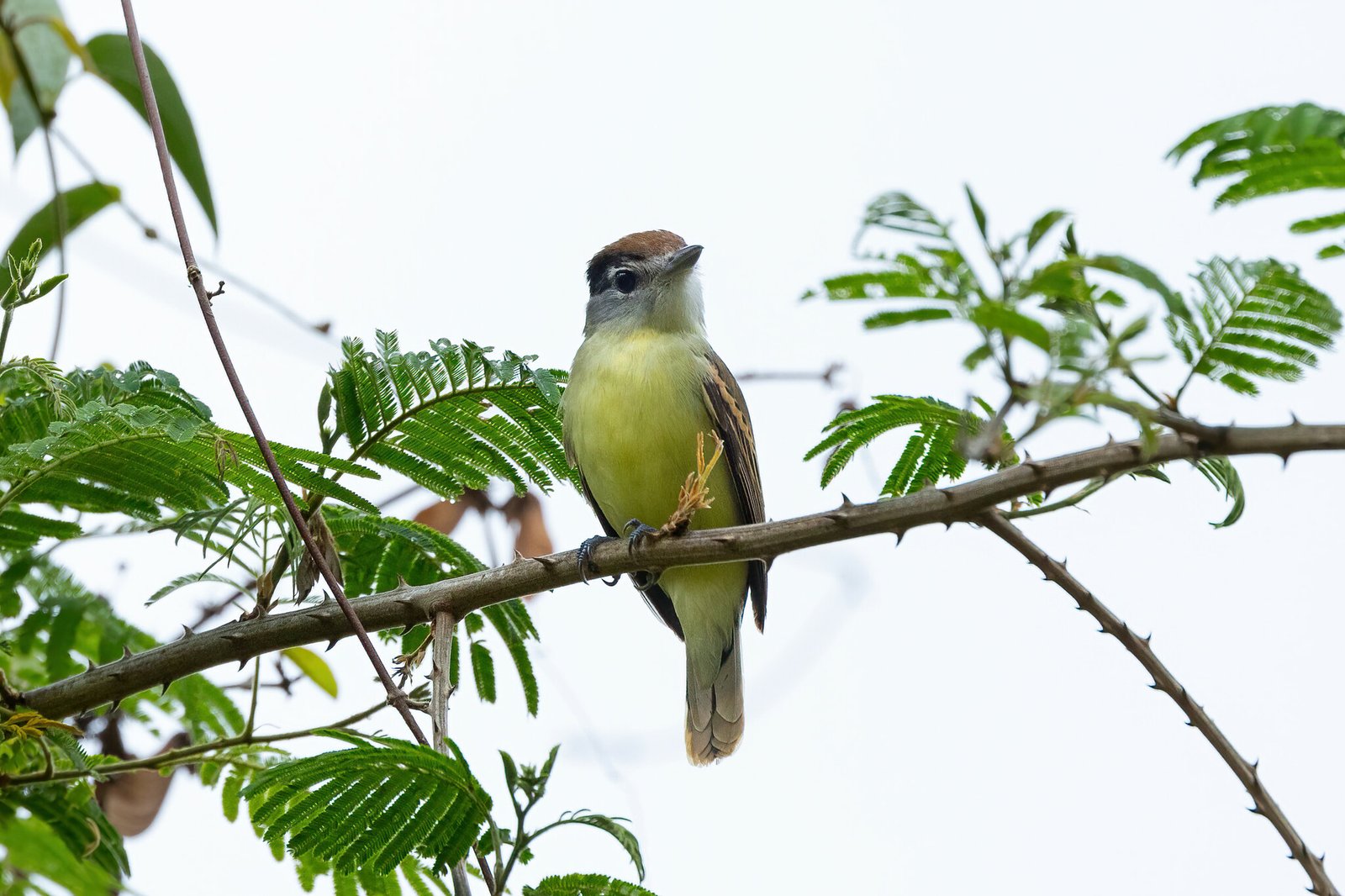
14 cm, with a large head and a short bill that is proportionately finer than in other becards. The male has a glossy blue-black crown, grey lores with a pale stripe above them, a grey back and whitish to pale grey underparts. The wings are black with white edges, a narrow white upper wing bar and pale edges to the alula. The female has a chestnut crown bordered black, an olive back, blackish wings with cinnamon edges and pale yellow to greenish-yellow underparts.
Confusion species
Black-and-white Becard Pachyramphus albogriseus is almost identical, with a heavier bill, black lores, a broader upper wing bar and often a greyer breast band; song is the best feature. The male Slaty Becard Pachyramphus spodiurus is dark slate-grey, without a white supercilium and with little white in the wing. The male White-winged Becard Pachyramphus polychopterus has a black back.
Habitat
Dry thorn forest, semi-humid deciduous forest, humid foothill and montane forest, secondary forest and wooded farmland such as coffee plantations and pastures with trees, from sea level to over 2000 m. It takes insects and fruit in the middle storey and canopy, often in mixed flocks. The nest is presumably, as in related species, a large, globular structure with a side entrance.
Where the bird is most at home, classified by the vegetation units of the Andes and the west coast.


Range and movements
In Colombia on the west slope in the south, mainly in Nariño. In Ecuador on the west slope and in the western lowlands, and in small numbers on the east slope in the centre and south. In Peru in the north-west on both slopes of the Andes and in the Marañón region, south to La Libertad and San Martín and possibly further on the east slope. Absent from Bolivia and the Galápagos. Does not occur outside the guide area.
- Resident
- dark = core range, pale = thinly spread
How and when to look
Search mixed flocks in western Ecuador, for example around Mindo, and in the forests of Loja and El Oro. Listen for the short, rapid three-note phrase, especially in the early morning.
Conservation status
Not Evaluated. The species has not yet been assessed separately; the former Black-and-white Becard, to which it belonged, was rated Least Concern. It is fairly scarce and occurs in a few protected areas in Ecuador and Peru.
Scientific name
Pachyramphus salvini | Richmond, 1899
Richmond described the species in 1899 and placed it straight away in the genus where it still stands. The genus Pachyramphus was introduced in 1840 by Gray. The genus name comes from Greek pakhus, 'stout, thick', and rhamphos, 'bill'. The species name honours the English ornithologist Osbert Salvin (1835–1898); Richmond gave this replacement name in 1899 because Salvin's older name similis was preoccupied. The specimen the first description was based on came from Chusgón, Peru.