All species › Passerines › Tyrant flycatchers and allies › Cinnamon-faced Tyrannulet
Cinnamon-faced Tyrannulet | Phylloscartes parkeri
Parkers looftiran | Orejerito de Parker | Borboletinha-de-cara-canela
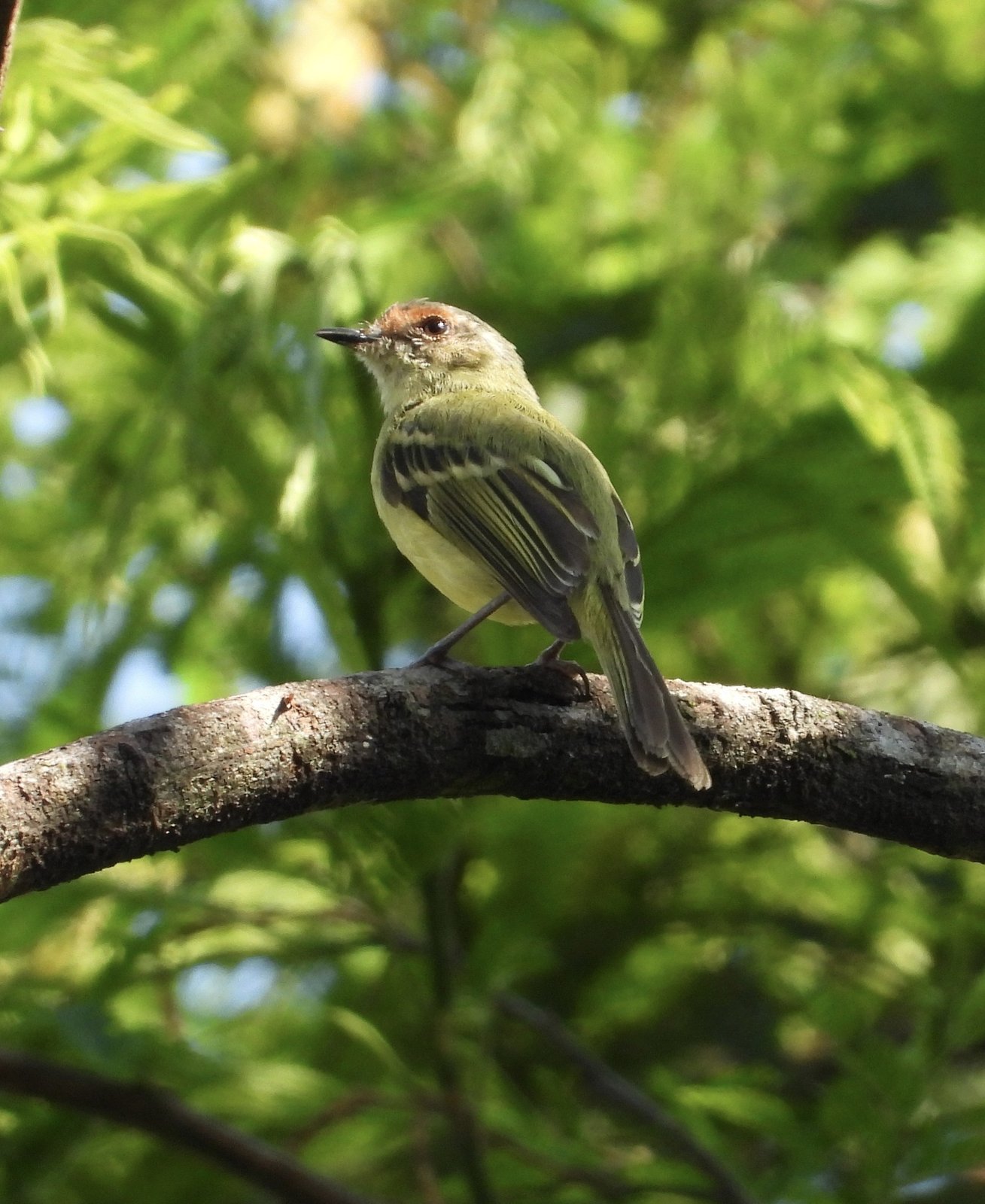
The Cinnamon-faced Tyrannulet is a small tyrant of the foothills on the east slope of the Andes in southern Peru and Bolivia; its scientific name honours the American ornithologist Theodore A. Parker III. The cinnamon face separates it from related species. It forages with mixed flocks in the middle storey and canopy.
Voice
A rapid, dry trill and short, high tsit calls.
Recording: GABRIEL LEITE — CC BY-NC-SA 4.0 · xeno-canto
Identification
11 cm, with a narrow black bill. Crown and upperparts olive-green. Lores, eye-ring and a short supercilium cinnamon to buff, the cheek also washed cinnamon with a dark crescent at the rear of the ear-coverts. Wings dark with two yellow wing-bars. Throat pale yellow, breast yellow with an olive wash, belly yellow. Sexes alike; juveniles duller.
Confusion species
Mottle-cheeked Tyrannulet Phylloscartes ventralis lives higher and has a grey and yellowish-white mottled cheek without a cinnamon wash. Spectacled Bristle Tyrant Pogonotriccus orbitalis has a white eye-ring, perches upright and lifts one wing. Yellow Tyrannulet Capsiempis flaveola has a yellow supercilium and entirely yellow underparts, and lives mainly in bamboo and forest edges in the lowlands.
Habitat
The middle storey and canopy of humid foothill and lower montane forest, also forest edges and bamboo, roughly between 600 and 1500 m. It hops actively along twigs and picks small insects from leaves, usually in mixed flocks.
Where the bird is most at home, classified by the vegetation units of the Andes and the west coast.


Range and movements
Colombia and Ecuador: absent. Peru: on the east slope of the Andes in the centre and south-east of the country, among other places in Cusco and Puno. Bolivia: in the north, in the foothills of La Paz. Absent from the Galápagos. Does not occur outside the guide area.
- Resident
- dark = core range, pale = thinly spread
How and when to look
Search foothill forest in Cusco or La Paz at 800–1300 m, for example along the road to Manu, and follow the mixed flocks; watch for an olive-green tyrannulet with a cinnamon face.
Conservation status
Least Concern. The range is limited, but large parts of it lie in still little-disturbed foothill forest, partly in protected areas.
Scientific name
Phylloscartes parkeri | Fitzpatrick & Stotz, 1997
Fitzpatrick & Stotz described the species in 1997 and placed it straight away in the genus where it still stands. The genus Phylloscartes was introduced in 1860 by Cabanis & Heine. The genus name combines Greek phullon, 'leaf', with skairō, 'to skip, to dance'. The species name honours Theodore A. Parker III (1953–1993), American ornithologist and expert on South American bird sounds and conservation. The specimen the first description was based on came from Hacienda Amazonia, Madre de Dios, Peru.