All species › Passerines › Tyrant flycatchers and allies › Ecuadorian Tyrannulet
Ecuadorian Tyrannulet | Phylloscartes gualaquizae
Ecuadoraanse looftiran | Tiranolete ecuatoriano | Borboletinha-equatoriana
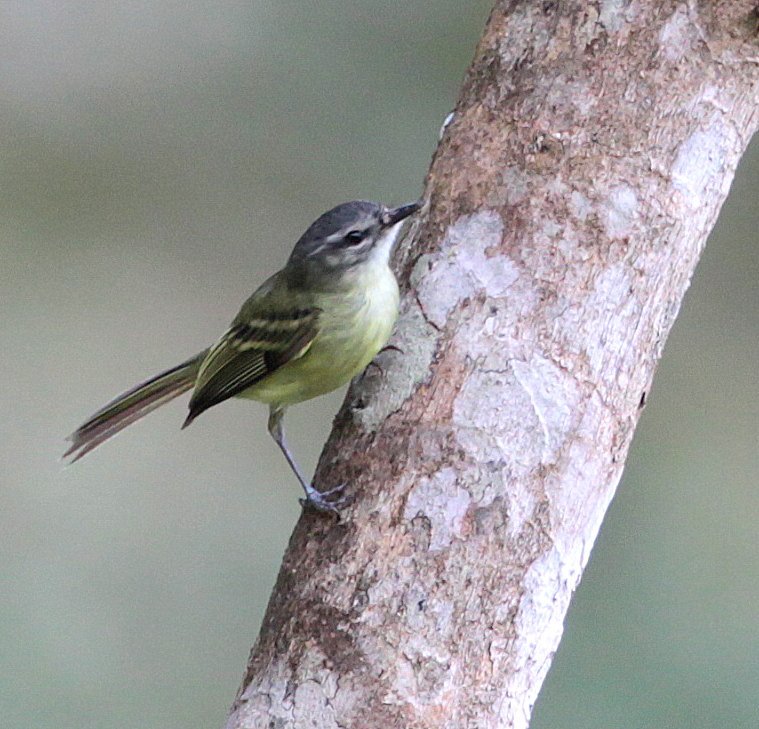
The Ecuadorian Tyrannulet is a small tyrant of the foothills on the east slope of the Andes, mainly in Ecuador; its scientific name refers to Gualaquiza in south-eastern Ecuador. It forages in the canopy with mixed flocks, often holding the tail cocked. The species has a small range.
Voice
A high, fast, slightly rising trill and short, thin tsit calls.
Recording: Juan Freile — CC BY-NC-SA 4.0 · xeno-canto
Identification
11 cm, with a narrow black bill. Crown and nape grey, back olive-green. Lores and a narrow eye-ring white; a dark crescent at the rear of the ear-coverts. Wings dark with two yellow wing-bars and yellow-edged flight feathers. Throat greyish-white, breast yellowish with an olive wash, belly pale yellow. Sexes alike; juveniles duller.
Confusion species
Spectacled Bristle Tyrant Pogonotriccus orbitalis has an olive crown, perches upright and lifts one wing. Rufous-browed Tyrannulet Phylloscartes superciliaris has a white belly, a rufous brow and no wing-bars. Slaty-capped Flycatcher Leptopogon superciliaris is larger, with a distinct black ear patch and buff wing-bars. Golden-faced Tyrannulet Zimmerius chrysops has a yellow face and a short, stubby bill.
Habitat
The canopy and middle storey of humid foothill forest, forest edges and tall secondary forest, roughly between 400 and 1400 m. It hops actively along twigs and leaves and picks small insects from the foliage, often in mixed flocks with tanagers and other tyrants.
Where the bird is most at home, classified by the vegetation units of the Andes and the west coast.


Range and movements
Colombia: in the far south, on the east slope of the Andes in Putumayo. Ecuador: on the east slope of the Andes, mainly in the centre and south, including the Cordillera del Cóndor. Peru: on the east slope in the north, south to San Martín. Bolivia: absent. Absent from the Galápagos. Does not occur outside the guide area.
- Resident
- dark = core range, pale = thinly spread
How and when to look
Search foothill forest on the east slope of Ecuador at 700–1200 m, for example in Zamora-Chinchipe or Morona-Santiago, and check mixed flocks in the canopy for a grey-headed tyrannulet with yellow wing-bars.
Conservation status
Least Concern. The range is small and lies in a zone where forest is being converted into pasture and farmland; locally the species is fairly common.
Scientific name
Phylloscartes gualaquizae | (Sclater, 1887)
Sclater described the species in 1887 as Pogonotriccus gualaquizae; because it was later moved to another genus, the author and year stand in brackets. The genus Phylloscartes was introduced in 1860 by Cabanis & Heine. The genus name combines Greek phullon, 'leaf', with skairō, 'to skip, to dance'. The species name refers to Gualaquiza in south-eastern Ecuador. The specimen the first description was based on came from Gualaquiza, Morona-Santiago, Ecuador.