All species › Passerines › Tyrant flycatchers and allies › Rufous-browed Tyrannulet
Rufous-browed Tyrannulet | Phylloscartes superciliaris
Roodbrauwlooftiran | Orejerito cejirrufo | Borboletinha-de-sobrancelha-ruiva
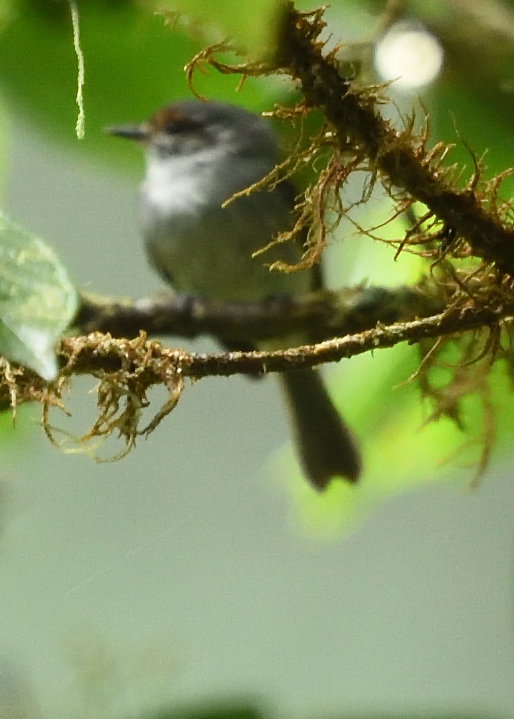
The Rufous-browed Tyrannulet is a small tyrant with a distinctive head pattern: a grey crown, a white cheek framed by a black crescent and a narrow rufous supercilium. It lives very locally in montane forest from Costa Rica to northern Peru, and in the guide area it occurs mainly in Colombia and south-eastern Ecuador. It forages actively in the canopy with mixed flocks.
Voice
Sharp, high tseet calls and a fast, chattering duet or short series tsi-tsi-tsi-tsrrr.
Recording: Lelis Navarrete — CC BY-NC-SA 4.0 · xeno-canto
Identification
11 cm, with a short, narrow black bill. Crown and nape slaty grey; a narrow rufous stripe above and in front of the eye. Cheek white with a black crescent along the rear of the ear-coverts. Back and wings olive-green, the wings without distinct wing-bars. Throat and belly white, breast greyish, flanks and undertail coverts pale yellowish. Sexes alike; juveniles duller, with less rufous in the brow.
Confusion species
Slaty-capped Flycatcher Leptopogon superciliaris has a similar head pattern, but is larger, has buff wing-bars, a yellow belly and perches upright in the understorey. Ecuadorian Tyrannulet Phylloscartes gualaquizae has yellow underparts, yellow wing-bars and no rufous brow. Golden-faced Tyrannulet Zimmerius chrysops has a yellow face and a short, stubby bill.
Habitat
The canopy and upper storey of humid, mossy montane forest, often on ridges with shorter forest, roughly between 1000 and 2000 m. It hops quickly along twigs and leaves, holds the tail slightly raised and picks insects from foliage. Almost always in mixed flocks.
Where the bird is most at home, classified by the vegetation units of the Andes and the west coast.


Range and movements
Colombia: locally in the montane forests of the Andes and the Serranía de Perijá. Ecuador: in the south-east, in the Cordillera del Cóndor and adjacent ridges. Peru: very scarce; only a few records from the Cordillera del Cóndor on the border with Ecuador. Bolivia: absent. Absent from the Galápagos. Outside the guide area in Costa Rica, Panama and western Venezuela.
- Resident
- dark = core range, pale = thinly spread
How and when to look
Search mossy montane forest at about 1300–1900 m in Colombia or on the ridges of the Cordillera del Cóndor in south-eastern Ecuador and check each mixed flock in the canopy for the black-and-white cheek pattern.
Conservation status
Least Concern. The range is fragmented and the species is local everywhere; deforestation and mining in the Cordillera del Cóndor affect part of the population in the guide area.
Scientific name
Phylloscartes superciliaris | (Sclater & Salvin, 1868)
Sclater & Salvin described the species in 1868 as Leptotriccus superciliaris; because it was later moved to another genus, the author and year stand in brackets. The genus Phylloscartes was introduced in 1860 by Cabanis & Heine. The genus name combines Greek phullon, 'leaf', with skairō, 'to skip, to dance'. Latin superciliaris means 'of the eyebrow', referring to the rufous brow. The specimen the first description was based on came from Chitra, Veraguas, Panama.