All species › Passerines › Tyrant flycatchers and allies › Mottle-cheeked Tyrannulet
Mottle-cheeked Tyrannulet | Phylloscartes ventralis
Vlekwanglooftiran | Orejerito oliváceo | Borboletinha-do-mato
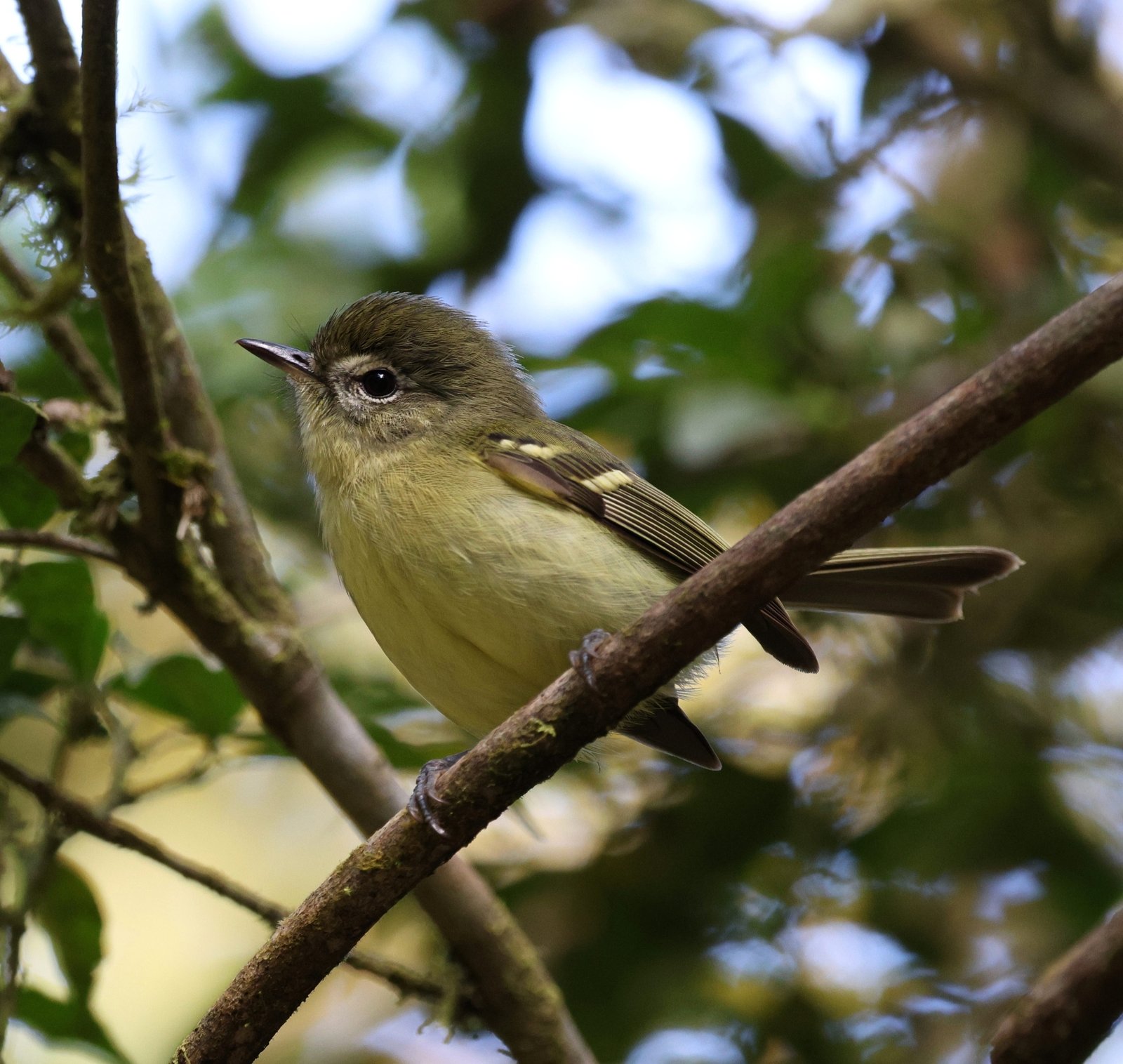
The Mottle-cheeked Tyrannulet is a small, active tyrant of the montane forests of the Yungas, which also occurs in south-eastern Brazil and north-eastern Argentina. It forages horizontally along branches, often with the tail slightly raised and the wings briefly flicking, and almost always joins mixed flocks. The mottled cheek gives it its name.
Voice
A rapid, dry, slightly descending trill and short, sharp tsip or tsit calls.
Recording: rudy gelis — CC BY-NC-SA 4.0 · xeno-canto
Identification
12 cm, with a narrow dark bill with a pale lower mandible. Upperparts olive-green, crown slightly greyer. A narrow pale supercilium and a grey and yellowish-white mottled cheek with a dark crescent at the rear of the ear-coverts. Two yellow wing-bars and yellow-edged flight feathers. Throat yellowish-white, breast yellow with an olive wash, belly brighter yellow. Sexes alike; juveniles duller.
Confusion species
Bolivian Tyrannulet Zimmerius bolivianus has a shorter bill, a pale eye and no mottled cheek. Sulphur-bellied Tyrannulet Mecocerculus minor has cream to buff wing-bars and a distinct white supercilium. Marble-faced Bristle Tyrant Pogonotriccus ophthalmicus perches upright, lifts one wing and has a more strongly marbled face. Cinnamon-faced Tyrannulet Phylloscartes parkeri lives lower and has a cinnamon face.
Habitat
The canopy and middle storey of humid montane forest and cloud forest, also forest edges and tall shrubs along streams, roughly between 1200 and 2600 m. It picks small insects from leaves, often after a short hop or flutter. It builds a globular nest of moss and plant fibres with a side entrance.
Where the bird is most at home, classified by the vegetation units of the Andes and the west coast.


Range and movements
Colombia and Ecuador: absent. Peru: on the east slope of the Andes in the central and southern part of the country, south to Puno. Bolivia: in the Yungas of La Paz, Cochabamba and Santa Cruz and further south in the montane forests along the east slope. Absent from the Galápagos. Outside the guide area in north-western Argentina, with a separate population in south-eastern Brazil, Paraguay, Uruguay and north-eastern Argentina.
- Resident
- dark = core range, pale = thinly spread
How and when to look
Follow mixed flocks in the Yungas at 1500–2500 m, for instance along roads through montane forest in La Paz or Cochabamba; watch for a small olive-green tyrant moving horizontally along the branches.
Conservation status
Least Concern. Widespread and locally common; it persists in forest edges and secondary forest as long as enough trees and shrubs remain.
Scientific name
Phylloscartes ventralis | (Temminck, 1824)
Temminck described the species in 1824 as Muscicapa ventralis; because it was later moved to another genus, the author and year stand in brackets. The genus Phylloscartes was introduced in 1860 by Cabanis & Heine. The genus name combines Greek phullon, 'leaf', with skairō, 'to skip, to dance'. Latin ventralis means 'of the belly', probably referring to the yellow underparts. The specimen the first description was based on came from Ipanema, São Paulo, Brazil.