All species › Passerines › Tyrant flycatchers and allies › Spectacled Tyrant
Spectacled Tyrant | Hymenops perspicillatus
Briltiran | Pico de plata | Viuvinha-de-óculos
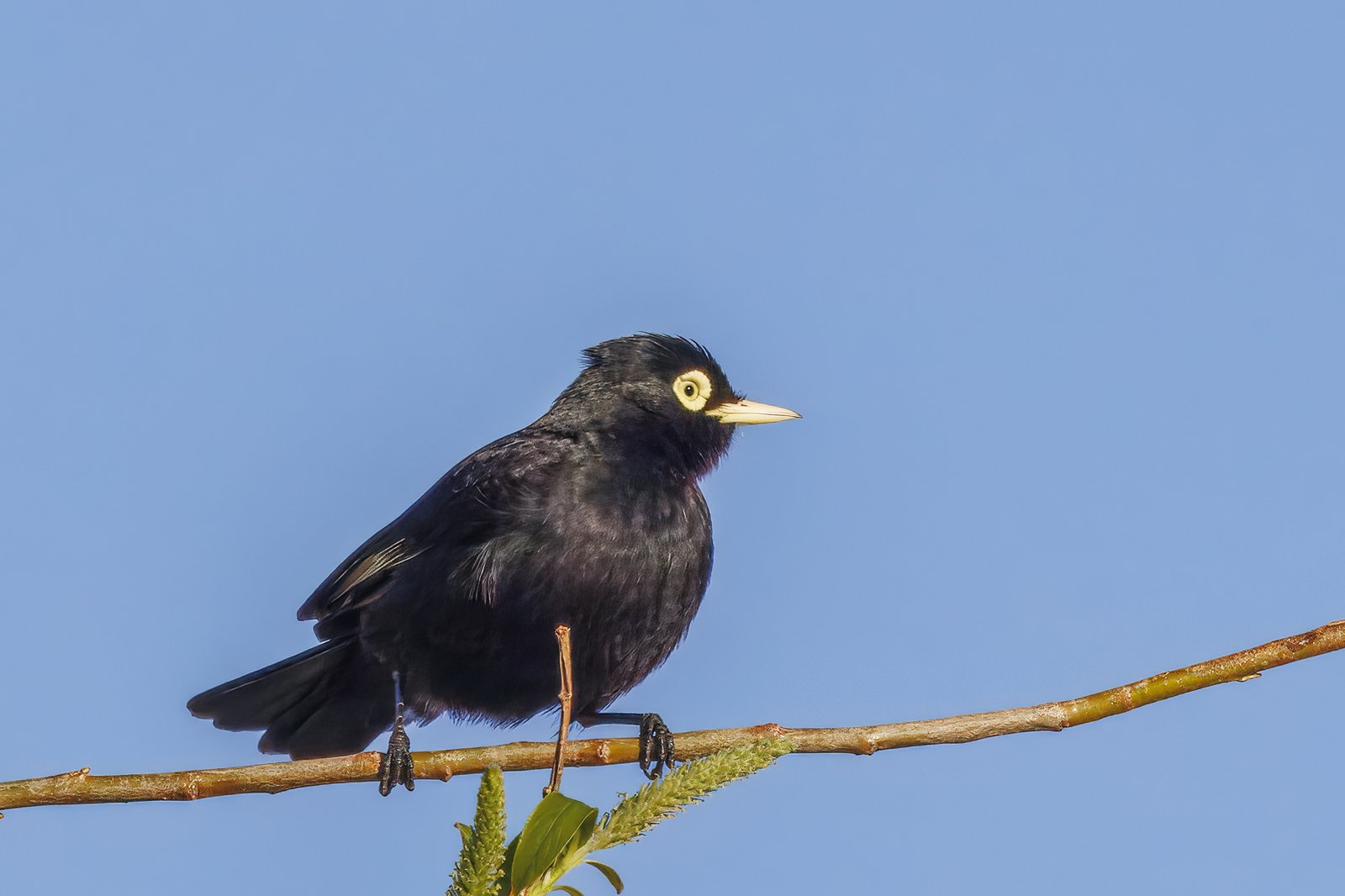
The Spectacled Tyrant is a tyrant of open, wet grasslands and marshes in the south of South America. The black male has a yellow bill, a broad, yellow, scalloped wattle around the eye and white primaries that form a large white wing patch in flight. In the guide area it is an austral winter visitor to the lowlands of Bolivia.
Voice
Not very vocal. In display flight the male gives a shrill, thin zheeee as it descends, while the wings buzz; otherwise a series of thin, squeaky notes.
Recording: Andrew Spencer — CC BY-NC-SA 3.0 · xeno-canto
Identification
14–16 cm. The male is entirely black, with white primaries that show as a narrow white line at rest and as a large white patch in flight. The bill is pale yellow, and the eye is white and surrounded by a broad, scalloped yellow wattle. The female is brown, with dark streaks on the breast and upperparts, a smaller yellow eye-ring and rufous primaries that are conspicuous in flight. Young birds resemble the female.
Confusion species
White-winged Black Tyrant Knipolegus aterrimus is smaller, the male lacks the yellow eye wattle and has a bluish-grey bill, and it lives in scrub and forest edges. The male Shiny Cowbird Molothrus bonariensis is glossy blue-black, without white in the wing. The female Austral Negrito Lessonia rufa is smaller and unstreaked, with a rufous back.
Habitat
Marshes, wet grasslands, pastures and the edges of pools and lakes, often close to water, in the guide area in the lowlands, mostly below 1000 m. It perches low on a reed stem, small shrub or fence post and sallies after insects in the air or on the ground. As far as is known it does not breed in the guide area; the nest is an open grass cup on the ground among tussocks.
Where the bird is most at home, classified by the vegetation units of the Andes and the west coast.


Range and movements
Bolivia: winter visitor in the austral winter in the lowlands of the east and south, in Beni, Santa Cruz and Tarija. Peru: vagrant only. Absent from Colombia, Ecuador and the Galápagos. Outside the guide area the species breeds in Argentina, Chile, Uruguay, southern Brazil and locally in Paraguay.
- Resident
- Summer visitor (c. Apr–Sep)
- dark = core range, pale = thinly spread
How and when to look
Between May and September, search wet grasslands and marsh edges in the lowlands of eastern Bolivia for black birds perching low on a stem; in flight the white wings are immediately obvious.
Conservation status
Least Concern. The species is widespread and common in its breeding range, but disappears locally where marshes are drained.
Scientific name
Hymenops perspicillatus | (Gmelin, 1789)
Gmelin described the species in 1789 as Motacilla perspicillata; because it was later moved to another genus, the author and year stand in brackets. The genus Hymenops was introduced in 1828 by Lesson. The genus name comes from Greek humēn, 'membrane, skin', and ōps, 'eye', for the yellow wattle around the eye. The species name is New Latin perspicillatus, 'spectacled', for the wattle around the eye. The specimen the first description was based on came from Montevideo, Uruguay.