All species › Passerines › Tyrant flycatchers and allies › Southern Antpipit
Southern Antpipit | Corythopis delalandi
Delalandes piepertiran | Mosquero terrestre sureño | Estalador
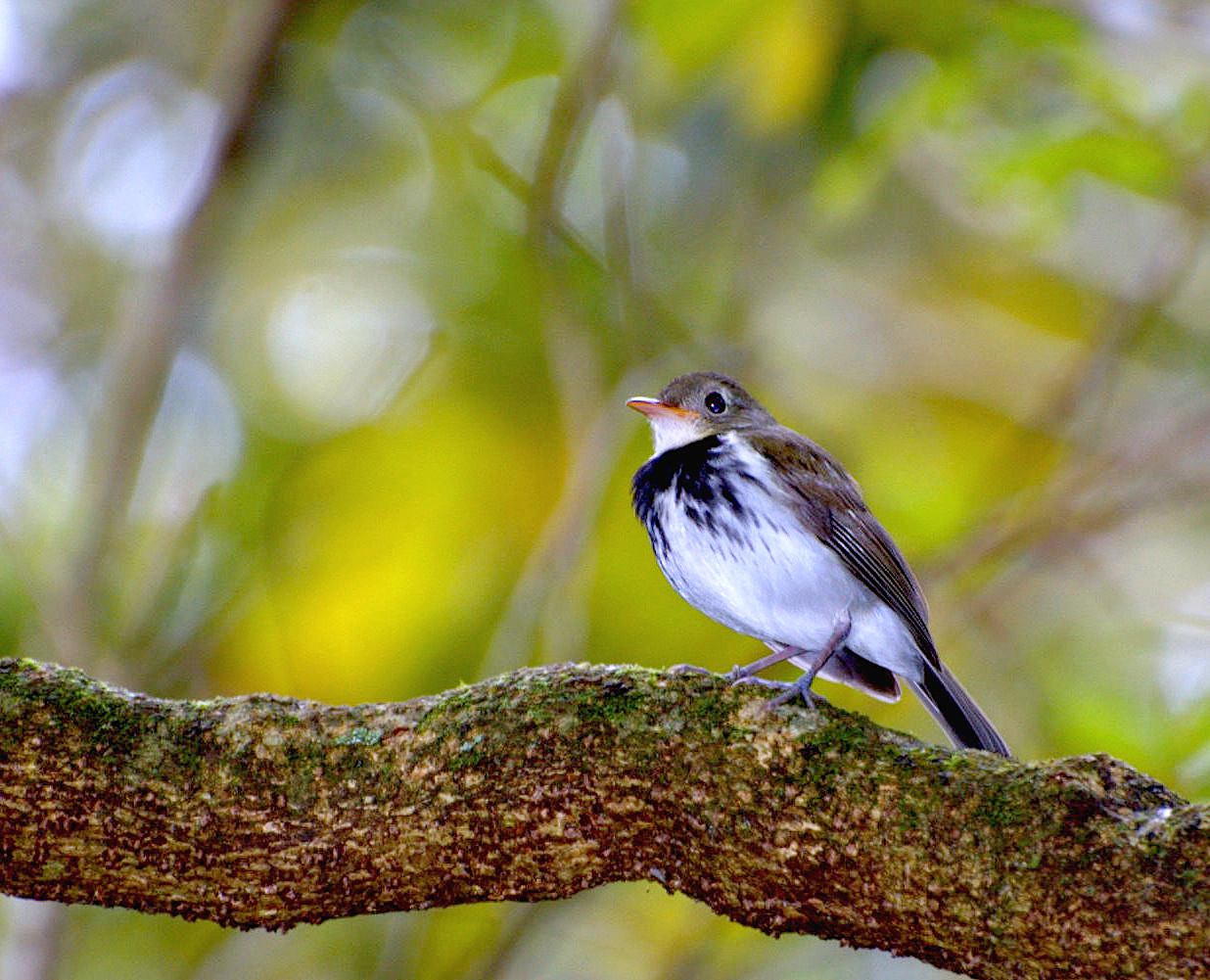
The Southern Antpipit is a tyrant flycatcher that walks over the forest floor like a pipit. It moves with short, quick steps over the leaf litter, wags its tail and audibly snaps its bill. In the guide area it is the southern species of the genus Corythopis, restricted to eastern Bolivia.
Voice
A clear, whistled phrase of two or three notes, the last one falling, repeated at intervals. Also dry bill snaps, mainly when disturbed.
Recording: Fabrício Grigolin — CC BY-NC-SA 4.0 · xeno-canto
Identification
13–14 cm, with a straight, rather fine bill with a pale lower mandible, and long, pale legs. The upperparts are plain olive-brown, the crown hardly darker than the back. The throat and belly are white; a band of black spots crosses the breast, turning into streaks towards the flanks. Wings and tail are brown, without wing bars. The sexes are alike; juveniles are duller, with a less sharply defined breast band.
Confusion species
Ringed Antpipit Corythopis torquatus is very similar and is best separated by range: it lives in the Amazonian lowlands of northern Bolivia and further north. It has a darker, more greyish-brown crown and a broader, blacker breast band. Pipits Anthus have a similarly streaked breast but live in open country and have a streaked back.
Habitat
The floor of semi-humid and dry forest, gallery forest and the edges of humid lowland forest, up to about 1000 m. It walks over the leaf litter and through low vegetation, picking insects and spiders from the ground and from the air just above it. The nest is a domed ball of moss and plant material on the ground or on a low, sloping trunk.
Where the bird is most at home, classified by the vegetation units of the Andes and the west coast.


Range and movements
Bolivia: in the eastern lowlands, mainly in Santa Cruz and adjacent Beni, in Chiquitano forest and the transition to Amazonian forest. Absent from Colombia, Ecuador, Peru and the Galápagos. Outside the guide area in central and southern Brazil, Paraguay and north-eastern Argentina.
- Resident
- dark = core range, pale = thinly spread
How and when to look
Walk slowly along forest trails in Chiquitano forest and watch for a small bird that walks away over the ground ahead of you and then perches on a low branch. In the early morning it gives itself away by its whistles and bill snaps.
Conservation status
Least Concern. The species depends on forest with an open floor and disappears where forest is cleared, but it has a large range.
Scientific name
Corythopis delalandi | (Lesson, 1831)
Lesson described the species in 1831 as Muscicapa Delalandi; because it was later moved to another genus, the author and year stand in brackets. The genus Corythopis was introduced in 1836 by Sundevall. The genus name combines Greek koruthōn, 'lark', with ōps, 'appearance': a bird that looks like a lark. Named after the French naturalist, explorer and collector Pierre Antoine Delalande (1787–1823), who collected in Brazil in 1816 and in tropical Africa from 1818 to 1822. The specimen the first description was based on came from Near Rio de Janeiro, Brazil.