All species › Passerines › Tyrant flycatchers and allies › Ringed Antpipit
Ringed Antpipit | Corythopis torquatus
Geringde piepertiran | Corotopo fajeado | Estalador-do-norte
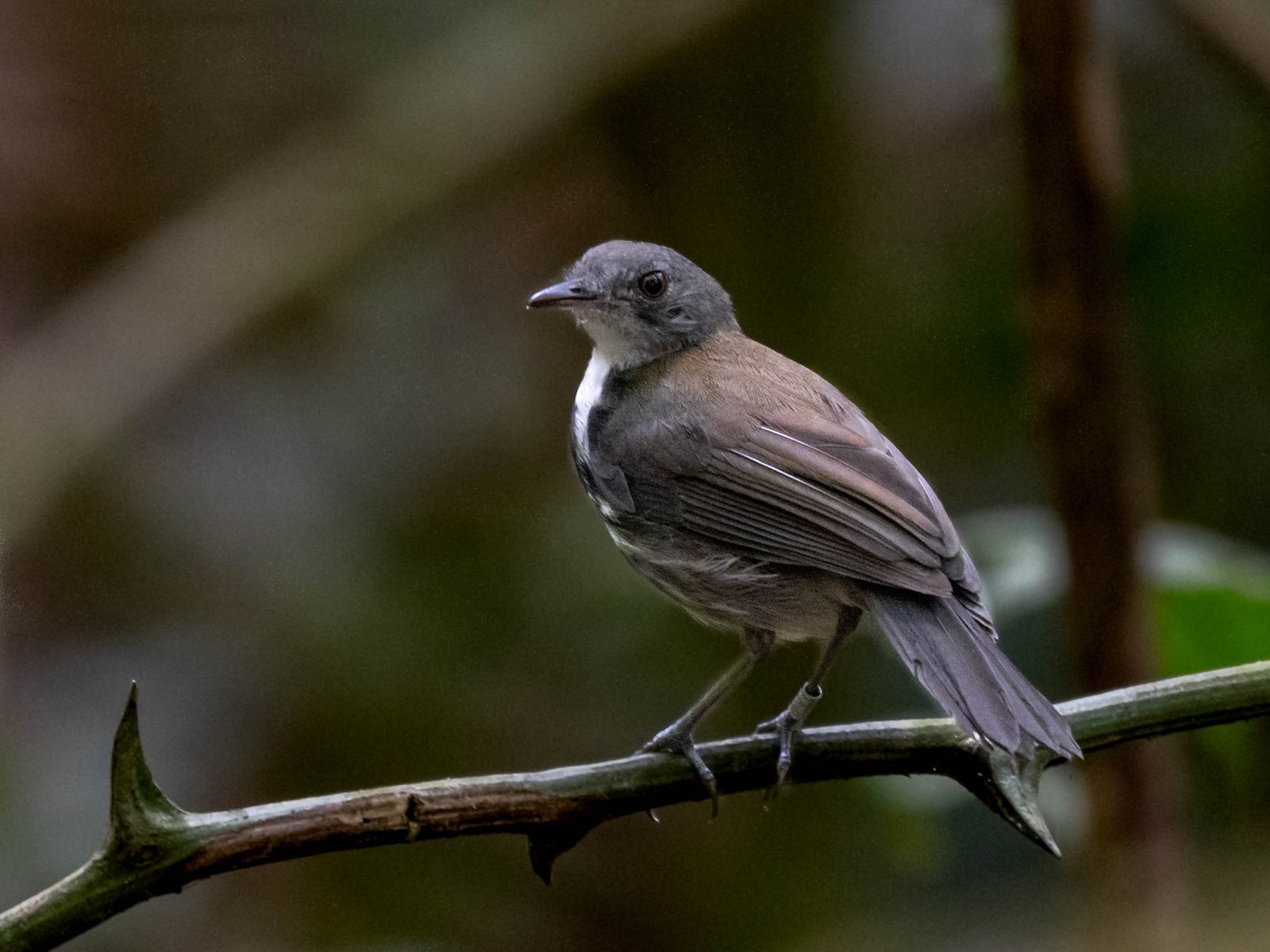
The Ringed Antpipit is a tyrant flycatcher that walks over the floor of Amazonian forest like a pipit. It constantly wags its tail, gives a clear whistle and snaps its bill. With its black breast band and long, pale legs it has no counterpart among the other lowland tyrant flycatchers.
Voice
A clear, whistled phrase of two or three notes, for example pee-pee-peeur, the last one falling. Also dry bill snaps, mainly when disturbed.
Recording: Jacob Wijpkema — CC BY-NC-SA 4.0 · xeno-canto
Identification
13–14 cm, with a straight, rather fine bill with a pale lower mandible, and long, pale legs. The upperparts are dark olive-brown, the crown and head slightly greyer and darker. The throat and belly are white; a broad band of black spots crosses the breast, turning into streaks towards the flanks. Wings and tail are plain brown. The sexes are alike; juveniles are browner, with a fainter breast band.
Confusion species
Southern Antpipit Corythopis delalandi is very similar but has an olive-brown crown that does not contrast with the back and a narrower breast band; it lives in eastern Bolivia, south of this species. Leaftossers such as Black-tailed Leaftosser Sclerurus caudacutus also live on the forest floor but are larger and dark brown, without a white belly or breast band, and do not walk about wagging their tails.
Habitat
The floor of tall humid terra firme forest in the lowlands, less often seasonally flooded forest, and the foothills up to about 1100 m. It walks over the leaf litter and along fallen logs, taking insects and spiders from the ground, sometimes with a short jump into the air. The nest is a domed ball of moss on the ground or on a low, sloping trunk.
Where the bird is most at home, classified by the vegetation units of the Andes and the west coast.


Range and movements
Colombia: in the Amazonian lowlands of the south-east and along the base of the Andes. Ecuador: in the Amazonian lowlands and the foothills of the east slope. Peru: throughout the Amazonian lowlands east of the Andes. Bolivia: in the north, in Pando, Beni, northern La Paz and Cochabamba and northern Santa Cruz. Absent from the Galápagos. Outside the guide area in southern Venezuela, the Guianas and Amazonian Brazil.
- Resident
- dark = core range, pale = thinly spread
How and when to look
Walk trails through tall terra firme forest in the early morning and listen for the whistles; a bird usually walks ahead of you along the trail and then perches on a low branch, wagging its tail.
Conservation status
Least Concern. The species is widespread in Amazonian forest, but disappears where forest is cleared or heavily fragmented.
Scientific name
Corythopis torquatus | Tschudi, 1844
Tschudi described the species in 1844 and placed it straight away in the genus where it still stands. The genus Corythopis was introduced in 1836 by Sundevall. The genus name combines Greek koruthōn, 'lark', with ōps, 'appearance': a bird that looks like a lark. Latin torquatus, 'collared', after the dark breast band. The specimen the first description was based on came from Chanchamayo Valley, Junín, Peru.