All species › Passerines › Tyrant flycatchers and allies › White-rumped Sirystes
White-rumped Sirystes | Sirystes albocinereus
Witstuitsirystestiran | Siristes lomiblanco | Gritador-de-sobre-branco
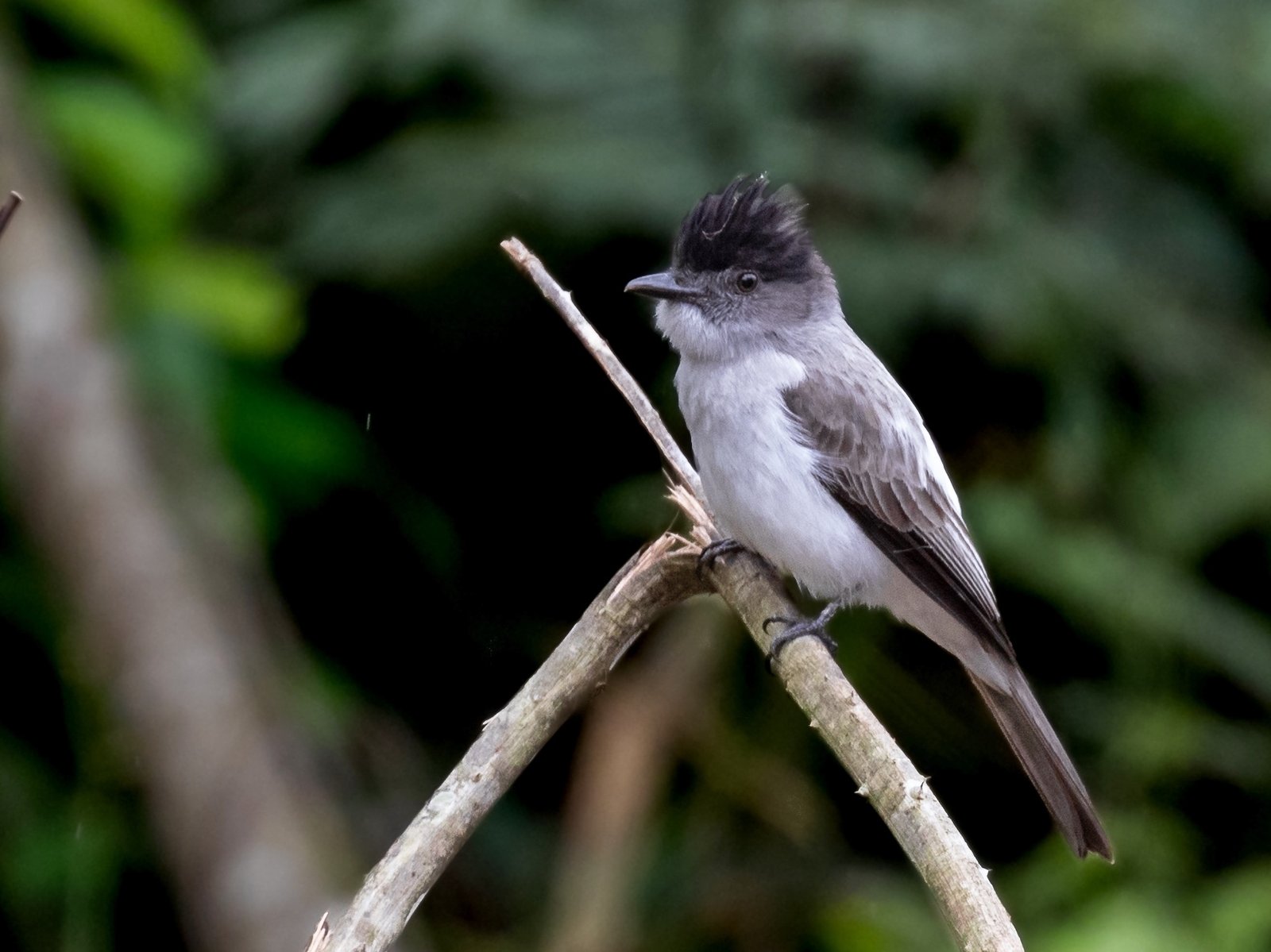
The White-rumped Sirystes is a grey-and-black canopy flycatcher of western Amazonia, with a black cap and a large white rump. It perches upright on open branches in the canopy and gives itself away by its clear, whistled calls. It was formerly treated as one species with the other sirystes; they were separated mainly on the basis of voice.
Voice
A mellow series of whistles, such as p'weer PEW-pu, and a whistle with a fast series of short notes, wheer-pi-pi-pi-pi-pi. Calls include variable series of pew notes and a whistle followed by a short note, wher-pew.
Recording: Dante Buzzetti — CC BY-NC-SA 4.0 · xeno-canto
Identification
18–19 cm, with a narrow, black bill. The crown is black with a slight crest, the rest of the head slate-grey. The nape and back are mottled grey, the rump with a large white patch, visible mainly in flight. The wings are blackish with pale grey edges to the coverts and white edges to the inner flight feathers. The long, square-tipped tail is blackish. The throat and breast are pale grey, the belly white. The sexes are alike.
Confusion species
Sibilant Sirystes Sirystes sibilator of eastern South America lacks the large white rump and has a different call. Black-capped Becard Pachyramphus marginatus is smaller and stockier, with a shorter tail and a thicker bill. Males of White-winged Becard Pachyramphus polychopterus are darker grey to black below and have distinct white wing bars.
Habitat
Canopy and edges of humid várzea and riparian forest and the transitions to other forest types, up to about 400–700 m; in Bolivia also in dry and semi-deciduous forest. It perches high on open branches, often in mixed canopy flocks, and catches insects in flight or from the foliage. Little is known about the nest.
Where the bird is most at home, classified by the vegetation units of the Andes and the west coast.


Range and movements
Colombia: fairly scarce along the base of the Eastern Andes and in the eastern lowlands. Ecuador: fairly scarce in the eastern lowlands. Peru: in the eastern lowlands. Bolivia: from the north to northern Santa Cruz. Absent from the Galápagos. Outside the guide area in southwestern Venezuela and far western Brazil.
- Resident
- dark = core range, pale = thinly spread
How and when to look
Scan the canopy of várzea forest from a riverbank or canopy tower and listen for the clear whistled call; the white rump shows best when the bird flies off.
Conservation status
Least Concern. Widespread in western Amazonia, but fairly scarce and dependent on riverine forest.
Scientific name
Sirystes albocinereus | Sclater & Salvin, 1880
Sclater & Salvin described the species in 1880 and placed it straight away in the genus where it still stands. The genus Sirystes was introduced in 1860 by Cabanis & Heine. The genus name comes from Greek syristēs, 'piper', from syrizō, 'to play the pipes'. The species name comes from Latin albus, 'white', and cinereus, 'ash-grey', after the white rump and grey plumage. The specimen the first description was based on came from Bogotá, Colombia.