All species › Passerines › Tyrant flycatchers and allies › Cinnamon Flycatcher
Cinnamon Flycatcher | Pyrrhomyias cinnamomeus
Kaneeltiran | Mosquerito canelo | Papa-moscas-canela
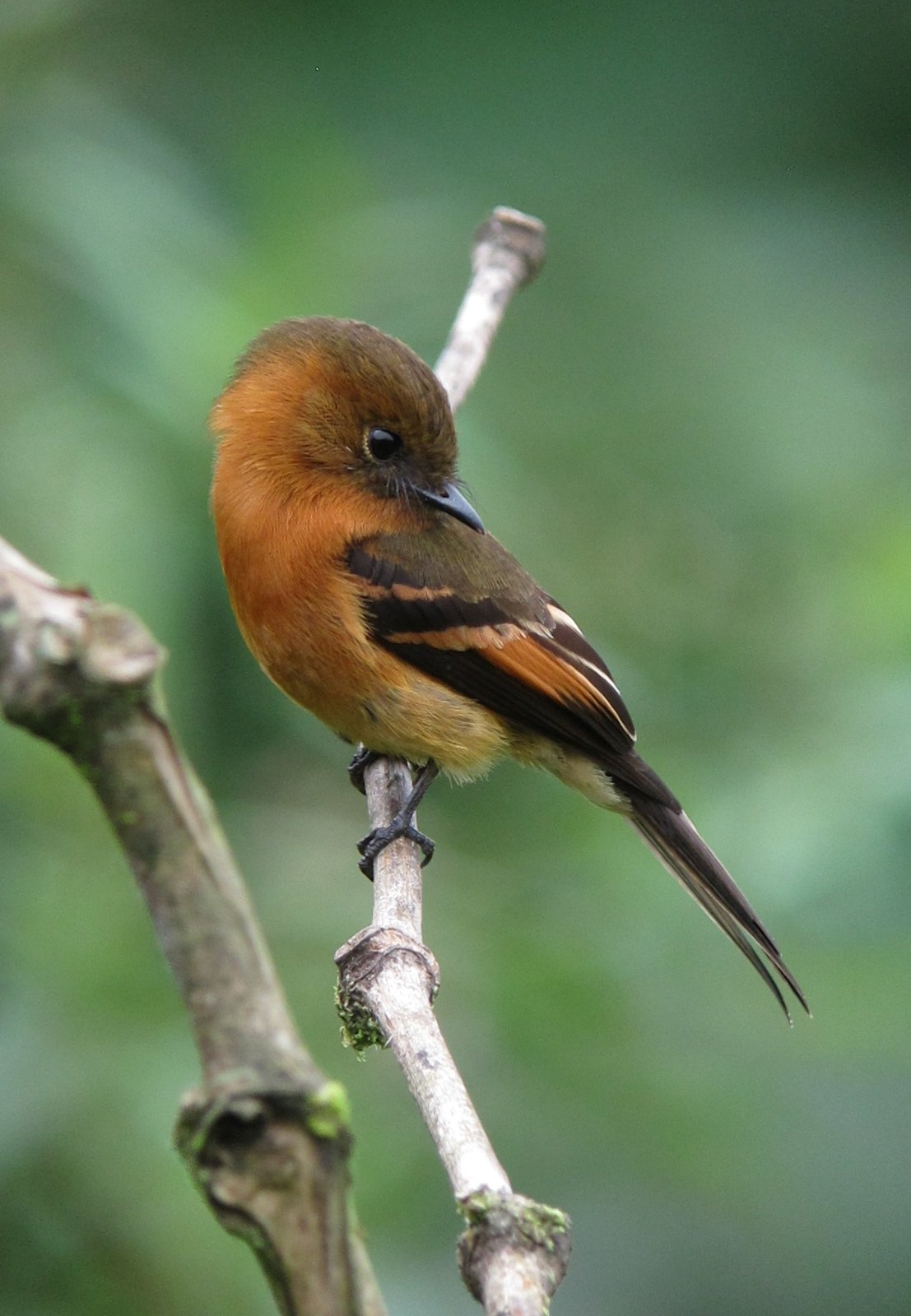
The Cinnamon Flycatcher is a small tyrant flycatcher of cloud forest and upper montane forest throughout the Andes of the guide area. It often perches in the open on a bare branch at the forest edge or along a road and keeps making short sallies after insects. With its cinnamon underparts it is one of the characteristic birds of montane forest edges.
Voice
A dry, whirring trill trrrrrr and sharp short pit calls, often repeated from the perch.
Recording: Brian Cox — CC BY-NC-SA 4.0 · xeno-canto
Identification
13 cm, small and compact, with a short, broad bill. The upperparts are olive-brown, the rump with a rufous band. The wings and tail are dark, the wings with cinnamon bars and a cinnamon panel. The underparts are uniform cinnamon-rufous. There is a small, usually concealed yellow crown patch. The sexes are alike; birds from the south of the guide area are more rufous above.
Confusion species
Cliff Flycatcher Hirundinea ferruginea is much larger, has long wings and lives on rock faces. Rufous-breasted Chat-Tyrant Ochthoeca rufipectoralis has a white supercilium, a grey belly and only a rufous breast band. Ochraceous-breasted Flycatcher Nephelomyias ochraceiventris has an olive throat and a yellow belly. Ruddy-tailed Flycatcher Terenotriccus erythrurus lives in the lowlands and has a grey head and a rufous tail.
Habitat
Edges and clearings of cloud forest and upper montane forest, landslides, stream valleys and verges along mountain roads, mostly between 1200 and 3100 m. It perches in the middle storey on an open branch, sallies briefly after flying insects and often returns to the same spot; it lives in pairs and sometimes joins mixed flocks. The nest is a moss cup in a niche in a steep bank or rock.
Where the bird is most at home, classified by the vegetation units of the Andes and the west coast.


Range and movements
Colombia: in all three Andean ranges, the Sierra Nevada de Santa Marta and the Serranía de Perijá. Ecuador: on both slopes of the Andes. Peru: on both slopes, mainly on the east side. Bolivia: in the Yungas on the east slope. Absent from the Galápagos. Outside the guide area in Venezuela and north-western Argentina.
- Resident
- dark = core range, pale = thinly spread
How and when to look
Drive or walk along a road through cloud forest at 1500–2800 m and watch bare branches at the forest edge; the bird perches in the open, makes short sallies and often comes back to the same branch.
Conservation status
Least Concern. The species is widespread, common and tolerates forest edges and partly logged forest.
Scientific name
Pyrrhomyias cinnamomeus | (d'Orbigny, ACVMD & de Lafresnaye, 1837)
D'Orbigny, ACVMD & de Lafresnaye described the species in 1837 as M[uscipeta] cinnamomea; because it was later moved to another genus, the author and year stand in brackets. The genus Pyrrhomyias was introduced in 1860 by Cabanis & Heine. The genus name comes from Greek purrhos, 'flame-coloured, reddish', and muia, 'fly'. The species name comes from Latin cinnamomeus, 'cinnamon-coloured'. The specimen the first description was based on came from Yungas, Bolivia.