All species › Passerines › Tyrant flycatchers and allies › Galapagos Flycatcher
Galapagos Flycatcher | Myiarchus magnirostris
Galápagostiran | Copetón de Galápagos | Maria-cavaleira-de-galápagos
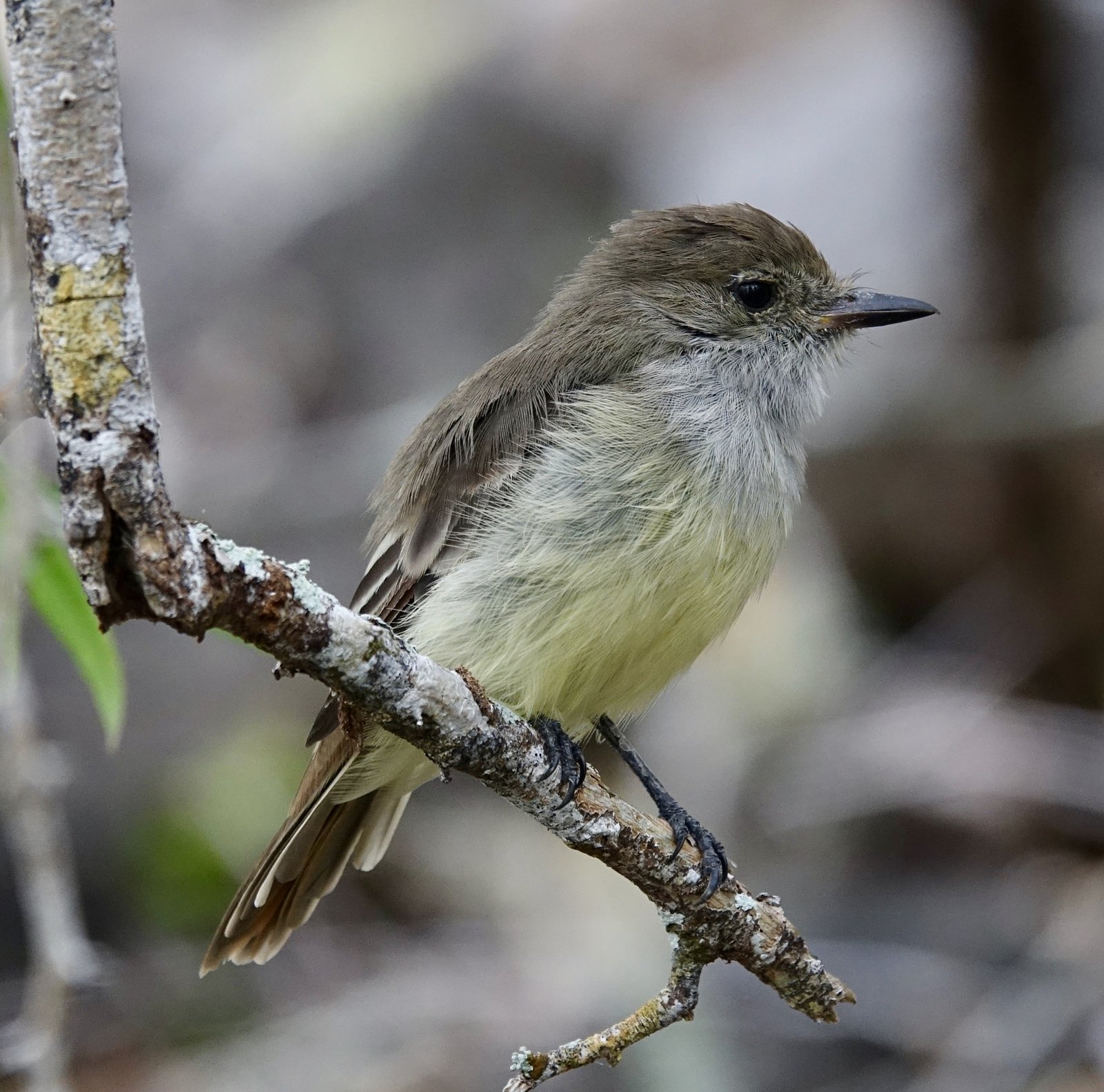
The Galapagos Flycatcher is the only Myiarchus of the Galápagos and occurs nowhere else. It is small for the genus and shows little fear of people; it sometimes lands on visitors and pulls out hairs to line its nest.
Voice
A soft, clear whistle, whee-rr or whee, and short, husky calls; at dawn a repeated series.
Recording: Eric DeFonso — CC BY-NC-SA 3.0 · xeno-canto
Identification
15 cm. A small Myiarchus with a relatively broad bill. The upperparts are greyish-brown, the crown slightly darker and loosely raised. Throat and breast are pale grey, the belly pale yellow. The wings show two dull wing-bars and pale edges to the secondaries; the tail has narrow rusty inner edges. Sexes alike; juveniles have broader rufous edges to the wings and tail.
Confusion species
There is no other Myiarchus on the Galápagos. Vermilion Flycatcher Pyrocephalus rubinus (on the Galápagos the form nanus) is smaller, with a shorter bill; the female and juvenile have yellowish or white underparts without a grey breast. The ground finches (Geospiza) and Galapagos Mockingbird Mimus parvulus differ in shape and behaviour.
Habitat
Mainly the arid zone with palo santo, cacti and dry scrub, but also mangroves, the coast, Scalesia forest and the humid highlands. It catches insects in short sallies from a branch or from the ground. It nests in cavities in trees, cacti or rock crevices.
Where the bird is most at home, classified by the vegetation units of the Andes and the west coast.


Range and movements
Endemic to the Galápagos (Ecuador), on most larger islands, including Española, Floreana, San Cristóbal, Santa Cruz, Santiago and Isabela. Occurs nowhere else.
- Resident
How and when to look
In the arid zone of any island visited, look for a small grey-brown flycatcher on a branch or cactus; it often approaches people to within a short distance.
Conservation status
Least Concern. Widespread in the archipelago; introduced predators and parasites are a potential risk, but no clear decline is known.
Scientific name
Myiarchus magnirostris | (Gould, 1838)
Gould described the species in 1838 as Tyrannula magnirostris; because it was later moved to another genus, the author and year stand in brackets. The genus Myiarchus was introduced in 1844 by Cabanis. The genus name comes from Greek muia, 'fly', and arkhos, 'ruler, chief'. The species name comes from Latin magnus, 'large', and rostrum, 'bill'. The specimen the first description was based on came from San Cristóbal Island, Galápagos.