All species › Passerines › Tyrant flycatchers and allies › Brown-crested Flycatcher
Brown-crested Flycatcher | Myiarchus tyrannulus
Cayennetiran | Copetón tiranillo | Maria-cavaleira-de-rabo-enferrujado
The Brown-crested Flycatcher is the largest Myiarchus of open dry woodland and savanna, with a range extending from the southern United States to Argentina. In the guide area it lives mainly in the dry lowlands of Colombia and Bolivia. It nests in tree cavities and hollow cacti.
Voice
A loud, short whit and a rasping whay-burg, often combined with rapid series of short whistles. At dawn a longer, varied song.
Recording: JAYRSON ARAUJO DE OLIVEIRA — CC BY-NC-SA 4.0 · xeno-canto
Identification
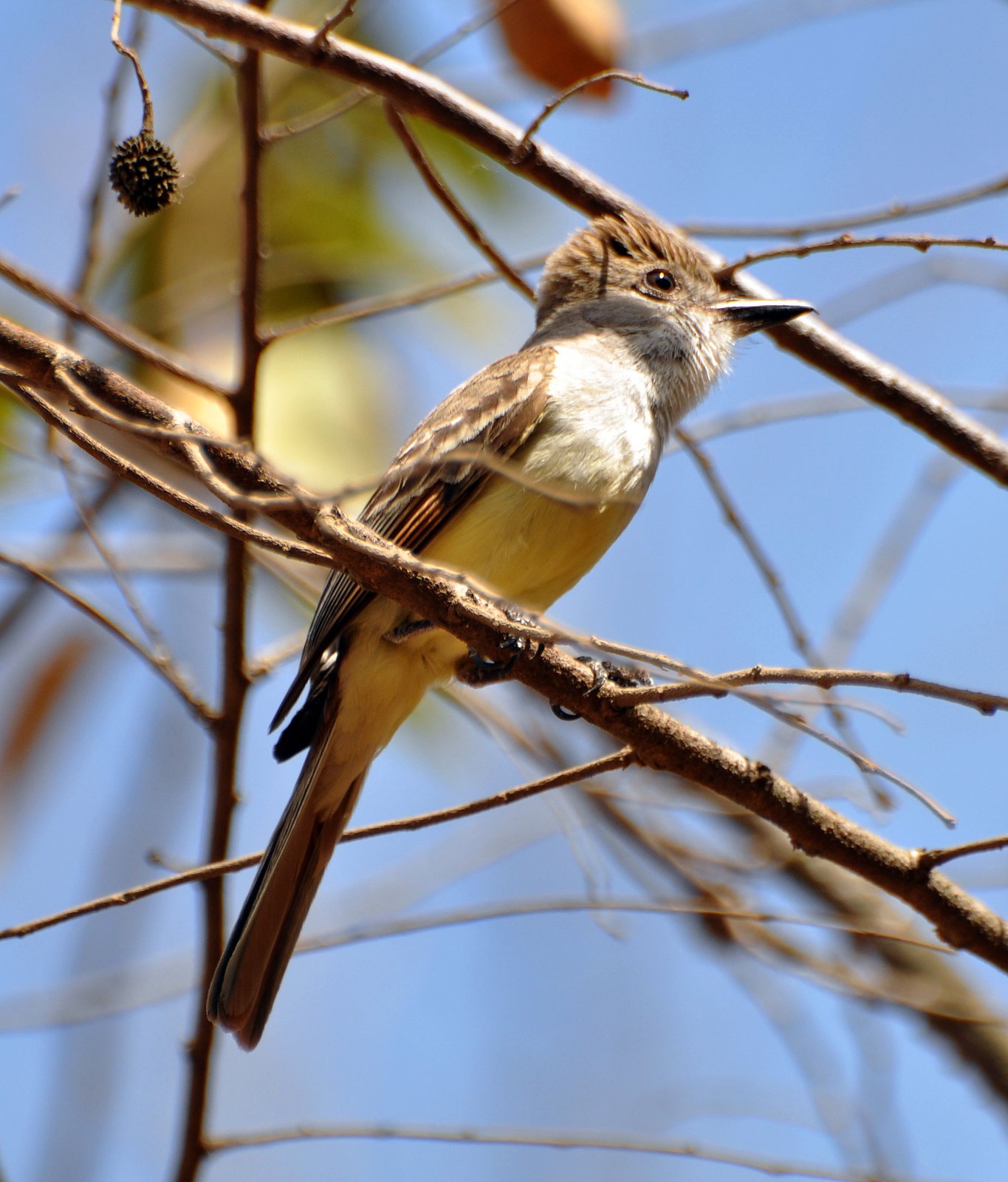
19–20 cm. A large Myiarchus with a long, stout, entirely dark bill and a full, slightly raised crest. The upperparts are greyish-brown to olive-brown. Throat and breast are pale grey, gradually merging into the pale yellow belly. The wings show two pale wing-bars and cinnamon-rufous edges to the primaries; the inner webs of the tail feathers are broadly cinnamon-rufous. Sexes alike; juveniles show more rufous in wing and tail.
Confusion species
Great Crested Flycatcher Myiarchus crinitus, a winter visitor in Colombia, has a darker grey breast sharply bordered against the bright yellow belly and often a pale base to the lower mandible. Short-crested Flycatcher Myiarchus ferox and Swainson's Flycatcher Myiarchus swainsoni have little or no rufous in the tail. Venezuelan Flycatcher Myiarchus venezuelensis in northern Colombia is smaller, with a smaller bill.
Habitat
Deciduous and dry woodland, savanna with trees, gallery forest, thorn scrub and semi-open country with cacti, in the guide area mostly below 1000 m. It catches insects in the middle and upper storeys and also eats fruit. It nests in natural cavities or old woodpecker holes in trees and large cacti.
Where the bird is most at home, classified by the vegetation units of the Andes and the west coast.


Range and movements
Colombia: in the dry lowlands of the north, including La Guajira and the Caribbean lowlands, and in the Llanos in the east. Ecuador: not confirmed; only a few sight records. Peru: locally in the north, and in the extreme south-east, where it occurs mainly as an austral winter visitor. Bolivia: in the lowlands of the north and east, including the Chaco. Absent from the Galápagos. Outside the guide area from the south-western United States through Central America to Venezuela, the Guianas, Brazil, Paraguay and northern Argentina.
- Resident
- dark = core range, pale = thinly spread
How and when to look
Search in dry woodland and savanna in northern Colombia or in the Chaco and Chiquitano forest of Bolivia. It often perches high on a bare branch and calls mainly in the morning.
Conservation status
Least Concern. Widespread and common over a large range.
Scientific name
Myiarchus tyrannulus | (Müller, 1776)
Müller described the species in 1776 as Muscicapa tyrannulus; because it was later moved to another genus, the author and year stand in brackets. The genus Myiarchus was introduced in 1844 by Cabanis. The genus name comes from Greek muia, 'fly', and arkhos, 'ruler, chief'. The species name comes from Latin tyrannulus, 'little tyrant', diminutive of tyrannus. The specimen the first description was based on came from Cayenne, French Guiana.