All species › Passerines › Tyrant flycatchers and allies › Great Crested Flycatcher
Great Crested Flycatcher | Myiarchus crinitus
Grote kuiftiran | Copetón viajero | Maria-cavaleira-de-crista-grande
The Great Crested Flycatcher breeds in deciduous woodland in eastern North America and winters from Mexico to northern South America. In the guide area it is a winter visitor, mainly in Colombia. It nests in tree cavities and often works a shed snakeskin or plastic into the nest.
Voice
A loud, rising whistle wheeep, also heard on the wintering grounds, and a rolling prrrit.
Recording: Bobby Wilcox — CC BY-NC-SA 4.0 · xeno-canto
Identification
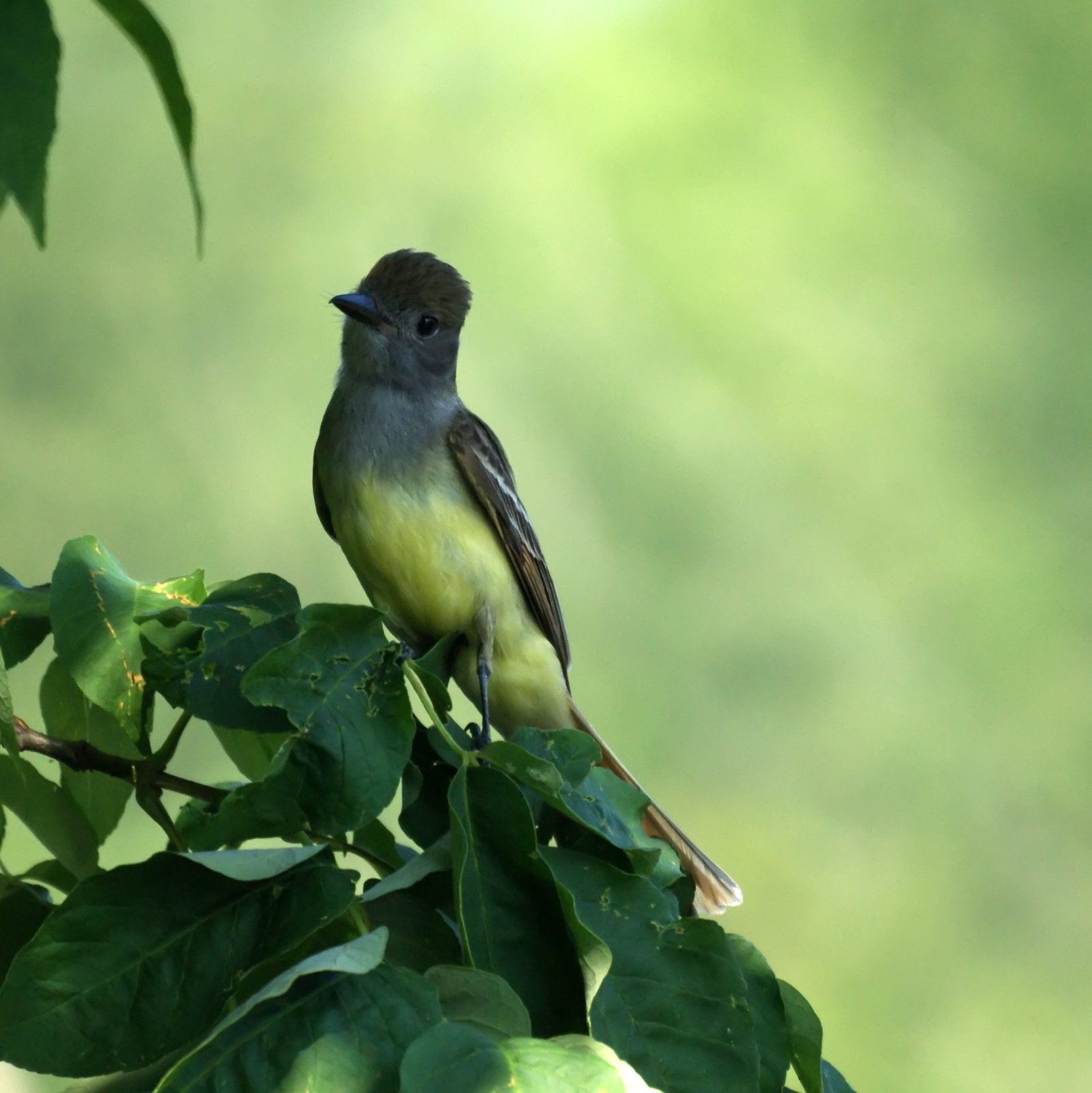
18–20 cm. A large, heavily built Myiarchus with a stout bill whose lower mandible often has a paler base. The upperparts are olive-brown, the head with a slight crest. Throat and breast are clear dark grey, sharply contrasting with the bright yellow belly. The wings show two pale wing-bars, a white edge to the innermost tertial and much cinnamon-rufous in the primaries. The inner webs of the tail feathers are also broadly cinnamon-rufous. Sexes alike.
Confusion species
Brown-crested Flycatcher Myiarchus tyrannulus is slightly paler, with a pale grey throat and breast and a less sharp transition to the pale yellow belly; its lower mandible is entirely dark. Short-crested Flycatcher Myiarchus ferox and Swainson's Flycatcher Myiarchus swainsoni have almost no rufous in the tail. Dusky-capped Flycatcher Myiarchus tuberculifer is smaller, with a dark cap.
Habitat
In winter in forest edges, secondary forest, gallery forest, plantations with shade trees and semi-open country with tall trees, mostly below 1500 m. It forages in the canopy, picking insects from leaves, and eats much fruit in winter.
Where the bird is most at home, classified by the vegetation units of the Andes and the west coast.


Range and movements
Colombia: winter visitor, mainly in the north, the Magdalena Valley and the foot of the Andes. Ecuador: rare winter visitor, with scattered records. Peru and Bolivia: not regular; at most a very rare vagrant. Absent from the Galápagos. Breeds in eastern North America and winters from Mexico and Central America to Venezuela.
- Winter visitor (c. Oct–Mar)
- dark = core range, pale = thinly spread
How and when to look
From October to April in Colombia, listen in forest edges and plantations for the rising wheeep. With a large Myiarchus showing much rufous in wing and tail, check for the dark grey breast and its sharp border with the yellow belly.
Conservation status
Least Concern. Common on the breeding grounds; in the guide area a scarce winter visitor at the southern edge of the wintering range.
Scientific name
Myiarchus crinitus | (Linnaeus, 1758)
Linnaeus described the species in 1758 as [Turdus] crinitus; because it was later moved to another genus, the author and year stand in brackets. The genus Myiarchus was introduced in 1844 by Cabanis. The genus name comes from Greek muia, 'fly', and arkhos, 'ruler, chief'. The species name comes from Latin crinitus, 'long-haired' (from crinis, 'hair'), for the crest. The specimen the first description was based on came from South Carolina, United States.