All species › Passerines › Tyrant flycatchers and allies › Pale-edged Flycatcher
Pale-edged Flycatcher | Myiarchus cephalotes
Taczanowski's tiran | Copetón montañero | Maria-cavaleira-de-borda-clara
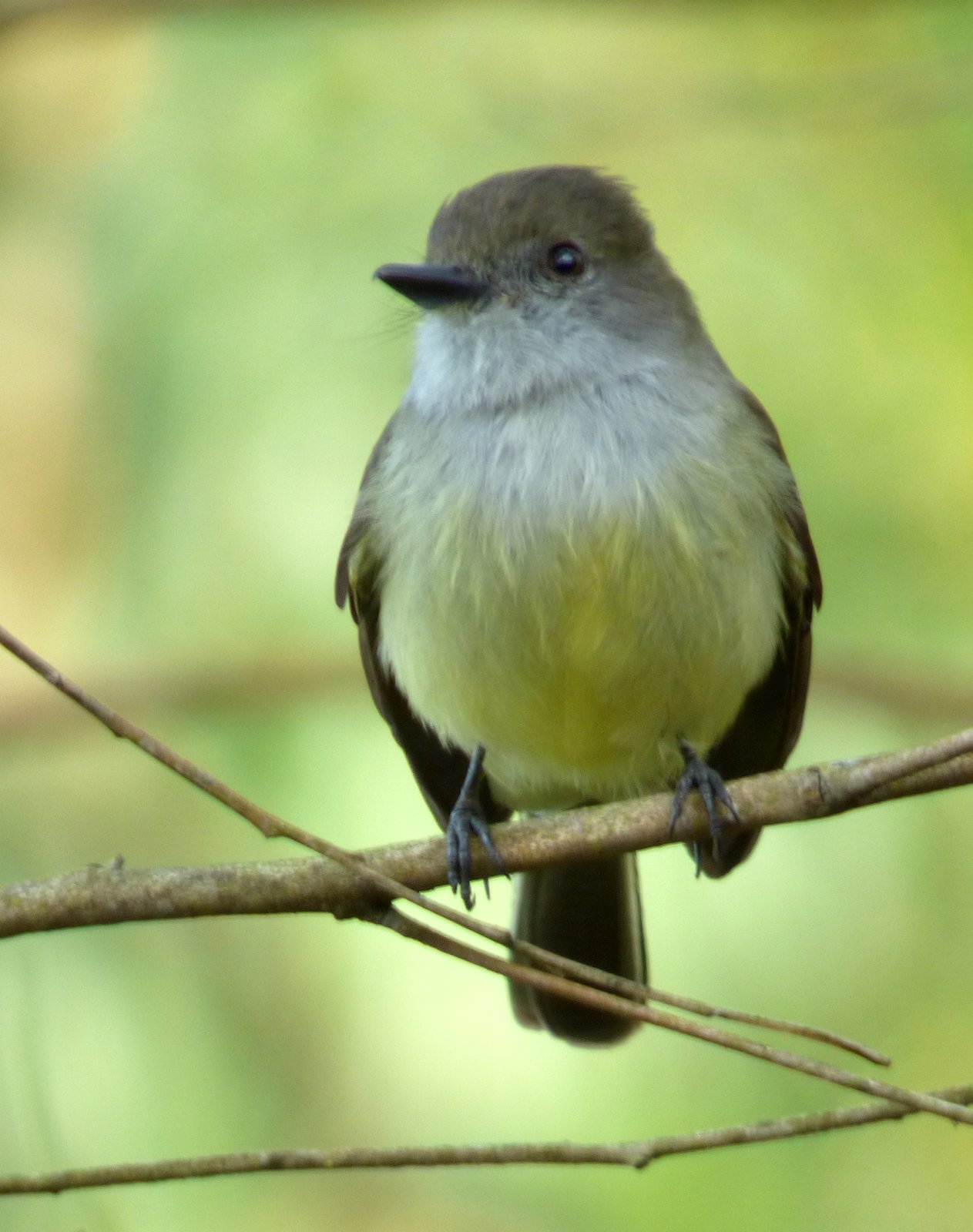
The Pale-edged Flycatcher is a Myiarchus of Andean montane forest and occurs higher than most related species. Its name refers to the pale edges of the outer tail feathers. It perches upright on a lookout at the forest edge and catches insects in short sallies.
Voice
A series of clear, repeated whistles, roughly pip-pip-pip, and a falling, plaintive peeuw. At dawn it sings a longer series.
Recording: Jacob Wijpkema — CC BY-NC-SA 4.0 · xeno-canto
Identification
18 cm. The upperparts are dark olive-brown, the crown slightly darker and loosely raised. Throat and breast are grey, the belly pale yellow. The wings are dark, with two greyish-white wing-bars and pale edges to the secondaries. The outer web of the outer tail feathers is dull white, so the tail looks pale-edged; rufous tones in the tail are almost absent. The bill is black. Sexes alike; juveniles have rufous edges to the wings and tail.
Confusion species
Dusky-capped Flycatcher Myiarchus tuberculifer is smaller, with a more sharply defined dark cap, rufous edges to the wings and tail and no pale tail edge; it usually lives lower. Sooty-crowned Flycatcher Myiarchus phaeocephalus of the west and the Marañón Valley lives in drier, lower areas and has a greyer crown. Short-crested Flycatcher Myiarchus ferox and Swainson's Flycatcher Myiarchus swainsoni are lowland species without distinctly pale tail edges.
Habitat
Edges and clearings of humid montane forest and cloud forest, also semi-open country with trees and coffee plantations near forest, mostly between 1200 and 3000 m. It catches insects from a lookout in the middle and upper storeys and also eats small fruits. It nests in a tree cavity.
Where the bird is most at home, classified by the vegetation units of the Andes and the west coast.


Range and movements
Colombia: in the Andes. Ecuador: on both slopes of the Andes. Peru: on the eastern slope of the Andes along the whole length of the country. Bolivia: on the eastern slope of the Andes, from La Paz to Santa Cruz. Absent from the Galápagos. Outside the guide area in the mountains of Venezuela.
- Resident
- dark = core range, pale = thinly spread
How and when to look
Search along forest edges and roads through cloud forest between 1500 and 2500 m, where it perches on a bare branch. With any Myiarchus in montane forest, check for the pale tail edge.
Conservation status
Least Concern. Widespread in the Andes and tolerates semi-open country, provided there is forest nearby.
Scientific name
Myiarchus cephalotes | Taczanowski, 1880
Taczanowski described the species in 1880 and placed it straight away in the genus where it still stands. The genus Myiarchus was introduced in 1844 by Cabanis. The genus name comes from Greek muia, 'fly', and arkhos, 'ruler, chief'. The species name comes from Greek kephalōtos, 'large-headed'. The specimen the first description was based on came from Tambillo, northern Peru.