All species › Passerines › Tyrant flycatchers and allies › Sooty-crowned Flycatcher
Sooty-crowned Flycatcher | Myiarchus phaeocephalus
Roetkruintiran | Copetón coronitiznado | Maria-cavaleira-de-coroa-fuliginosa
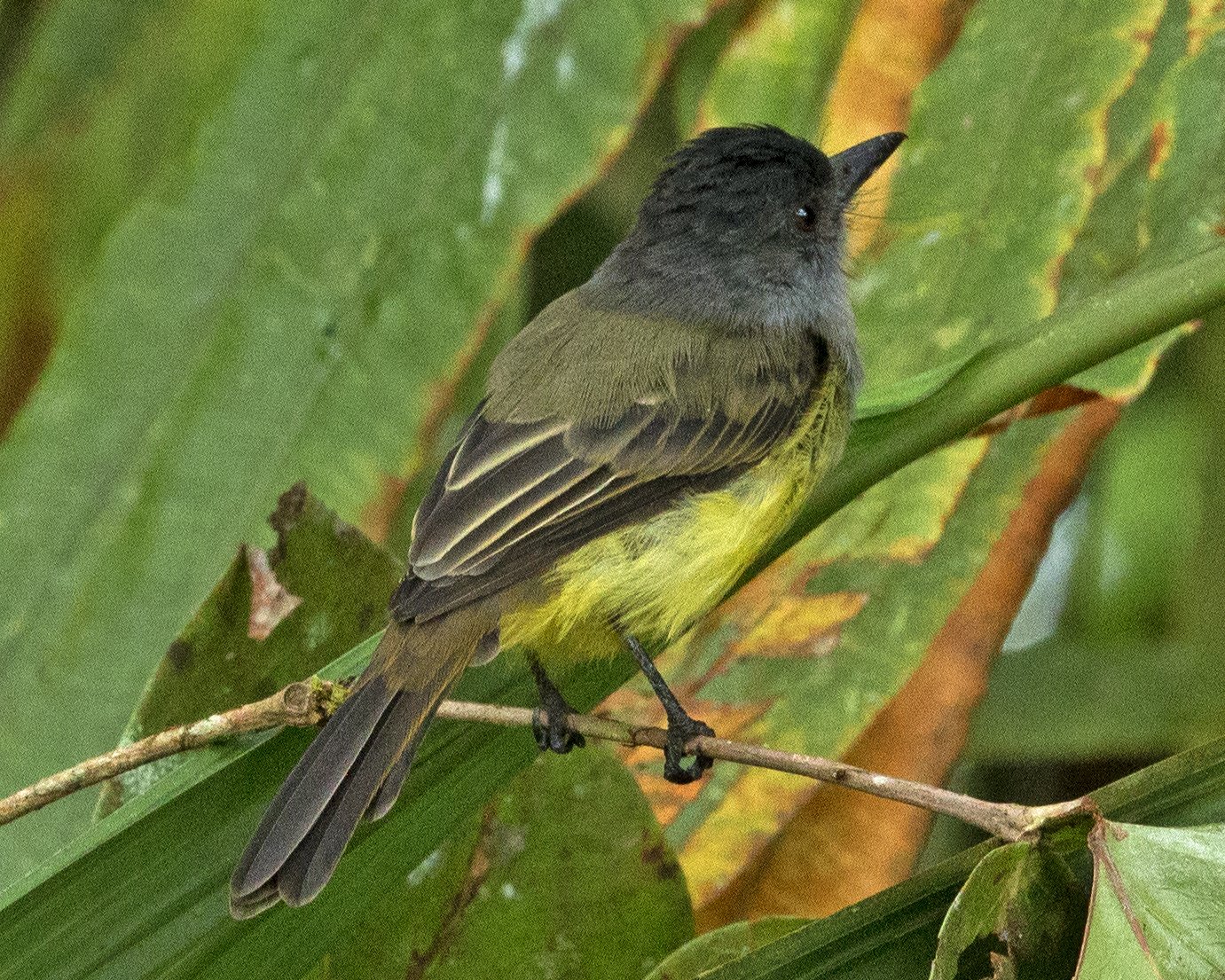
The Sooty-crowned Flycatcher is a Myiarchus of dry and semi-humid forest in western Ecuador and north-western Peru, with a separate subspecies (interior) in the Marañón valley. It resembles Dusky-capped Flycatcher, but the sooty-grey crown grades into the back.
Voice
A loud, rising whistle like wheet and rolling series of short notes; at dawn repeated whistles.
Recording: Mitch Lysinger — CC BY-NC-SA 4.0 · xeno-canto
Identification
18–19 cm, with a black bill. The crown is sooty grey and merges without a sharp boundary into the greyish-olive back; the forehead and sides of the head are slightly paler grey. The throat and breast are pale grey, the belly yellow. The wings have whitish edges to the coverts and tertials; the outer tail feathers have narrow pale edges. The sexes are alike.
Confusion species
Dusky-capped Flycatcher Myiarchus tuberculifer is smaller, with a blackish cap sharply contrasting with the back. Rufous Flycatcher Myiarchus semirufus has entirely rufous underparts. Pale-edged Flycatcher Myiarchus cephalotes lives higher, in humid montane forest, and has more distinct pale outer edges to the tail.
Habitat
Dry and semi-humid deciduous forest, forest edges, gallery forest and scrub with trees, mainly below 1000 m and higher in the Marañón valley. It catches insects in short sallies from a perch at middle levels of the forest. It nests in tree cavities.
Where the bird is most at home, classified by the vegetation units of the Andes and the west coast.


Range and movements
In Ecuador in the western lowlands and on the western foothills of the Andes, mainly in the centre and south. In Peru in the north-west, in Tumbes, Piura, Lambayeque and Cajamarca, and in the dry Marañón valley. Absent from Colombia, Bolivia and the Galápagos. The species does not occur outside the guide area.
- Resident
- dark = core range, pale = thinly spread
How and when to look
Search the dry forest of south-western Ecuador, for example at Cerro Blanco near Guayaquil, or the dry forest of Tumbes; in the Marañón valley in riverside scrub.
Conservation status
Least Concern. The dry forest of the Tumbesian region is highly fragmented, but the species tolerates secondary forest and forest edges.
Scientific name
Myiarchus phaeocephalus | Sclater, 1860
Sclater described the species in 1860 and placed it straight away in the genus where it still stands. The genus Myiarchus was introduced in 1844 by Cabanis. The genus name comes from Greek muia, 'fly', and arkhos, 'ruler, chief'. The species name comes from Greek phaios, 'dusky, grey-brown', and -kephalos, '-headed'. The specimen the first description was based on came from Babahoyo, Ecuador.