All species › Passerines › Tyrant flycatchers and allies › Apical Flycatcher
Apical Flycatcher | Myiarchus apicalis
Zoomstaarttiran | Copetón apical | Maria-cavaleira-apical
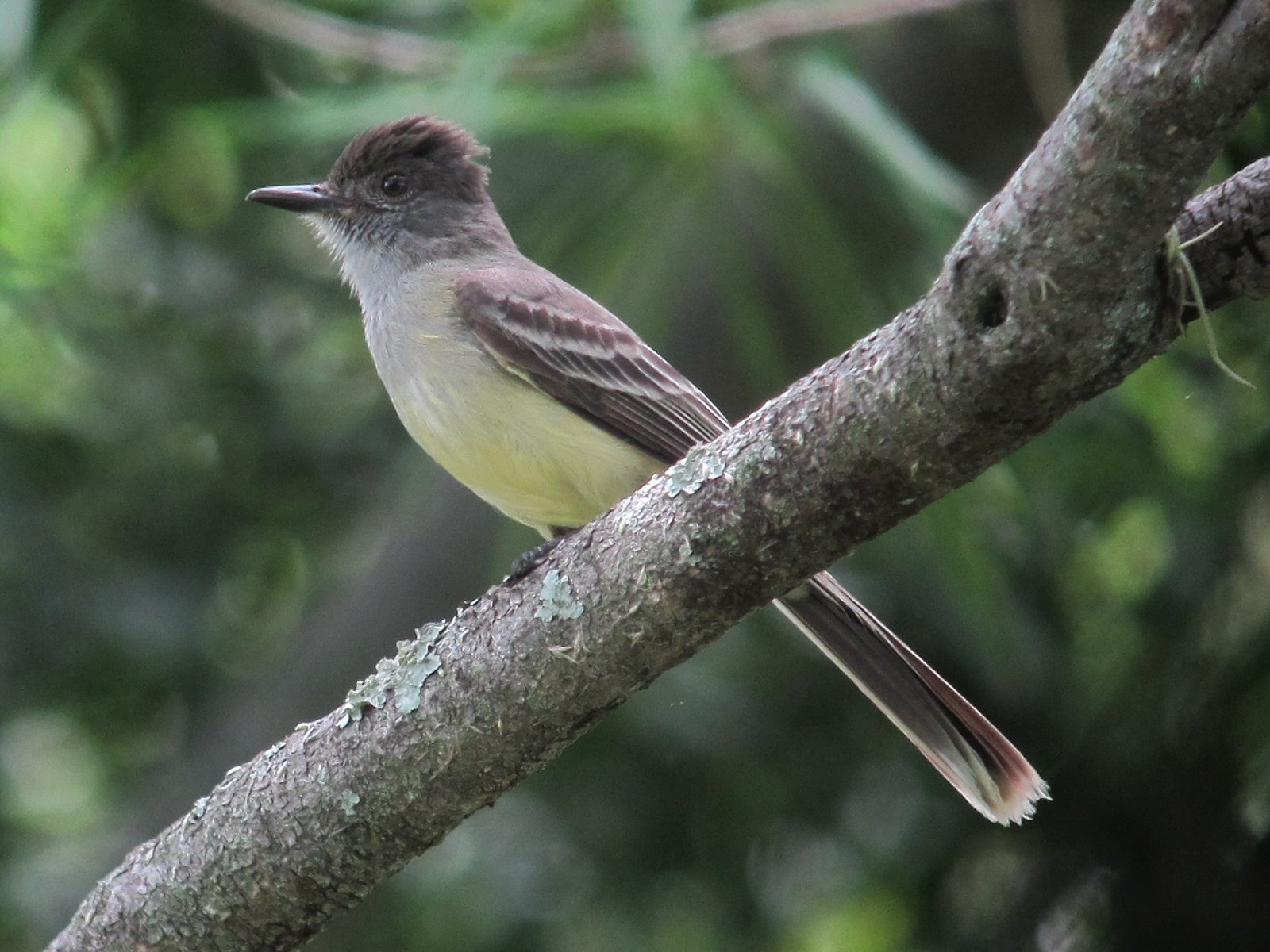
The Apical Flycatcher occurs only in Colombia, in the dry valleys west of the Eastern Andes. It is the only Myiarchus of the guide area with broad pale tips to the tail feathers, to which its name refers. It is often seen in pairs and is usually the only member of the genus in its dry habitat.
Voice
Raspy, rolling calls and short whistles, often given alternately by the two birds of a pair.
Recording: David Monroy Rengifo — CC BY-NC-SA 4.0 · xeno-canto
Identification
19 cm, with a black bill. The upperparts are olive-brown, the crown slightly darker. The throat and breast are grey, the belly yellow. The wings have pale edges to the coverts and tertials. The tail is dark, with broad whitish to pale brown tips to the outer feathers, best seen from below and in flight. The sexes are alike.
Confusion species
Dusky-capped Flycatcher Myiarchus tuberculifer is smaller, with a blackish cap and no pale tail tips. Panama Flycatcher Myiarchus panamensis, which occurs in the lower parts of the Cauca and Magdalena valleys, is greyer and lacks pale tail tips. Pale-edged Flycatcher Myiarchus cephalotes lives higher, in humid montane forest, and has pale outer edges to the tail instead of tips.
Habitat
Dry woodland, scrub with cacti, gallery forest and semi-open country with trees in the dry valleys, roughly between 400 and 2500 m. It catches insects in short sallies from a perch. It nests in tree cavities.
Where the bird is most at home, classified by the vegetation units of the Andes and the west coast.


Range and movements
Colombia: in the dry parts of the Magdalena and Cauca valleys and in other dry valleys west of the Eastern Andes. Absent from Ecuador, Peru, Bolivia and the Galápagos. The species does not occur outside Colombia.
- Resident
- dark = core range, pale = thinly spread
How and when to look
Search the dry scrub of the upper Magdalena valley, in Huila and Tolima, and the dry Cauca valley; watch for pairs with pale tail tips.
Conservation status
Least Concern. The dry forest in the valleys is highly fragmented, but the species also occurs in scrub and semi-open country.
Scientific name
Myiarchus apicalis | Sclater & Salvin, 1881
Sclater & Salvin described the species in 1881 and placed it straight away in the genus where it still stands. The genus Myiarchus was introduced in 1844 by Cabanis. The genus name comes from Greek muia, 'fly', and arkhos, 'ruler, chief'. The species name comes from Latin apex, apicis, 'tip', for the pale tips of the tail feathers. The specimen the first description was based on came from Honda, Tolima, Colombia.