All species › Passerines › Tyrant flycatchers and allies › Short-crested Flycatcher
Short-crested Flycatcher | Myiarchus ferox
Kortkuiftiran | Copetón cresticorto | Maria-cavaleira
The Short-crested Flycatcher is the commonest Myiarchus of Amazonia. It is dark and plain and is best recognised by its short, rolling call. In the austral winter it shares its range with wintering Swainson's Flycatchers, which closely resemble it.
Voice
A short, soft, rolling trill like prrrt, often repeated; at dawn a series of whistles and trills.
Recording: Juan Freile — CC BY-NC-SA 4.0 · xeno-canto
Identification
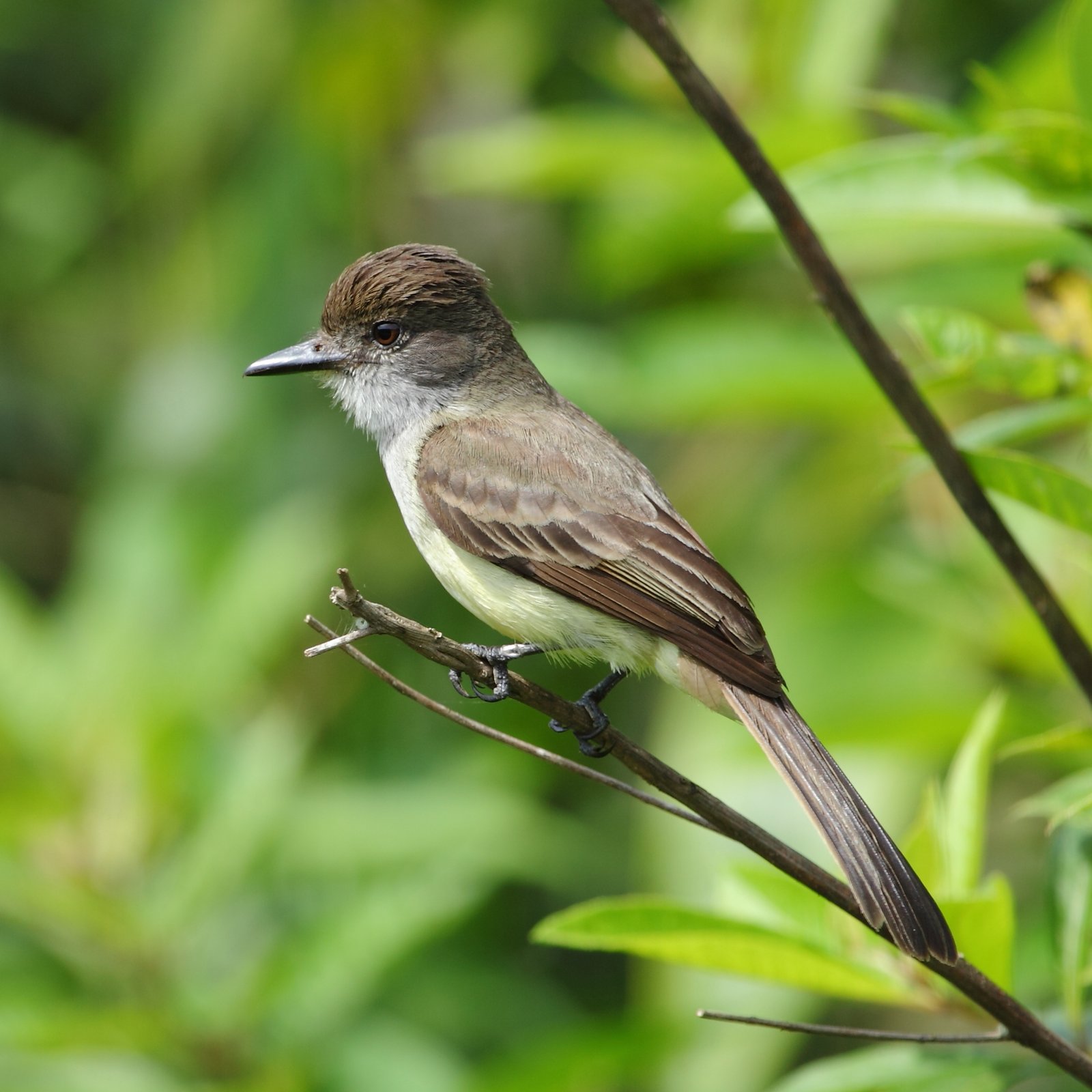
18–19 cm, with an all-black bill and a short crest. The upperparts are dark olive-brown, the crown and sides of the head slightly darker. The throat and breast are grey, the belly pale yellow. The wings have narrow whitish edges to the coverts and tertials; wing and tail show little or no rufous. The sexes are alike.
Confusion species
Swainson's Flycatcher Myiarchus swainsoni is duller and paler, often with a pale base to the lower mandible, and has a different call. Dusky-capped Flycatcher Myiarchus tuberculifer is smaller, with a blackish cap and a yellower belly. Brown-crested Flycatcher Myiarchus tyrannulus has rufous in the wing and tail. Greyish Mourner Rhytipterna simplex is plain grey without wing edgings and lives in the forest interior.
Habitat
Forest edges, várzea, vegetated river islands, clearings with trees, secondary forest and gardens in the lowlands, up to about 1000 m. It forages at middle levels of the vegetation and catches insects in short sallies from a perch. It nests in tree cavities and hollow stumps.
Where the bird is most at home, classified by the vegetation units of the Andes and the west coast.


Range and movements
In Colombia east of the Andes, in Amazonia and the Llanos. In Ecuador in the eastern lowlands. In Peru in the Amazonian lowlands and on the lowest parts of the eastern slope. In Bolivia in the northern and eastern lowlands. Absent west of the Andes and from the Galápagos. Outside the guide area in Venezuela, the Guianas, Brazil, Paraguay and north-eastern Argentina.
- Resident
- dark = core range, pale = thinly spread
How and when to look
Listen for the short, rolling call along riverbanks, forest edges and clearings in the Amazonian lowlands; the bird often sits low to mid-height on an open branch.
Conservation status
Least Concern. The species has a very large range and tolerates forest edges and secondary growth.
Scientific name
Myiarchus ferox | (Gmelin, 1789)
Gmelin described the species in 1789 as [Muscicapa] ferox; because it was later moved to another genus, the author and year stand in brackets. The genus Myiarchus was introduced in 1844 by Cabanis. The genus name comes from Greek muia, 'fly', and arkhos, 'ruler, chief'. The species name comes from Latin ferox, 'fierce, wild'. The specimen the first description was based on came from Cayenne, French Guiana.