All species › Waterfowl › Ducks, swans and geese › Cinnamon Teal
Cinnamon Teal | Spatula cyanoptera
Kaneeltaling | Cerceta colorada | Marreca-colorada
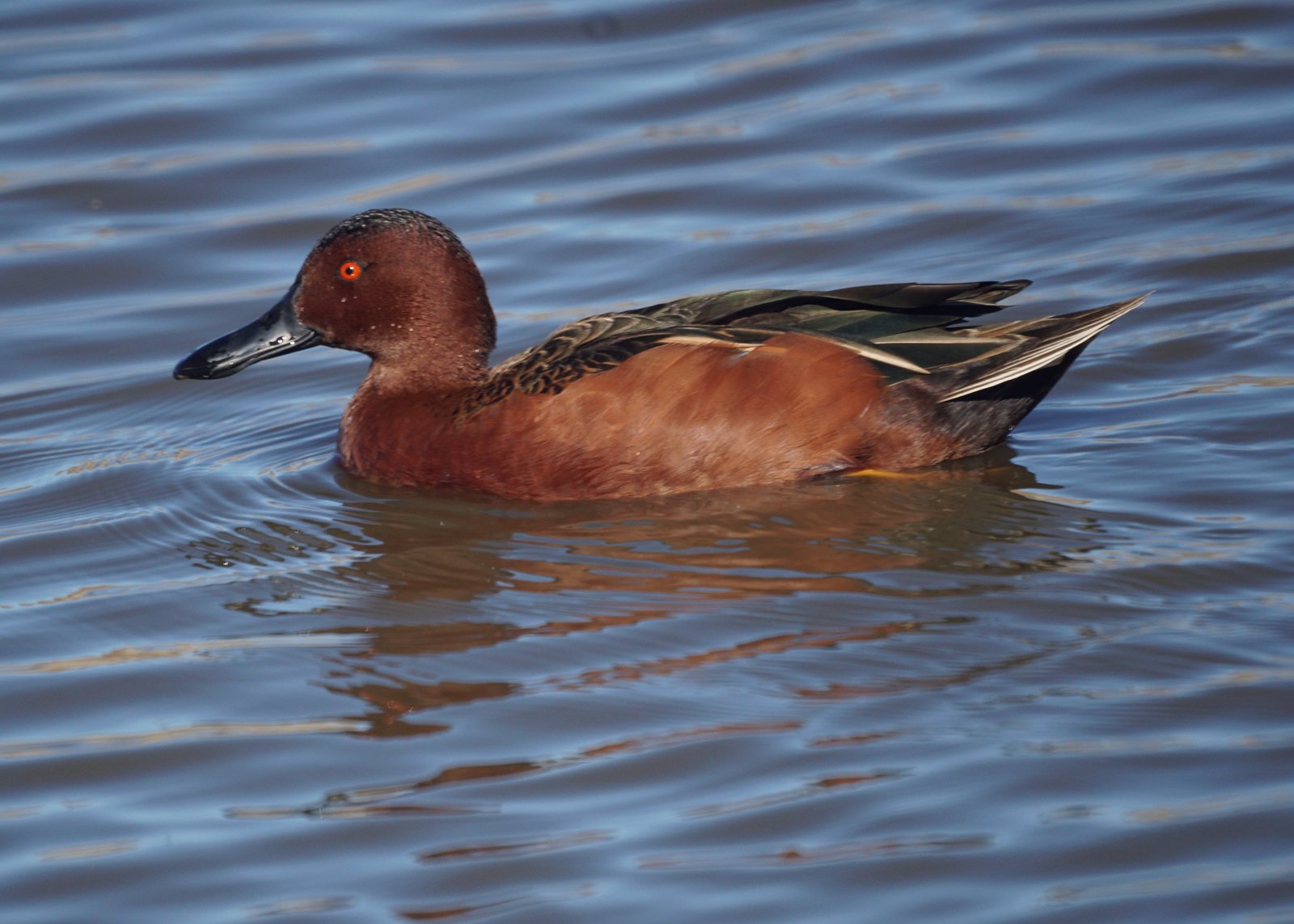
The Cinnamon Teal is a small duck with a split range across North and South America. The male is almost entirely deep cinnamon-red, with a red iris. In the guide area resident birds live in the Andes of Peru and Bolivia, along the coast of Peru and very locally in Colombia.
Voice
Mostly silent. The male gives a soft, rattling chatter, the female a soft, hoarse quack.
Recording: Bernabe Lopez-Lanus — CC BY-NC-SA 3.0 · xeno-canto
Identification
38–43 cm, a small duck with a fairly long, broad, dark bill. The male is deep cinnamon to chestnut-red, with a darker back, a red iris and a blackish rear end. The female is warm mottled brown, with a fairly plain face and a dark iris. Both sexes have pale blue forewings and a green speculum. Highland birds are larger than those of the lowlands. Juveniles resemble the female.
Confusion species
The female Blue-winged Teal Spatula discors is cooler brown, with a clearer eye-stripe, a pale spot at the base of the bill and a broken pale eye-ring. Red Shoveler Spatula platalea is larger, with a much longer, spatulate bill, a longer tail and black spots on the body. Fulvous Whistling Duck Dendrocygna bicolor is also rufous, but much larger, with long legs and a long neck.
Habitat
Fresh and brackish lakes, marshes, bogs and wet shores in the Andes, mainly between 3000 and 4500 m, and coastal lagoons and marshes along the coast of Peru. It feeds while swimming at the surface on seeds, aquatic plants and small invertebrates. The nest is on the ground in dense shoreline vegetation.
Where the bird is most at home, classified by the vegetation units of the Andes and the west coast.


Range and movements
In Colombia very local in the Andes and valleys, with a greatly reduced population. In Ecuador scarce and irregular. In Peru on lakes and marshes in the Andes, such as Lake Junín and Lake Titicaca, and in lagoons along the coast. In Bolivia on the lakes and bogs of the altiplano. Absent from the Galápagos. Outside the guide area in western North America and Mexico, and in Chile, Argentina, Paraguay, Uruguay and southern Brazil.
- Resident
- dark = core range, pale = thinly spread
How and when to look
Year-round on the lakes and bogs of the altiplano in southern Peru and Bolivia, often in pairs among other ducks; also in the coastal lagoons of Peru.
Conservation status
Least Concern. The Colombian population has declined strongly through the loss of wetlands; elsewhere hunting and the drying out of lakes are local threats.
Scientific name
Spatula cyanoptera | (Vieillot, 1816)
Vieillot described the species in 1816 as Anas cyanoptera; because it was later moved to another genus, the author and year stand in brackets. The genus Spatula was introduced in 1822 by Boie. The genus name is Latin spatula, 'spoon, spatula', after the broad bill. The species name cyanoptera comes from Greek kuanos, 'dark blue', and pteron, 'wing', after the blue forewing. The specimen the first description was based on came from Río de la Plata, Buenos Aires, Argentina.