All species › Waterfowl › Ducks, swans and geese › Blue-winged Teal
Blue-winged Teal | Spatula discors
Blauwvleugeltaling | Cerceta aliazul | Marreca-de-asa-azul
The Blue-winged Teal is a small North American duck that migrates in large numbers to northern South America. In the guide area it is the most numerous wintering duck, especially in Colombia and Ecuador. On highland lakes and coastal lagoons it often mixes with resident ducks.
Voice
The male gives a high, thin whistle tsee, the female a high, short quack.
Recording: Fernando Castro — CC BY-NC-SA 4.0 · xeno-canto
Identification
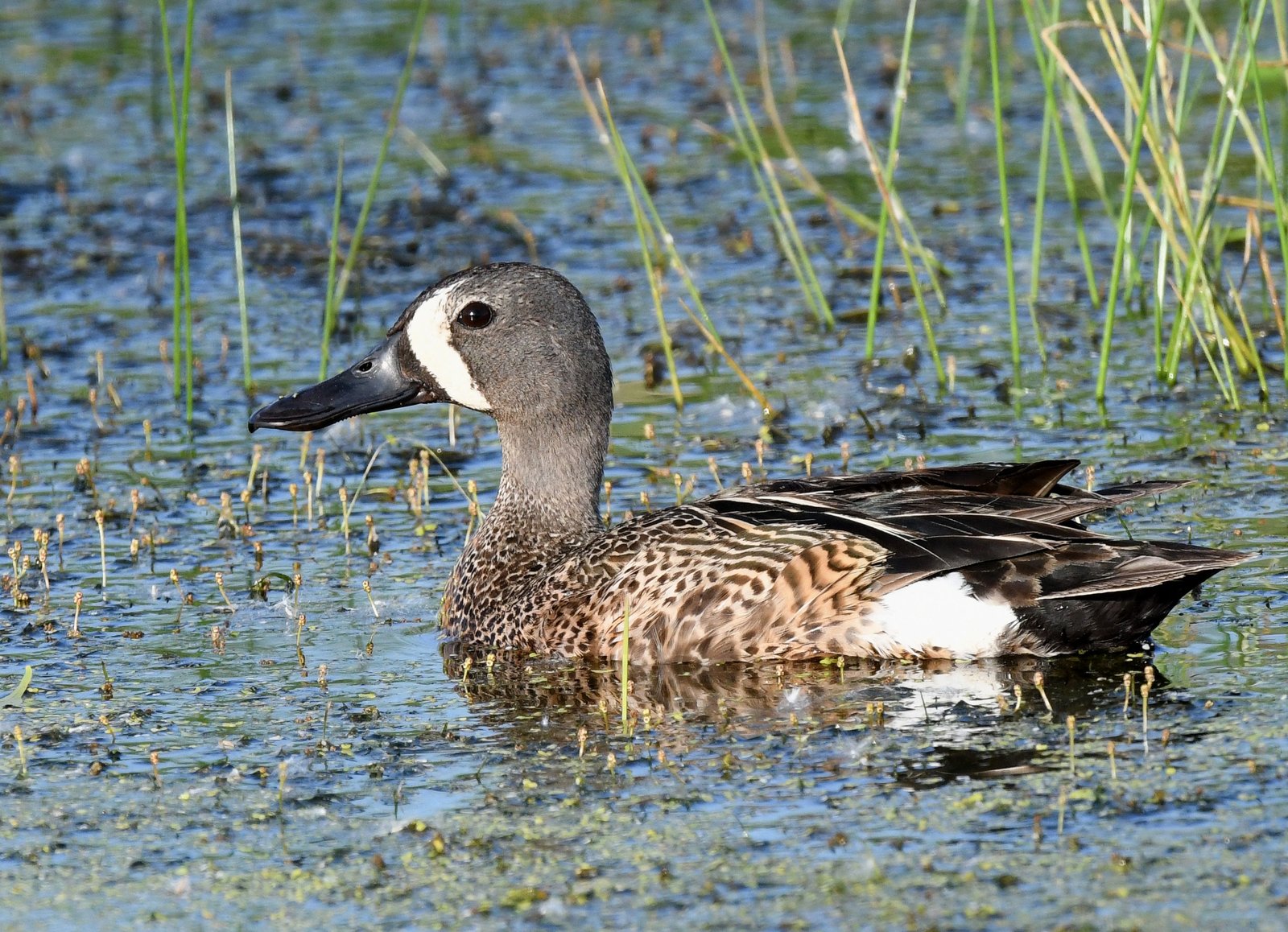
37–41 cm, a small duck with a fairly long, dark bill. The male has a grey-blue head with a white crescent in front of the eye, a brown body densely spotted black and a white patch in front of the black rear end; during the winter months the male is often still in eclipse plumage and then browner. The female is mottled brown, with a dark eye-stripe, a pale spot at the base of the bill and a broken pale eye-ring. Both sexes have pale blue forewings and a green speculum. Juveniles resemble the female.
Confusion species
The female Cinnamon Teal Spatula cyanoptera closely resembles the female of this species, but is warmer brown, with a plainer face, a less distinct pale spot at the base of the bill and a slightly longer, broader bill. Red Shoveler Spatula platalea and Northern Shoveler Spatula clypeata are larger, with a much larger, spatulate bill. Andean Teal Anas andium lacks the pale blue forewing.
Habitat
Shallow fresh and brackish lakes, marshes, coastal lagoons, rice fields and sewage ponds, from sea level to about 3500 m. It feeds while swimming at the surface, filtering seeds, plant matter and small invertebrates from the water. It does not breed in the guide area.
Where the bird is most at home, classified by the vegetation units of the Andes and the west coast.


Range and movements
In Colombia common in the Caribbean lowlands, in the Magdalena and Cauca valleys and on the lakes of the Eastern Andes. In Ecuador on lakes and lagoons along the coast and in the inter-Andean valleys. In Peru scarcer, mainly in the north and along the coast. In Bolivia rare. On the Galápagos a rare vagrant. It breeds in North America and winters from the southern United States to northern South America.
- Resident
- Winter visitor (c. Oct–Mar)
- dark = core range, pale = thinly spread
How and when to look
From October to March on shallow lakes and coastal lagoons in Colombia and Ecuador, often in small groups; when flushed the pale blue forewings stand out.
Conservation status
Least Concern. The species is numerous and is hunted in large numbers in North America; the loss of wetlands in the breeding and wintering areas is a threat.
Scientific name
Spatula discors | (Linnaeus, 1766)
Linnaeus described the species in 1766 as Anas discors; because it was later moved to another genus, the author and year stand in brackets. The genus Spatula was introduced in 1822 by Boie. The genus name is Latin spatula, 'spoon, spatula', after the broad bill. The species name discors is Latin for 'discordant, at variance'. The name goes back to Catesby's 'White-face Teal' and probably refers to the drake's variegated face pattern; other authors thought of the wing markings or the call. The specimen the first description was based on came from Virginia or Carolina, United States.