All species › Waterfowl › Ducks, swans and geese › Red Shoveler
Red Shoveler | Spatula platalea
Argentijnse slobeend | Pato cuchara | Marreca-colhereira
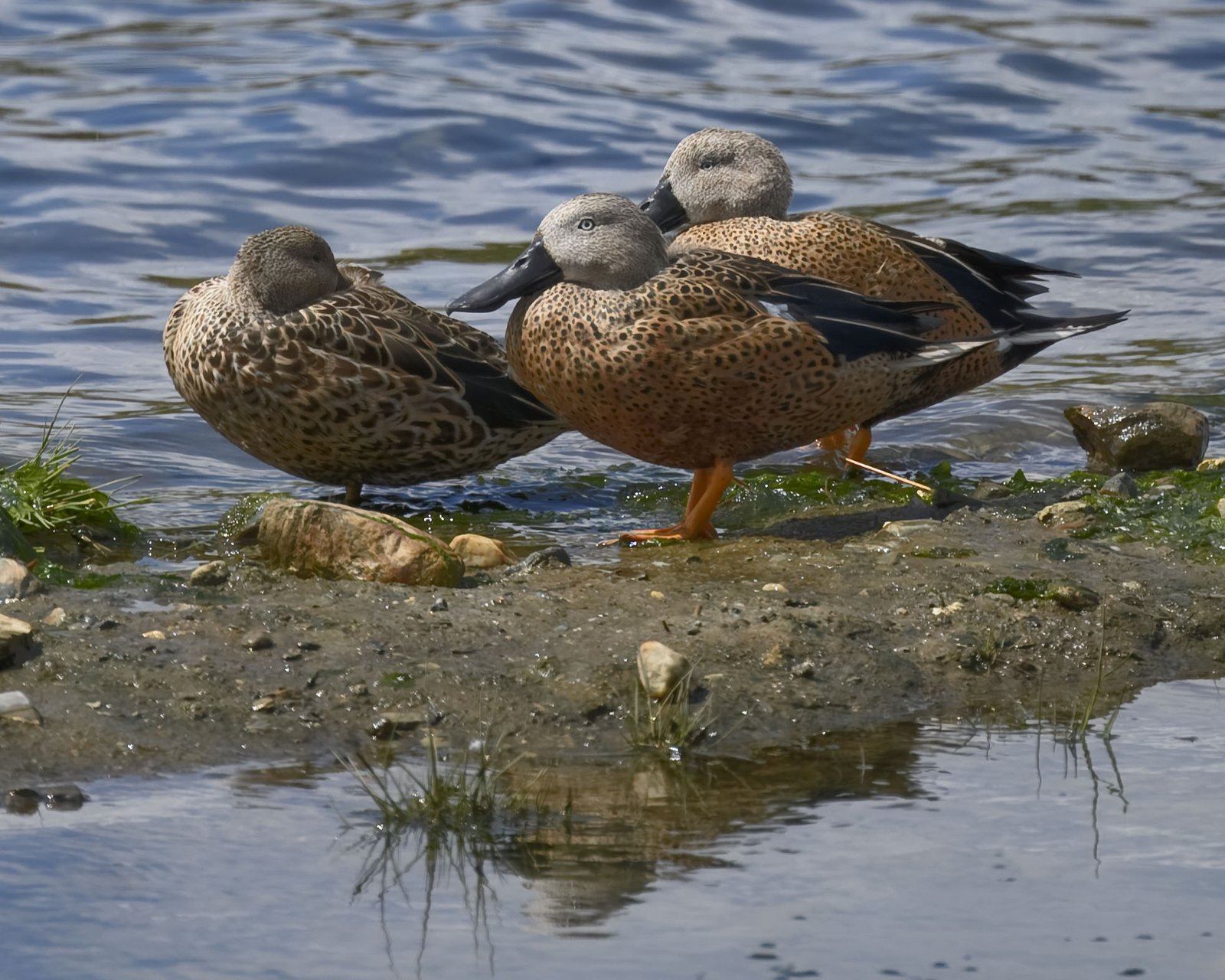
The Red Shoveler is the South American counterpart of the Northern Shoveler, with the same long bill broadened at the tip. The male is cinnamon-red with black spots and a pale head with a light iris. In the guide area it is a bird of the south, mainly of the altiplano lakes of Bolivia and southern Peru.
Voice
Mostly silent. The male gives a dry, rattling trrr-trrr, the female a soft quack.
Recording: Bernabe Lopez-Lanus — CC BY-NC-SA 3.0 · xeno-canto
Identification
45–51 cm, with a long, black, spatulate bill and a fairly long, pointed tail. The male has a pale, finely speckled head with a whitish to yellow iris and a cinnamon-red body densely spotted black; the undertail coverts are black. The female is mottled brown, with a dark iris. Both sexes have pale blue forewings and a green speculum, visible mainly in flight. Juveniles resemble the female.
Confusion species
Northern Shoveler Spatula clypeata, a rare winter visitor in the north, has a green head, white breast and chestnut flanks in male plumage; the female has a shorter tail and an orange edge to the bill. Females of Cinnamon Teal Spatula cyanoptera and Blue-winged Teal Spatula discors are smaller, with a shorter bill. Silver Teal Spatula versicolor and Puna Teal Spatula puna have a dark crown and pale cheeks.
Habitat
Shallow fresh and brackish lakes, lagoons and marshes with abundant aquatic plants, in the guide area mainly on the altiplano to above 4000 m, and also in lowland lakes and coastal lagoons. It filters plankton, small invertebrates and seeds from the water surface with its bill. The nest is on the ground in shoreline vegetation, close to the water.
Where the bird is most at home, classified by the vegetation units of the Andes and the west coast.


Range and movements
In Bolivia mainly on the lakes of the altiplano, where it partly breeds, and outside the breeding season also in the lowlands of the south-east. In Peru scarce, mainly in the south, for example around Lake Titicaca and on the coast of Arequipa. In Ecuador and Colombia absent or only a very rare vagrant. Absent from the Galápagos. Outside the guide area in Argentina, Chile, Paraguay, Uruguay, southern Brazil and the Falkland Islands.
- Resident
- Summer visitor (c. Apr–Sep)
- Winter visitor (c. Oct–Mar)
- Passage (Mar–Apr, Oct–Nov)
- dark = core range, pale = thinly spread
How and when to look
On shallow altiplano lakes, look for ducks sweeping the surface water with their bills. A small group of cinnamon-red ducks with large bills among other ducks is usually this species.
Conservation status
Least Concern. The population is large; locally hunting and the drying out or pollution of lakes are threats.
Scientific name
Spatula platalea | (Vieillot, 1816)
Vieillot described the species in 1816 as Anas platalea; because it was later moved to another genus, the author and year stand in brackets. The genus Spatula was introduced in 1822 by Boie. The genus name is Latin spatula, 'spoon, spatula', after the broad bill. The species name platalea is Latin for 'spoonbill', after the spoon-shaped bill. The specimen the first description was based on came from Paraguay.